
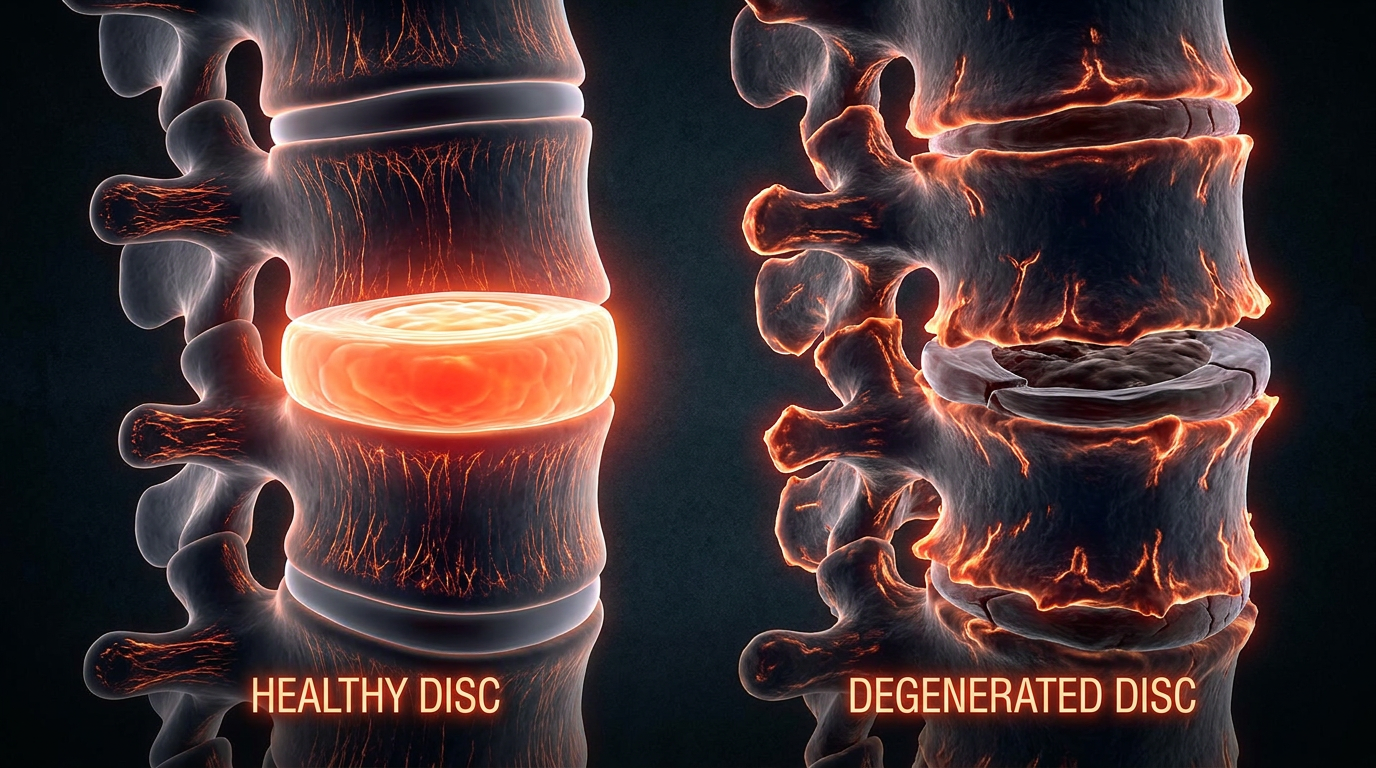
Your MRI report came back showing degenerative disc disease, and the term sounds heavier than your doctor made it sound in the exam room. You want to know what the 4 stages of degenerative disc disease look like, where you fall on that range and whether the ache in your lower back means surgery is coming.
Knowing where you sit on the progression makes the next steps less confusing and helps you sort out what treatment fits now versus what might come later. We’ll walk through how disc wear progresses through four overlapping stages, what causes it to advance and how treatment shifts from physical therapy in the early stages to injections or surgery if things move further.
Table of Contents
ToggleHow Degenerative Disc Disease Progresses Through Four Stages
Degenerative disc disease (DDD) is the gradual breakdown of the cushioning discs between your vertebrae, and the wear tends to move from mild to severe in a recognizable pattern. Each disc has an outer ring called the annulus fibrosus and a soft, gel-like center called the nucleus pulposus that absorbs shock. As you age, the gel center loses water, the outer ring develops small tears and the disc flattens.
Disc changes are common in people who feel fine. By age 50, about 80 percent of people with no back pain already show disc degeneration on MRI, which is why your scan alone doesn’t tell your doctor much about your pain. Spine doctors track the wear as an overlapping cascade of structural changes, and patient education materials commonly group that cascade into four stages: dysfunction, dehydration, stabilization and collapse.
Stage 1: Early Dysfunction in the Disc
Stage 1 is when the first small cracks form in the outer wall of the disc, often years before you feel anything. The damage starts inside and works outward, with tiny tears from the repetitive load of bending, lifting and sitting over decades.
Structural Changes Inside the Disc
Small tears called fissures open in the outer ring, and over time, pain-sensing nerves grow into those tears. A disc that had no way to send pain signals before now has the wiring to do it. The cartilage end plates that anchor the disc to the vertebrae above and below also pull away, which cuts off some of the nutrient flow the disc needs.
Symptoms You Might or Might Not Feel
Most people pass through Stage 1 without realizing anything has changed. If symptoms show up, they’re usually mild: stiffness after a long day, occasional muscle fatigue or a low-grade ache you’d chalk up to a tough workout or sleeping wrong. The discomfort comes and goes, and it settles within a day or two once you move around.
What Helps Slow It Down at Stage 1
Your best window at Stage 1 is protecting what you have before the wear gets ahead of you. Low-impact movement like walking, swimming and cycling keeps the muscles around your spine strong and helps the disc pull in nutrients through motion. A healthy weight, better posture and quitting smoking all slow the rate the discs break down, since nicotine cuts blood flow to the tissues around the spine.
Stage 2: Dehydration and Height Loss
Stage 2 is when the disc loses water and height, and it’s where back pain often shows up for the first time. The gel center can’t hold as much fluid as it used to, so the disc flattens and the space between vertebrae narrows.
Why the Disc Loses Water and Height
The nucleus pulposus depends on its water content to spread force evenly across the disc. By Stage 2, it’s dried out enough that it can’t absorb shock the way it used to, so more load shifts onto the facet joints, the small paired joints at the back of your spine. The surrounding ligaments take on extra strain too, which is why this stage feels different from Stage 1.
The Pain Pattern That Tends to Show Up
Pain at Stage 2 usually feels like a steady low back ache that may spread into your buttocks, groin or upper thighs. Long stretches of sitting at a desk or in a car make it worse, while changing positions or taking a short walk brings some relief. The ache is continuous rather than sharp, and it wears on you over weeks even when each flare feels manageable on its own.
Conservative Care That Slows Progression
Most Stage 2 symptoms respond to non-surgical care, and your doctor will usually layer a few pieces together rather than counting on one to do all the work:
- Physical therapy: A structured exercise program builds the core and back muscles that share load with the worn disc, paired with stretching and posture work.
- Anti-inflammatory medication: NSAIDs like ibuprofen or naproxen bring pain down enough that you can stay active in therapy.
- Activity, not bed rest: Short rest during a flare is fine, but prolonged bed rest isn’t recommended because inactivity weakens the muscles that protect your spine.
Stage 3: The Stabilization Stage
Stage 3 is your body’s attempt to lock down a wobbly disc segment by growing extra bone around it, and that response calms the instability while creating new pressure points on nearby nerves. The disc has lost enough height that the segment moves in ways your spine wasn’t built for, so the surrounding bone and ligaments take over.
How Your Body Tries to Stabilize the Segment
Your spine answers the instability by building bone spurs along the edges of the vertebrae, called osteophytes, which form where a joint is under repeated stress. The ligaments along the back of the spinal canal also thicken, which trims the space the nerves have to pass through.
If the canal narrows enough, you can develop spinal stenosis, a tightening of the bony tunnel that houses your spinal cord and nerve roots. Stenosis often shows up as pain or heaviness in the legs that worsens with standing and walking and eases when you sit or lean forward.
Daily Pain, Radiating Leg Symptoms and Stiffness
Pain at Stage 3 shows up most days rather than only during flares, and morning stiffness takes longer to work out. If a bone spur or thickened ligament is squeezing a nerve root, you can feel radicular pain, a sharp, electric line that runs from the lower back through the buttock and down one leg. Your range of motion narrows, and long workdays or weekend activities that used to leave you a little sore now leave you flared up for days.
When Injections Become Part of the Plan
If six or more weeks of physical therapy and NSAIDs haven’t moved your pain, your doctor may recommend epidural steroid injections to deliver anti-inflammatory medication around the irritated nerve. Facet joint injections target the small joints behind the disc and help when arthritis at those joints is driving the pain. Injections don’t reverse disc changes, but they can quiet the inflammation enough that you keep doing the rehab work that protects the rest of your spine.
Been told your disc disease needs surgery?
Most people with degenerative disc disease never need surgery, even at the later stages, so a recommendation for one is worth a second look. Premier’s spine team reviews your prior imaging and records before your visit, not during it, and talks through whether conservative care or a motion-preserving option still fits.
Stage 4: The Collapsing Stage
Stage 4 is the endpoint, where the disc has lost nearly all of its height and the segment has little shock absorption left to give. Pain at this point is usually constant rather than intermittent, and nerve compression symptoms drive most decisions about what to do next.
What End-Stage Disc Changes Look Like on Imaging
Imaging at Stage 4 often shows the disc space squeezed down to a thin line, sometimes with the vacuum phenomenon, small pockets of gas that appear inside the worn disc as the tissue dries out. Bone spurs can bridge from one vertebra to the next, a spontaneous fusion that locks the segment in place without surgery. End-stage degeneration doesn’t always look as bad on you as it does on the scan, so your doctor reads the imaging alongside your symptoms and exam to figure out what’s actually driving the pain.
How Stage 4 Affects Daily Life
Pain at Stage 4 is severe and constant, with flares triggered by things that used to be routine like standing in line, loading the dishwasher or walking the dog. Nerve compression can cause numbness, tingling or weakness in your arms or legs, and some people develop foot drop or trouble lifting things that used to feel light. Sleep gets harder, and the cycle of poor sleep and high pain wears on your energy.
When Surgery Enters the Picture
Your surgeon may recommend surgery when non-surgical care hasn’t relieved your symptoms and imaging confirms a structural problem that matches your pain. Candidacy and recovery vary by procedure, age and overall health, so the right choice gets worked out together:
- Discectomy or microdiscectomy: Removes the piece of herniated disc material pressing on a nerve through a small incision.
- Laminectomy: Removes bone spurs and thickened ligaments compressing the spinal canal to open up space for the nerves.
- Spinal fusion: Joins two or more vertebrae with bone graft and hardware to stop motion at the unstable segment.
- Artificial disc replacement: Swaps the damaged disc for an implant that preserves motion at that level, which can take pressure off neighboring discs.
How Treatment Shifts as You Move Through the Stages
Treatment changes shape at each stage, with the bar for procedures climbing the further along you go. Stages 1 and 2 lean on conservative care: physical therapy, low-impact exercise, weight management, quitting smoking and NSAIDs. Most people in those stages improve with that foundation and never need anything beyond it.
At Stage 3, the same foundation stays in place, with injections layered on when six or more weeks of conservative care haven’t moved the needle. Epidural steroid injections and facet joint injections calm inflammation around irritated nerves and joints, and a meaningful share of people get enough relief to keep working with their physical therapist and stay out of the operating room. Surgery becomes the right conversation when nerve compression symptoms keep progressing despite months of non-surgical treatment and the imaging matches the pain you’re actually feeling.
What Causes DDD to Progress Through the Stages
Age is the strongest universal driver. Most people develop some disc degeneration after age 40 as the discs lose water and height, though many of those changes never cause pain. Genetics push the timeline harder than people realize, and inherited factors explain a large share of how fast disc degeneration moves from one person to the next.
Lifestyle decides much of what’s left. Smoking cuts blood flow to the discs, extra body weight loads the lumbar segments with force they weren’t built for, and repetitive lifting or long hours behind the wheel speed the wear along. The factors you control still move the dial, even after age and genetics set the start.
When to See a Spine Specialist About Disc Degeneration
A spine evaluation makes sense if your back pain hasn’t eased after six weeks of conservative care, or if it’s getting in the way of work, sleep or activities you care about. The referral doesn’t mean surgery. Most disc problems improve with physical therapy, medication and time, and a specialist confirms which path fits your stage.
A small set of symptoms needs same-day attention in the emergency room:
- Saddle numbness: New loss of sensation in your inner thighs, groin or buttocks can signal severe pressure on the nerve bundle at the base of your spine.
- Loss of bladder or bowel control: New incontinence or accidents you can’t explain often point to nerve compression that needs urgent imaging.
- Inability to urinate: A sudden inability to pass urine, paired with a full bladder you can’t empty, calls for emergency evaluation.
- Sudden weakness in both legs: Rapidly worsening weakness in both legs, especially with new numbness, suggests the lower nerves aren’t getting through.
These are warning signs for cauda equina syndrome, and outcomes improve when treatment happens within the first 48 hours. Go to an emergency room if any of them show up.
How Premier Manages Degenerative Disc Disease at Every Stage
Premier Orthopaedics & Sports Medicine builds your treatment plan around the stage you’re in. Our spine team starts with physical therapy, NSAIDs and activity changes for Stages 1 and 2. If you’ve hit Stage 3 and therapy alone isn’t holding the line, Premier’s pain management specialists add epidural steroid injections and facet blocks to settle inflammation around the compressed nerves.
For Stage 4 cases where structural collapse is driving disabling symptoms, our spine team offers minimally invasive decompression, motion-preserving disc replacement and spinal fusion. We treat people across Northern New Jersey and match each step to your imaging, exam and what you’re trying to get back to. If your back pain has stuck around past a few weeks, call 201-833-9500 or schedule an appointment online.
Get an Evaluation for Your Degenerative Disc Disease
A spine evaluation can pinpoint which of the four stages matches your MRI and symptoms, so you know whether physical therapy, injections or something more is the right next step. Premier’s Northern New Jersey spine team builds that plan around your actual pain, not just what the scan shows.
Frequently Asked Questions About the 4 Stages of Degenerative Disc Disease
Can degenerative disc disease be reversed?
No, the structural changes inside a worn disc can’t be undone, but the symptoms and the pace of progression are manageable. Most people improve with non-surgical care that combines physical therapy, weight management, smoking cessation and ergonomic changes at work.
How fast does DDD progress from stage to stage?
The full process spans roughly 20 to 30 years in most people, though the pace varies widely. Genetics, body weight, smoking, prior spine injuries and occupational load all shape how quickly you move from one stage to the next. Periodic check-ins with Premier’s spine team help track whether your pattern is stable or shifting in a way that calls for a new plan.
Is DDD considered a disability?
The Social Security Administration recognizes musculoskeletal disorders as a disability category, and the SSA may evaluate DDD under it when documented functional limits meet the criteria. An MRI report alone doesn’t qualify you. The SSA weighs your imaging alongside exam findings and how your symptoms restrict your ability to work, and Premier can document those limits as part of your care record.
At what stage do most people need surgery?
Most people with DDD never need surgery, even at Stage 4. Surgery becomes a real conversation when disabling symptoms persist after therapy, medication and injections, and imaging shows a structural source that matches what you’re feeling. A surgical evaluation at Premier weighs nerve compression, instability and your overall function before recommending a specific procedure.
This article is for general information only and isn’t a substitute for professional medical advice. Talk to your doctor about your specific situation before making treatment decisions.