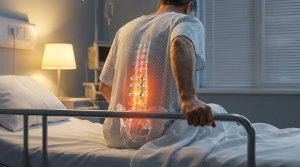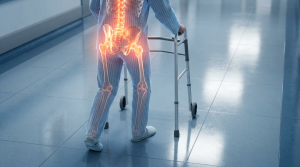

Your parent or sibling received a spinal stenosis diagnosis, and now your own back or legs bother you when you walk or stand for a while. That connection has you wondering whether spinal stenosis is hereditary and whether you can do anything about it. Spinal stenosis is usually multifactorial.
Genetic influence shows up in congenital canal size and degenerative changes, while body weight, cigarette smoking and daily movement habits remain practical areas to discuss with your doctor regardless of family history.
Table of Contents
ToggleWhat Spinal Stenosis Is and Why It Develops
Spinal stenosis means the open space inside your spine narrows enough to put pressure on nerves in or near the spinal canal. When stenosis squeezes those nerves, you feel it in the parts of the body they serve, which is why stenosis in your lower back can send pain or nerve symptoms such as numbness and weakness into your legs, and stenosis in your neck area can do the same in your arms. The pressure builds gradually, so many people don’t connect their symptoms to their spine until walking or standing becomes uncomfortable.
Stenosis falls into two categories. Degenerative stenosis develops over time as age and everyday wear change the structures around the canal. Congenital stenosis means your spinal canal started out naturally narrower than average. The lower back and neck are common locations, and degenerative stenosis often appears after 50. The usual age of onset points to accumulated change as the biggest driver.
The Genetic Component of Spinal Stenosis
Stenosis can run in families, but it is usually multifactorial. Several inherited and environmental influences combine, so a family diagnosis is useful context while leaving room for prevention-minded choices. Genetics feeds into stenosis in a few separate ways, and each one shows where your family history actually fits.
Congenital Spinal Stenosis
Some people inherit a spinal canal that is narrower than average. A naturally narrow canal may not cause symptoms right away, because some people still have enough room for the nerves during younger adulthood. Symptoms may become more likely later, once age-related changes start taking up some of that already-limited space.
A narrow canal increases risk, but it does not guarantee symptomatic stenosis. Congenital or inherited conditions linked to a narrow canal include a small spinal canal from birth, scoliosis and achondroplasia.
Hereditary Factors in Degenerative Stenosis
Genetics can influence how quickly the parts of your spine wear down, and that wear is what narrows the canal over time. Inherited factors shape disc degeneration and may also contribute to ligament and bone changes involved in stenosis.
Disc degeneration in particular is highly heritable, which is one reason a family history of early-onset spine problems can raise your own risk. That same pattern shows up in a related process: a herniated disc, where disc material pushes into the canal, shares many of the degenerative roots that heredity influences.
Lumbar spinal stenosis has a large inherited component, with heritability roughly two-thirds, though those estimates come from measured spine features and may not map directly onto the clinical syndrome a doctor diagnoses. Spinal arthritis can follow a similar theme when family patterns and inherited factors contribute. That means it can be hereditary too. Genes tilt the odds without setting them.
Related Conditions with Genetic Links
Some family-linked conditions can change the shape or alignment of your spine and indirectly contribute to stenosis. Spondylolisthesis, which means one vertebra slips forward over another, and scoliosis, which means the spine curves sideways, may matter for your own spine because altered alignment can reduce the space nerves need. Achondroplasia, a bone-growth condition, can narrow the canal as well. Your doctor should know about any of these conditions linked to spinal stenosis if they appear in your family.
Already been told you need decompression or fusion?
A second opinion is a normal step before a decision this size, especially when family history already has you thinking about your spine. Premier’s spine team takes a conservative-first approach and reviews your prior imaging and records before the visit, not during it.
Risk Factors Beyond Genetics
Several major risk factors remain within your control, even when family history contributes to your risk. Separating fixed risk factors from modifiable ones helps you focus your energy where it actually moves the needle. Age is a fixed factor. Most of what follows is modifiable.
Age and Wear-and-Tear Changes
Age and the cumulative wear that comes with it are the main drivers of degenerative stenosis, which is why the condition usually appears later in life. Decades of movement, loading and small injuries add up, and the tissues around your canal gradually change in ways that reduce space. This isn’t something anyone controls, and pretending otherwise would be dishonest. Your choices around modifiable factors matter because they are the parts of risk you can actually influence.
Lifestyle, Occupation and Body Weight
Several everyday factors can add strain to your spine regardless of what you inherited, and each one is something you may have room to adjust. These tend to compound over years, so small changes now may support general spine health later.
- Limiting repeated bending and lifting when possible
- Managing higher body weight, which adds load to the lumbar spine
- Avoiding cigarette smoking, independently linked to lumbar spinal stenosis
- Asking about core and back strength
- Reviewing prior disc or spine problems if they have already changed your mechanics
These modifiable factors give you practical steps to act on even when your family history stays fixed.
What to Do If Spinal Stenosis Runs in Your Family
When spinal stenosis runs in your family, your best next step is to focus on the parts of spine health you can control and learn which symptoms actually warrant a specialist. A relative’s diagnosis gives your doctor useful context; your doctor can use your symptoms and exam findings to decide whether imaging would be useful. Steady habits may help manage avoidable strain, and certain symptom patterns deserve medical attention.
Staying Ahead of Symptoms
You can take proactive steps that may help manage avoidable stress on your spine, even though symptoms may still appear. These habits are aimed at supporting the muscles and structures around your canal and reducing repeated strain where you can.
- Maintaining a healthy weight to limit load on the lumbar spine
- Building core strength so your trunk better supports your back
- Choosing low-impact exercise options like walking, swimming or cycling
- Checking posture during long periods of sitting or standing
- Reviewing work ergonomics if repeated bending and twisting are part of your day
Family history by itself usually means tracking symptoms and modifiable risk; MRI or surgery discussions depend on symptoms and exam findings. Premier Orthopaedics & Sports Medicine’s spine care FAQ can help you understand what to watch for over time.
When to See a Specialist
Certain symptom patterns deserve evaluation. Leg pain that comes on with walking and eases when you sit or lean forward can point to stenosis. Numbness, weakness, balance changes and persistent neck or arm symptoms can also warrant attention. Bringing your family history to the visit gives your doctor helpful context for deciding whether an exam and imaging make sense.
At Premier, Premier’s spine team evaluates stenosis symptoms with a conservative-first approach and can coordinate in-office imaging when it’s appropriate. Our neck and back specialists see patients across Northern New Jersey, so you can get answers close to home. For broader questions about spine care, our spine care FAQ covers many of the common ones.
How Spinal Stenosis Is Treated
Treatment almost always starts with conservative care, unless your symptoms are severe or your nerve function is getting worse. The first steps usually involve activity modification and physical therapy to strengthen the muscles that support your spine and reduce pressure on irritated nerves.
When those approaches don’t bring enough relief, interventional options such as epidural injections and nerve blocks may calm inflammation around the compressed nerves and support meaningful comfort. An epidural injection places anti-inflammatory medicine around irritated spinal nerves, while a nerve block uses medication near a specific nerve to reduce pain signals. Our pain management specialists handle these procedures and work alongside the spine team to keep your care coordinated.
Your doctor may discuss surgery only after you and your care team have fully explored conservative care, or when nerve compression is progressing or symptoms like weakness and numbness are getting worse.
In that situation, your surgeon may discuss procedures like surgical decompression, which relieves pressure by removing bone or tissue crowding the canal, and fusion, which joins affected segments to stabilize the spine, when they fit your situation.
Dr. Jay Reidler, a Harvard, Hopkins and Columbia-trained spine surgeon, focuses on minimally invasive approaches where they apply, and Premier’s recovery guidance walks you through what to expect afterward. Treatment targets symptoms and nerve pressure. It doesn’t change heredity or your inherited canal shape, so the goal is functional relief.
Schedule a Spine Evaluation
If a parent or sibling had spinal stenosis and you’ve started noticing leg pain with walking or nagging back symptoms, our spine team across Northern New Jersey can help you understand what’s going on.
Frequently Asked Questions About Spinal Stenosis and Heredity
Can you prevent spinal stenosis if it runs in your family?
The size or structure of the spinal canal you were born with stays fixed, but you may be able to manage avoidable stress on your spine through weight management, core strength, low-impact exercise and better ergonomics. Those steps address the modifiable side of your risk equation even while the inherited side stays fixed. Prevention shifts the odds over the long run. It cannot guarantee that stenosis will never develop.
At what age does hereditary spinal stenosis usually show up?
The age varies, because it depends on whether the driver is a congenitally narrow canal or degenerative change layered on top of it. Congenital narrowing can bring symptoms on earlier in adulthood, since there’s less room to spare once any wear begins. Degenerative stenosis more often appears after 50, and a strong family history of early spine problems is useful context for your doctor.
Should I get screened for spinal stenosis if my parent had it?
For someone with a parent who had stenosis, symptoms are the reason to ask for evaluation: leg pain with walking, numbness, weakness or changes in balance. Bringing your family history to the visit helps your doctor decide whether a physical exam and imaging make sense for your specific situation.
This article is for general information only and isn’t a substitute for professional medical advice. Talk to your doctor about your specific situation before making treatment decisions.