The word “dextroscoliosis” showed up on your imaging report, or it came back on your child’s school screening, and it’s the kind of term that sends you straight to a search bar. Dextroscoliosis means your spine curves to the right, and in most cases, especially in the mid-back, it’s the expected direction for scoliosis.
We’ll walk through what the word means, what causes a right-curving spine and when a curve actually needs treatment.
Table of Contents
ToggleWhat Dextroscoliosis Means on Your Report
Dextroscoliosis is one of the more common patterns of scoliosis, and for most people it turns out to be a minor finding. Your report rarely explains that, and the search results you find tend to mix frightening surgical photos with vague reassurance while leaving the real question unanswered. The word itself gives the first clue to whether your curve is serious or barely matters.
Breaking Down the Term
Dextroscoliosis is a curve that bends to the right. “Dextro” points to the rightward direction, and “scoliosis” describes an abnormal side-to-side curvature of the spine. Together, they mean a spine that curves toward the right side of the body.
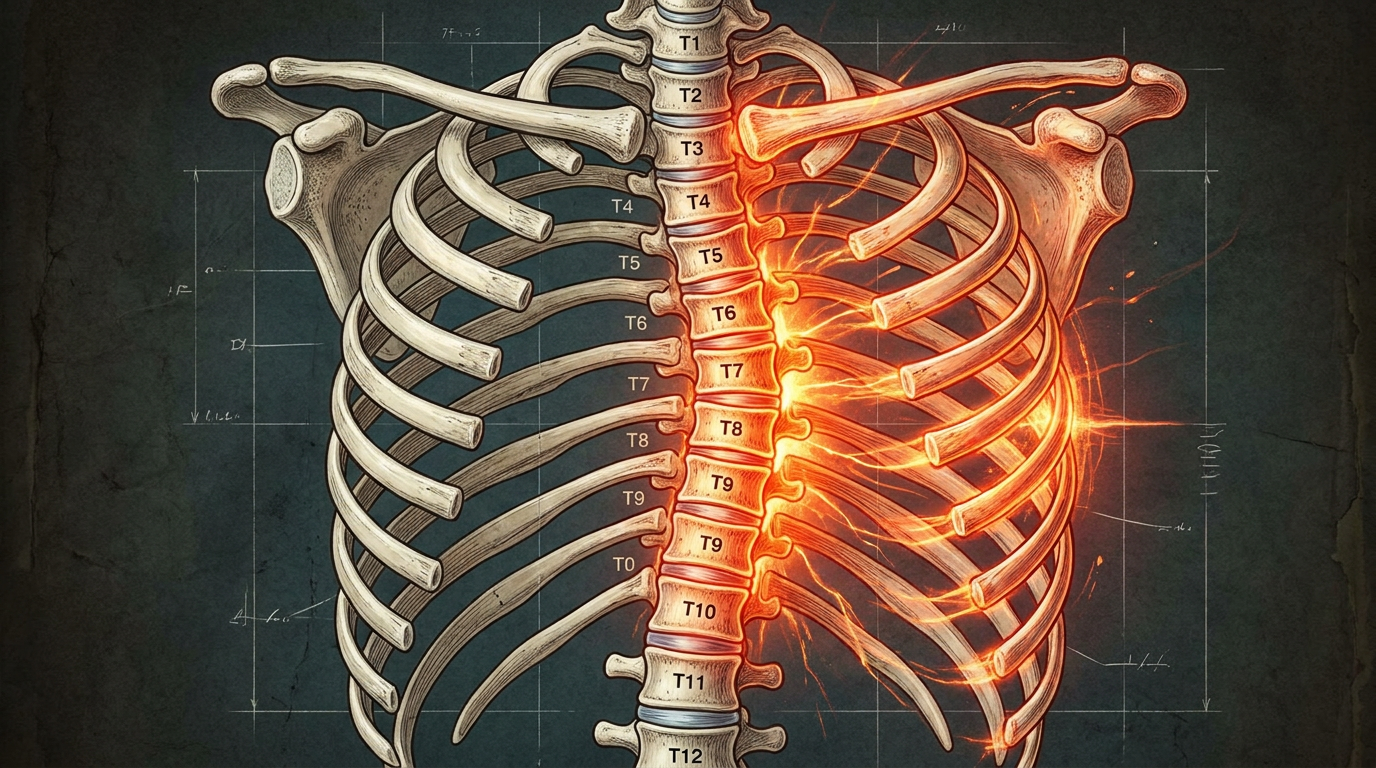
The curve may look like a backward “C” shape or an exaggerated “S” shape. Scoliosis also includes twisting or rotation of the spinal bones, which makes it a three-dimensional change in the shape of the spine.
The Cobb angle is the angle drawn between the most tilted bones at the top and bottom of the curve on a standing X-ray. A curve has to reach at least 10 degrees to count as scoliosis at all. Mild curves generally fall under 20 to 25 degrees, which is the range where doctors usually follow with observation.
Why Right-Curving Is the “Expected” Pattern
A right-curving thoracic curve is the standard presentation of scoliosis, which is reassuring. Most idiopathic thoracic curves, the kind with no identifiable cause, bend to the right. That is the typical curvature pattern.
In the lumbar spine, the picture is different because both directions are common in the lower back. Your doctor weighs direction alongside location, curve size and symptoms rather than treating direction alone as the whole story.
Curve direction carries extra weight mainly when a thoracic curve bends left, a detail your doctor considers with the rest of the exam. That pattern sometimes prompts an MRI to rule out other causes. For dextroscoliosis in the thoracic spine, the direction itself fits the expected pattern.
What Causes Dextroscoliosis
Dextroscoliosis has different roots depending on whether it appears in a growing child or an adult. The cause shapes how doctors evaluate the curve and what they recommend next.
In Children and Adolescents
The vast majority of right-curving scoliosis in young people has no identifiable cause. Adolescent idiopathic scoliosis is the most common type, and it tends to appear during the growth spurt between ages 10 and 18.
There’s a genetic thread here. The pattern involves many genes rather than a single one, so it doesn’t pass down predictably. That mixed pattern doesn’t point to one identifiable cause or a single predictable line of inheritance, so a new diagnosis doesn’t mean you caused the curve.
In Adults
In adults, dextroscoliosis usually traces to one of two paths. The first is degenerative scoliosis, a new curve that develops after age 50 from uneven wear on the discs and facet joints over decades. As discs collapse asymmetrically and joints degenerate, the spine gradually tilts and rotates.
The second path is an adolescent curve that nobody caught when it was mild, one that slowly worsened over the years. By the time it shows up on an adult’s imaging, it can look like a new problem even though it started decades earlier.
Been told your curve needs fusion surgery?
A second opinion is a normal step before committing to spinal fusion, especially since motion-preserving options like VBT may fit certain growing children. Premier’s spine team reviews your prior imaging and records before the visit, not during it, and can help you understand whether your curve’s pattern and size point toward surgery or continued monitoring.
Conservative Treatment for a Right-Curving Spine
Most dextroscoliosis never reaches the operating room. Treatment depends heavily on curve size and, for kids, how much growing is still ahead. The approach ladders up from watching to bracing to surgery, and most people stay on the lower rungs.
Monitoring Mild Curves
Most mild dextroscoliosis needs periodic standing X-rays as the main step to confirm it’s staying put. For a growing child with a curve under 25 degrees, that usually means X-rays every four to six months until the spine finishes growing. The frequency tracks how fast the child is still growing, since that’s when curves are most likely to change.
For adults with stable, mild curves, monitoring stretches out to once a year or every few years. New or worsening symptoms tend to trigger a fresh look sooner than a routine calendar interval. If the appearance of your back changes or your pain pattern shifts, that’s a reason to get checked sooner.
Bracing for Adolescents
Bracing comes into play when a growing child’s curve reaches roughly 25 degrees. The recommended range for bracing is about 25 to 45 degrees in a child who still has a lot of growing left. Families often ask whether a brace will straighten the spine. Bracing instead aims to keep the curve from getting worse before it reaches the point where surgery enters the conversation.
Bracing works better when children wear it more hours each day. Children usually wear most braces 16 to 23 hours a day, and your child keeps wearing one until the spine stops growing. Parents often worry a brace will sideline their kid, but children in braces stay involved in normal activities including athletics and dance, and the brace comes off for sports.
Physical Therapy and Exercise
Physical therapy plays a supporting role focused on core strength, posture and managing symptoms. In adults, the bones have finished growing, so exercise focuses on stabilizing the spine, building the muscles around it and easing pain and stiffness. The goal isn’t to realign the spine or shrink the curve.
For adults with degenerative dextroscoliosis, combining physical therapy with other care produces meaningful improvements in pain and quality of life. Scoliosis-specific methods like the Schroth approach require therapists trained in those techniques, and Schroth and SEAS are the most studied methods, though available evidence is insufficient to confirm the advantage of one technique over others.
At Premier Orthopaedics & Sports Medicine, our neck and back specialists evaluate and monitor scoliosis for both children and adults, with in-office X-ray at offices across Northern New Jersey. That makes it straightforward to establish a baseline and track whether anything is changing over time.
When Surgery Becomes Part of the Conversation
Mild curves rarely reach the surgical threshold. Surgery enters the discussion for curves that keep progressing despite conservative care. In adolescents, that threshold is generally a Cobb angle of 45 to 50 degrees, the point where curves are likely to keep worsening into adulthood.
For adults, there’s no set degree number, and surgery is generally reserved for disabling pain and imbalance or significant loss of function when conservative measures haven’t helped.
Fusion and VBT
Spinal fusion is the standard surgical treatment for a large, progressing curve. It uses metal rods, screws and bone graft to hold the corrected vertebrae in place until they fuse into solid bone. For certain growing children, Vertebral Body Tethering (VBT) is a motion-preserving alternative.
VBT anchors a flexible cord along the curve and uses the child’s remaining growth to gradually straighten the spine. It only works for kids who have a lot of growth left and curves in the right range, and it carries a higher chance of needing a second surgery than fusion does. That tradeoff makes VBT a careful, individualized choice.
Surgical Expertise
Dr. Jay Reidler performs both VBT and fusion for scoliosis patients. His deformity training came through fellowships at Columbia and NewYork-Presbyterian and at Shriners Hospital for Children, and he builds his spine surgery practice around matching the right procedure to the right curve based on each curve’s pattern.
Recovery and Living With Dextroscoliosis
For the monitored majority, daily life doesn’t change. There are no activity restrictions for stable mild curves, and kids can play any sport up to their own tolerance. The main task is showing up for periodic rechecks.
Bracing Recovery
Bracing is temporary. Once a child reaches skeletal maturity, around age 14 in girls and 16 in boys, the brace comes off and most kids return to full, unrestricted activity.
Surgical Recovery
Surgical recovery is proportional to the procedure. After fusion, your surgical team usually stages recovery from hospital care, to school or daily routines, to unrestricted activity six to 12 months out, once the fusion is solid. You can find more on what to expect in Premier’s recovery guidance. For most people with dextroscoliosis, life carries on without meaningful limitations.
Getting a Clear Answer About Dextroscoliosis
For most people, dextroscoliosis turns out to be a minor finding that needs nothing more than periodic monitoring. One proper evaluation is what tells you whether your curve is a footnote or something worth following over time.
Our conservative-first approach means our adult and pediatric spine specialists evaluate curves honestly and tell you plainly when nothing needs to be done, then build a monitoring or treatment plan around your specific curve. If dextroscoliosis turned up on your imaging or your child’s screening, Premier’s spine team in Northern New Jersey can help you understand what it means.
Get Evaluated for Dextroscoliosis
An evaluation can tell you where your curve sits, what the Cobb angle measures and whether it needs monitoring, bracing or further care. Premier’s Northern New Jersey offices offer in-office X-ray, so a child’s or adult’s curve can be measured and tracked from the first visit.
Frequently Asked Questions About Dextroscoliosis
Is dextroscoliosis the same as regular scoliosis?
Yes. Dextroscoliosis is a directional type of scoliosis, and the term only describes which way the spine curves, which is to the right. More useful questions to ask your doctor are where the curve sits, what the Cobb angle measures and whether the curve needs monitoring.
Can dextroscoliosis cause back pain?
Mild scoliosis often doesn’t cause noticeable pain. Larger curves can stress muscles or compress nerves, and in adults the discomfort usually traces to the degenerative disc and joint changes around the curve rather than the curve angle itself. If your pain pattern changes, a recheck plus pain management options can help separate the curve from other common spine problems.
Does dextroscoliosis get worse with age?
It depends on the curve size when the spine finishes growing. Curves under 30 degrees at skeletal maturity tend to stay stable, while curves over 45 to 50 degrees are more likely to keep worsening into adulthood. In older adults, disc wear and bone loss can also nudge a curve along.
What’s the difference between dextroscoliosis and levoscoliosis?
The difference is direction. Dextroscoliosis curves right and levoscoliosis curves left, but your doctor also looks at whether the curve sits in the thoracic spine, lumbar spine or both. Location matters because a left-curving thoracic curve sometimes prompts an MRI to rule out other causes, while a right-curving thoracic curve is the expected idiopathic pattern.
This article is for general information only and isn’t a substitute for professional medical advice. Talk to your doctor about your specific situation before making treatment decisions.