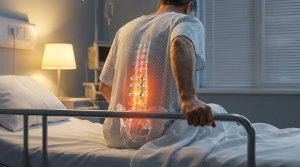

Your imaging report says “dextroscoliosis of the lumbar spine,” and nobody explained it. The phrase describes a sideways curve in your lower back that bends toward the right, and in many adults it’s mild.
This guide covers causes, symptoms, curve measurements, treatment choices and warning signs that need prompt care.
Table of Contents
ToggleWhat Is Dextroscoliosis of the Lumbar Spine?
Dextroscoliosis of the lumbar spine means a right-sided lumbar curve, with the bulge of the curve pointing right. “Dextro” is the radiology shorthand for right, so the convex, or outward-bulging, side of your curve points right.
Doctors typically measure the curve on a standing X-ray using the Cobb angle, the tilt between the most tilted vertebra at the top of the curve and the most tilted one at the bottom. A curve is considered scoliosis once the Cobb angle exceeds 10 degrees.
When it comes to dextroscoliosis of the lumbar spine, one group of adults with degenerative lumbar curves, 44 percent bent right, and 56 percent bent left.
The lumbar curve differs from a thoracic curve. The lumbar spine sits below your ribs, while a thoracic curve is higher in your back and involves the rib cage.
A lumbar curve can cause pain and nerve symptoms, including aching in the lower back or discomfort that travels into a hip or leg. The curve’s location helps your doctor compare those symptoms with your imaging.
What Causes a Right-Sided Curve in the Lower Back
In adults, lumbar dextroscoliosis may result from a curve that began in adolescence or from changes in the discs and joints later in life. When the curve first appeared helps your doctor understand its likely pattern.
A Teenage Curve That Followed You into Adulthood
Idiopathic means nobody identified a cause. If a doctor noted a curve when you were a teenager, or a school screening flagged your posture, your current report may show that same curve measured decades later.
Your clinician may also consider whether age-related changes around a previously off-center spine could contribute to symptoms that weren’t present when you were younger.
Degenerative Curves That Start After 50
Doctors call this adult degenerative lumbar scoliosis, or de novo scoliosis, because it develops later instead of carrying over from childhood. Disc and joint changes may accumulate unevenly over time, and the spine may gradually tilt.
Age 50 isn’t a strict diagnostic cutoff, so your clinician will focus on when the curve appeared and whether it has changed.
Symptoms of Lumbar Dextroscoliosis
Your doctor will assess pain separately from curve size. You may notice muscle fatigue, aching or stiffness, while advanced degenerative scoliosis can irritate or compress a nerve and send pain, numbness or tingling down the leg it serves.
Visible and day-to-day signs can include some of the following:
- An uneven waistline, or one hip sitting higher than the other
- One shoulder or shoulder blade riding higher
- One side of the rib cage pushing forward
- Lower back pain or stiffness
- Leg pain or numbness
- Fatigue after standing
These signs don’t indicate curve size, so the X-ray measurement matters more than the mirror reading. You can bring notes on what you notice and when it occurs, so your clinician can compare your symptoms with the exam and imaging results. At Premier Orthopaedics & Sports Medicine, we’ll provide you with a second opinion on your symptoms.
How Doctors Diagnose and Measure the Curve
During an evaluation for a lumbar curve, your clinician may examine your posture and how your spine sits when you bend forward, then decide which imaging is appropriate.
What X-Ray and MRI Each Tell Your Doctor
A standing X-ray is the primary tool for diagnosing and tracking scoliosis. It captures your spine under your body’s usual weight, which is how the Cobb angle is measured, and it shows the shape of the curve, vertebral rotation and overall alignment from your ribs down to your pelvis. Repeat standing X-rays let your doctor compare films over time to see whether the curve has changed.
An MRI is typically performed lying down, so the same curve may appear smaller or differently shaped on an MRI. The reports may describe curvature in general terms rather than provide a precise Cobb angle because MRI answers different questions, such as whether a disc, nerve or the spinal canal is involved in your symptoms.
If your MRI report and X-ray report list different numbers or different descriptions of the curve, that doesn’t necessarily mean one is wrong. Your doctor can explain which study produced the measurement, why the numbers differ and whether another image would add useful information
The Cobb Angle in Plain Terms
Your Cobb angle sorts your curve into a broad classification band. The table below uses a single treatment-aligned classification scheme, but these bands don’t determine adult treatment on their own.
| Cobb Range | Severity Label | What Doctors Typically Consider |
|---|---|---|
| About 10 to 24 degrees | Mild | Observation with periodic X-rays, exercise and activity changes |
| About 25 to 45 degrees | Moderate | Active treatment, closer monitoring and bracing discussions in growing patients |
| 45 degrees and up | Severe | Specialist evaluation alongside continued symptom management |
These bands roughly match where clinicians may shift between observation, bracing and surgery, particularly in growing patients. Your report or another doctor may list slightly different cutoffs.
Not sure what your dextroscoliosis report means?
Many imaging reports list a Cobb angle or curve description without explaining what it means for you or what to do next. Send Premier’s spine team the X-ray or MRI report you already have, and they’ll review the images and measurements before you come in for anything further.
Treatment Options for Lumbar Dextroscoliosis
Treatment for an adult lumbar curve starts with conservative care, and most adults with lumbar curves never need surgery. Your treatment plan generally reflects the curve measurement, your symptoms and how the condition affects your daily life. Those details also help determine which conservative options come first.
Conservative Care Comes First
For a mild curve, observation with periodic X-rays may be the whole plan at first. Your clinician may recommend follow-up imaging based on your symptoms and prior films. Several approaches may address the pain and stiffness directly:
- Physical therapy to support strength, movement and load tolerance
- Over-the-counter pain relievers for flare-ups, when appropriate for you
- Activity changes such as how you lift, how long you stand and how you break up long sitting
- Interventional pain treatment, meaning injections or other procedures your clinician may discuss based on the cause of your symptoms
Pain management treatments belong to this same conservative tier, and many adults manage their symptoms with some combination of these options. You can also ask your doctor about scoliosis-specific exercise programs.
Exercise may support symptom management, although your response can vary and the right program depends on your curve and overall health.
Bracing: Different Answers for Teens and Adults
Doctors usually recommend a brace for growing children with moderate curves because it can influence a spine that’s still developing.
However, in adult care, a brace may serve a different goal. Adults should ask whether a brace would provide short-term comfort or support during certain activities as part of their specific treatment plan.
When Surgery Enters the Conversation
In adults, the conversation usually turns on persistent pain, worsening weakness or numbness, walking difficulty or loss of daily function after conservative care has failed.
Changes on repeat imaging may also inform the decision, but the Cobb angle alone doesn’t determine whether an adult needs surgery.
If surgery is appropriate, your surgeon may discuss spinal fusion, a procedure that realigns curved vertebrae and joins them so they heal into a single segment of bone.
Premier’s spine surgery team treats spinal deformity, and Jay S. Reidler, MD, MPH, is fellowship-trained in complex and minimally invasive spine surgery with training at Harvard, Johns Hopkins and Columbia’s Och Spine Hospital.
He uses minimally invasive and robotic or computer-guided approaches where the anatomy and the goals of surgery make them appropriate.
What Recovery and Long-Term Outlook Look Like
Many adults with a lumbar curve can live normally with periodic monitoring. During a monitoring visit, your doctor may compare your new film with the old one. The visit can also cover recent changes, posture and leg strength.
Your response to conservative care may vary, so your clinician may adjust the plan based on your symptoms and prior response. Surgical recovery varies by procedure and patient. Your surgeon bases the timeline on the procedure, number of spinal levels treated, surgical approach, healing and the physical demands of your daily activities.
The first part of recovery focuses on pain control and safe movement, while physical therapy and additional activity begin as your surgeon clears you. Some procedures allow you to go home the same day while others require an inpatient stay.
Your surgeon may limit strenuous activity, heavy lifting and twisting until your back has healed enough for those movements. Our patient education resources cover what to expect over the longer term and which changes should prompt a call to your doctor.
When to See a Spine Specialist
Some symptoms require a change in plan from watching to acting and need immediate medical evaluation. Call your doctor or seek emergency care for any of the following:
- Leg pain or numbness that spreads or gets worse
- New weakness in one or both legs
- Changes in bowel or bladder control
- Pain that no longer responds to therapy, medication or injections
- A visibly worsening lean or posture change
Spreading leg pain or numbness warrants prompt contact with a clinician for assessment of nerve irritation. New or rapidly worsening weakness requires urgent evaluation, and bowel or bladder changes with rapidly worsening weakness can represent emergencies.
Pain that no longer responds to treatment or a worsening posture change may require a revised plan. A second opinion is reasonable before you commit to surgery or other treatments, particularly if the recommendation came quickly or your questions went unanswered.
Get Your Lumbar Curve Evaluated at Premier
If your imaging report mentions lumbar dextroscoliosis, or your lower back pain remains unexplained, our spine team can review your images and examine you at our offices across Northern New Jersey.
Frequently Asked Questions About Dextroscoliosis of the Lumbar Spine
Is dextroscoliosis the same as levoscoliosis?
They describe opposite directions. Dextroscoliosis curves to the right, while levoscoliosis curves to the left. Direction alone doesn’t show how severe the curve is or which treatment you need. When comparing reports, you should check whether each radiologist measured the same part of your spine and bring both reports to your appointment.
Can dextroscoliosis of the lumbar spine go away on its own?
Symptom improvement doesn’t necessarily mean that a measured adult curve has reversed. Mild dextroscoliosis of the lumbar spine may change slowly, and your response to strengthening and activity changes can vary. Bringing earlier standing X-rays gives your doctor a direct way to compare the same curve over time.
Which exercises should I avoid with a right-sided lumbar curve?
No single list of banned exercises applies to everyone with a lumbar curve. A physical therapist can evaluate your balance, strength, mobility and response to loaded or twisting movements before adapting your program.
Bringing your imaging report can also help the therapist understand which part of your lower back your doctor measured.
How often should you re-image a mild lumbar curve?
Your doctor sets the interval based on your symptoms and whether the curve has changed since the last film. A new pattern of leg pain, weakness or numbness may lead your clinician to recommend an earlier assessment.
Keeping copies of prior standing films helps the doctor compare the same vertebrae and measurement method, while our spine care FAQ answers other questions about monitoring.
This article is for general information only and isn’t a substitute for professional medical advice. Talk to your doctor about your specific situation before making treatment decisions.