
Spinal Stenosis Treatment in New Jersey
Living with pain from spinal stenosis can make everyday activities harder than they used to be. At Premier Orthopaedics & Sports Medicine, our New Jersey spine team identifies where the pressure is coming from and how closely it matches your symptoms. Request an appointment in our Bloomfield, Englewood, and Union City pain clinics to get relief today.
What is spinal stenosis?
Spinal stenosis happens when the spaces within the spine become narrower and reduce the room available for the nerves or spinal cord. This narrowing often develops gradually as structures in the spine change with age.
Spinal stenosis most commonly affects two areas:
- Lumbar spinal stenosis: develops in the lower back and can cause pain, numbness, tingling, heaviness, or weakness in the buttocks and legs.
- Cervical spinal stenosis: develops in the neck. When narrowing puts pressure on the spinal cord, symptoms may include hand weakness or clumsiness, problems with coordination, changes in walking, or difficulty with balance.
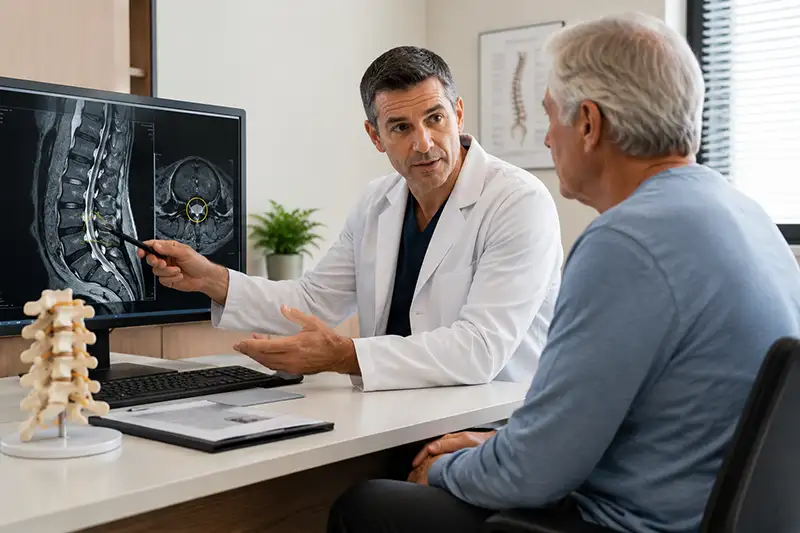
Because spinal stenosis seen on an MRI does not always cause symptoms, treatment should not be based on an imaging result alone. At Premier Orthopaedics in Bloomfield, Englewood, and Union City, Dr. Jay Reidler compares what appears on the scan with your symptoms and physical examination before recommending treatment.
What are the symptoms of spinal stenosis?

With lumbar spinal stenosis, symptoms commonly become more noticeable while standing or walking and improve after sitting or bending forward. This pattern is called neurogenic claudication. Symptoms may include:
- Aching, heaviness, or cramping in the buttocks or legs
- Numbness or tingling in the legs or feet
- Weakness in a leg or foot
- Leg symptoms that increase while standing or walking
- Symptoms that improve after sitting or bending forward
- Reduced ability to walk comfortably for longer distances
Cervical spinal stenosis can produce a different pattern, particularly when the narrowing affects the spinal cord. Symptoms may include:
- Neck pain or stiffness
- Numbness or tingling in the arms or hands
- Hand weakness or loss of dexterity
- Difficulty with buttons, writing, or other fine movements
- Problems with balance or coordination
- Changes in the way you walk
Back or neck pain may occur with spinal stenosis, but nerve-related symptoms often provide the more important clue. Seek emergency medical attention for new loss of bladder or bowel control, numbness around the groin or saddle area, or sudden severe weakness. These symptoms can indicate serious nerve compression that needs prompt evaluation.
What causes spinal stenosis?
Spinal stenosis most often develops from degenerative changes that gradually take up space within the spinal canal. Arthritis can lead to bone spurs, while ligaments around the spine may thicken over time. Bulging or degenerative discs and changes in the joints between the vertebrae can also reduce the space available for the nerves. In some cases, narrowing develops when a vertebra slips out of its normal position or changes in spinal alignment affect the spinal canal.
Some people are born with a naturally narrower spinal canal, which can allow symptoms to develop earlier. Age-related changes may also occur alongside other spine conditions. For example, some adults have both spinal stenosis and degenerative scoliosis. Having one of these changes does not automatically mean that it is causing pain. The location of the narrowing and the nerves involved need to match the symptoms you are experiencing.
How is spinal stenosis diagnosed?
Diagnosing spinal stenosis begins with what you are experiencing, not simply what appears on a scan. Dr. Reidler will ask where your symptoms occur, what brings them on, what makes them improve, and whether you have noticed changes in strength, sensation, walking, balance, or coordination.
A physical examination may evaluate:
- Muscle strength
- Sensation
- Reflexes
- Walking and balance
- Areas where symptoms travel
- How certain positions affect your symptoms
Imaging can then show where narrowing has developed and which structures may be affected. An MRI provides detailed images of the spinal canal, nerves, discs, and surrounding soft tissues. A CT scan may be used when MRI is not appropriate or when additional detail about the bones is needed.
Spinal narrowing becomes increasingly common with age, including in people who have no symptoms. At Premier Orthopaedics, Dr. Reidler uses imaging to confirm a diagnosis rather than treating the scan itself.
What are the treatment options for spinal stenosis?

Nonsurgical spinal stenosis treatment
Conservative treatment may include activity changes, physical therapy, medication, and injections.
- Physical therapy can strengthen the muscles that support the spine, improve mobility, and help you stay active within your symptoms.
- Anti-inflammatory or other medications may help manage pain depending on your health history and symptoms.
- When irritated spinal nerves continue to cause leg or arm pain, an epidural steroid injection may be considered. Injections do not widen the spinal canal, but they may reduce inflammation and symptoms around an irritated nerve.
The goal of nonsurgical treatment is to improve function and help you continue daily activities without exposing you to surgery when it is not necessary.
When is surgery considered for spinal stenosis?
Surgery may become appropriate when symptoms continue to significantly restrict walking, activity, or daily life despite nonsurgical treatment. It can also be considered sooner when spinal cord or nerve compression is causing significant weakness or other neurological changes.
The primary operation for spinal stenosis is decompression surgery. During decompression, the surgeon removes part of the bone or thickened tissue that is crowding the nerves, creating more room within the spinal canal. Not every patient with spinal stenosis needs a fusion. A spinal fusion may be added when instability, a slipped vertebra, deformity, or another structural problem also needs to be addressed.
Dr. Reidler may use minimally invasive or robotic-assisted surgical techniques when they are appropriate for the patient’s anatomy and procedure. The surgical approach depends on the location and severity of the narrowing and whether additional stabilization is necessary. He will explain why a particular procedure is being considered, what it is intended to accomplish, and what alternatives remain available before you decide whether to proceed.
| Nonsurgical treatment | Decompression surgery | |
|---|---|---|
| What it may involve | Activity changes, physical therapy, medication, and injections | Removing bone or tissue that is pressing on the nerves, with fusion when necessary |
| Often considered when | Symptoms are manageable and significant neurological changes are not present | Symptoms continue to significantly limit function despite conservative treatment or nerve compression is more serious |
| Main goal | Reduce symptoms and maintain activity | Create more space for compressed nerves |
| Recovery | Varies by treatment with little or no procedural downtime for many options | Depends on the operation, the patient’s health, and whether fusion is required |
When should you see a spine specialist for spinal stenosis?
Spinal stenosis rarely announces itself all at once, so the right time to get evaluated is usually when a pattern starts repeating rather than after a single bad day. Catching that pattern early gives you more treatment options and a better chance of staying ahead of the symptoms. Consider scheduling an evaluation when:
- Leg pain, heaviness, tingling, or numbness repeatedly starts when you stand or walk
- Your walking distance has noticeably decreased
- Weakness develops in an arm, hand, leg, or foot
- You have begun having difficulty with balance or coordination
- Hand dexterity has changed
- Symptoms continue despite rest or initial treatment
- You have already been diagnosed with spinal stenosis and want to understand your treatment options
- Another physician has recommended surgery and you want a second opinion
An evaluation can also help when you have an MRI showing spinal stenosis but are unsure whether the finding explains what you are feeling.
Why choose Premier Orthopaedics for spinal stenosis treatment in New Jersey?
Spinal stenosis treatment should address more than what appears on an MRI. The first question is whether the narrowing actually explains your symptoms. The next is what level of treatment makes sense based on how those symptoms affect your life.
At Premier Orthopaedics & Sports Medicine, patients can access spine evaluation, nonsurgical pain management, and surgical treatment within the same practice. Dr. Jay Reidler is a board-certified spine surgeon, and our care team can coordinate treatment based on whether your condition is best managed conservatively or requires surgical evaluation.
If surgery has already been recommended, you can also request a second opinion or submit your imaging for a free MRI review before making a decision.
Frequently Asked Questions About Spinal Stenosis in New Jersey
Does spinal stenosis go away on its own?
Can I avoid surgery for spinal stenosis?
What makes lumbar spinal stenosis feel better or worse?
Can cervical spinal stenosis affect balance and the hands?
Should I get a second opinion before spinal stenosis surgery?
A second opinion can be useful when you want to confirm why surgery has been recommended, whether decompression alone may be appropriate, whether fusion is necessary, or whether nonsurgical options remain. Premier Orthopaedics offers spine surgery second opinions and a free MRI review for patients who want another evaluation before deciding.
Have a question we did not cover here? Our spine care FAQ answers more of what patients ask before a visit in Bloomfield, Englewood, or Union City.