
Herniated Disc Treatment in New Jersey
Do you have back pain or pain that shoots down your arm or leg? You may be suffering from a herniated disc or similar spine condition. At Premier Orthopaedics & Sports Medicine, our spine and pain specialists treat herniated disc pain with conservative options first, reserving disc surgery for cases that do not improve over time or involve nerve damage. Request an appointment in our Bloomfield, Englewood, or Union City, NJ, clinic today to get answers and find lasting relief for your herniated disc pain.
What is a herniated disc?
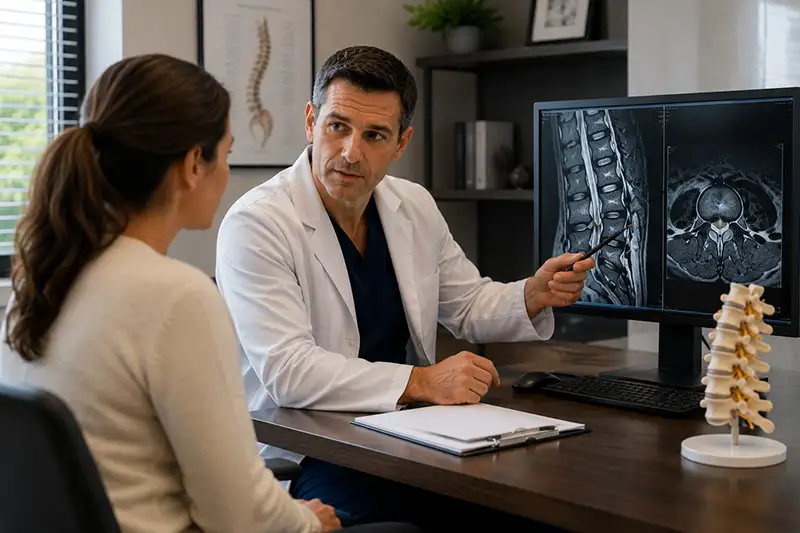
A herniated disc happens when the soft center of a spinal disc pushes out and presses on a nerve. Discs sit between the bones of your spine and act as cushions, each with a soft inside and a tough outer wall. When the inside pushes through a crack in that wall, it can pinch a nearby nerve and cause pain, numbness, or weakness down the path of the nerve. Most herniated discs happen in the lower back, where about 95% occur at the two lowest levels, though they can also occur in the neck. You may hear a herniated disc called a slipped disc or a ruptured disc, while a bulging disc is a similar but different condition. A hands-on exam and an MRI usually confirm the diagnosis.
At Premier Orthopaedics in Bloomfield, Englewood, and Union City, our spine and pain management team helps you find out whether a herniated disc is behind your back, neck, or leg pain.
What are the symptoms of a herniated disc?

Herniated disc symptoms depend on the disc’s spot and which nerve it presses on. In the lower back, the top sign is sciatica. Sciatica is a sharp or burning pain that runs from the buttock down the leg. In the neck, the pain often spreads into the shoulder and arm. Some herniated discs cause little or no pain, and those often show up by chance on a scan.
Common herniated disc symptoms include:
- Pain that spreads from the lower back into the buttock, leg, or foot (sciatica), or from the neck into the shoulder and arm
- Numbness or a pins-and-needles feeling along the nerve
- Weakness in the leg, foot, or hand that affects walking or grip
- Back or neck pain that gets worse when you sit, bend, cough, or sneeze
- Symptoms on just one side of the body
A few symptoms need emergency care right away. Go to the ER if you lose control of your bladder or bowels. The same is true for numbness around the groin or sudden weakness in both legs. Those can be signs of a rare but serious problem called cauda equina syndrome.
Most herniated disc symptoms are not emergencies, but they still deserve a look. If back, neck, or leg pain, numbness, or tingling is not easing up, contact Premier Orthopaedics in Bloomfield, Englewood, and Union City, NJ, and our specialists can pinpoint the cause and help you feel better sooner.
Who does a herniated disc affect?
Herniated discs can affect adults of any age. They are most common between ages 30 and 50, and a bit more common in men, based on a 2025 review of lumbar disc herniation. Discs also dry out and stiffen as we age, so the outer wall tears more easily. Daily habits play a role too and can cause herniated discs when lifting with your back instead of your legs, twisting as you lift, extra body weight, heavy physical jobs, a lot of driving, and smoking.
Your situation, not just your age, guides the right care. New, mild pain is often fine to treat with simple care at first. See a spine specialist soon if your pain is severe, keeps you from work or sleep, follows an injury, or comes with numbness or weakness.
What are the treatment options for a herniated disc?

At Premier Orthopaedics, we design each phase of care for your specific herniated disc symptoms, starting with conservative care before moving to surgery in more advanced cases.
Non-surgical care: First-line care works best for new, mild to moderate symptoms. It includes rest and short-term changes to your activity. It also includes physical therapy to build core strength and improve how you move. Anti-inflammatory medicine helps ease pain and swelling. Hands-on care like chiropractic treatment can help as well. Back pain usually eases within six to eight weeks with this kind of care.
Injection treatments: When pain sticks around, targeted shots can calm the nerve and help you stay active in therapy. Our pain management team offers epidural steroid injections. These place anti-inflammatory medicine near the sore nerve. We also offer nerve block injections. Both use imaging to guide the needle, and relief can last for months.
Spine surgery: Surgery is an option when weeks of non-surgical and injection care have not helped. It is also an option when weakness or nerve damage is getting worse. The most common surgery for a herniated disc is a microdiscectomy. In this small procedure, the surgeon removes the piece of disc that presses on the nerve. Some patients may need decompression instead, or a spinal fusion or artificial disc. Other spine procedures use robotic assistance for added precision. Surgery often eases leg pain faster than waiting. Choosing surgery is a shared decision. It is not a sign that you failed at non-surgical care.
Get advanced herniated disc treatment right here in New Jersey
Premier Orthopaedics brings spine care together in one place, from your first exam through recovery. Our team includes fellowship-trained spine surgeon Dr. Jay S. Reidler, a neurosurgeon, and interventional pain specialists. You can move from physical therapy to injections to surgery without switching practices. Dr. Reidler treats both adults and children, from routine cases to complex ones. When surgery is the right call, we offer small-incision and robotic-assisted options. We lead with non-surgical care, so most patients feel better without surgery.
You can see us at three offices across Northern New Jersey, in Bloomfield, Englewood, and Union City.