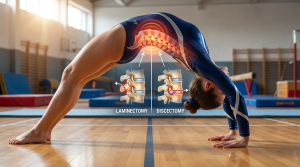
After months of physical therapy and injections, your leg pain still hasn’t let up, and your doctor has started talking about surgery. Sciatica surgery includes several procedures, and the right one depends entirely on what’s compressing the nerve. The main options are microdiscectomy, laminectomy, foraminotomy, endoscopic decompression and fusion, each matched to a different source of nerve compression.
When Sciatica Stops Responding to Everything Else
Sciatica may need another look when pain limits sitting, walking or sleep despite conservative care. After months of symptoms, conservative care that once gave you some relief can plateau.
A compressed nerve root in your lower back causes the symptoms. The most common cause is a herniated disc, where the soft center of a spinal disc pushes through its tougher outer layer and presses on a nearby nerve.
Spinal stenosis is the other frequent culprit, a narrowing of the canal that houses your spinal cord and nerves. Both put pressure on the nerve, and that pressure sends pain, numbness or weakness shooting down your leg.
Surgery treats the cause, the compression itself. That’s why two people with identical leg pain can need two completely different operations. A herniated disc pressing on a single nerve root calls for one approach, while stenosis squeezing multiple nerves calls for another.
Conservative Treatment: The Box You Check First
Most people with sciatica get better without surgery, especially when a herniated disc causes the pain. Herniated discs frequently shrink on their own as the body reabsorbs the material pressing on the nerve.
Conservative care leans on three main pieces, starting with physical therapy, then anti-inflammatory medication and activity modification, with epidural injections and nerve blocks when you need more relief. At Premier Orthopaedics & Sports Medicine, this conservative-first approach comes before any conversation about the operating room.
Surgery becomes the right conversation when conservative care has run its course. The usual threshold is six to eight weeks of conservative care that hasn’t relieved the pain, or symptoms that are getting worse rather than better. Progressive weakness in your leg or pain you can’t tolerate also moves the timeline forward.
If you develop loss of bowel or bladder control, numbness in the area a saddle would touch or sudden severe weakness in both legs, go to the ER now because these can signal cauda equina syndrome, a surgical emergency where fast treatment protects your long-term function.
When Surgery: The Main Sciatica Procedures Compared
Sciatica surgery breaks down into a handful of procedures, and each addresses a specific cause of nerve compression. Understanding the differences helps you have a sharper conversation with your surgeon about why one approach fits your case and another doesn’t.
Microdiscectomy: The Most Common Sciatica Surgery
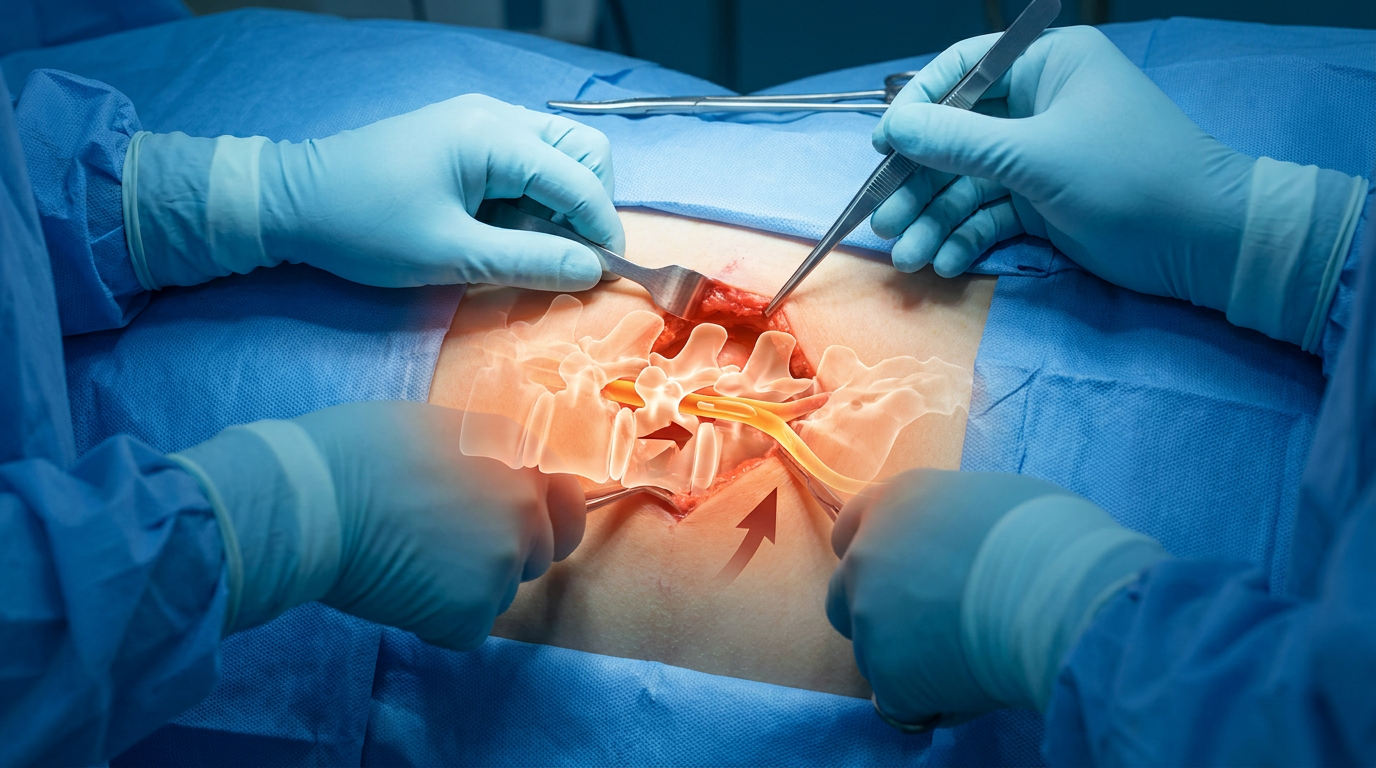
Microdiscectomy removes the fragment of disc pressing on your nerve root through a small incision, usually about an inch or two, often with a microscope to view the area. Your surgeon takes out only the herniated portion and any loose pieces, and the rest of the disc stays in place. The goal is to free the nerve without fusion or rebuilding.
This procedure typically fits a single herniated disc pressing on one nerve root. When your herniation sits at one level and your leg pain matches that level, microdiscectomy is usually the operation on the table. It’s often an outpatient procedure, so you can go home the same day after a few hours of observation. Many people are walking the next day.
Laminectomy: Making Room for Compressed Nerves
During laminectomy, your surgeon removes part of the lamina, the bony roof that covers your spinal canal, to enlarge the space and ease pressure on the nerves inside. The surgeon also clears away bone spurs, the bony overgrowths that come with spinal arthritis and aging. This is one of the most common operations for spinal stenosis.
Laminectomy is the typical choice when stenosis drives your symptoms, since stenosis may squeeze multiple nerve roots rather than one. It tends to come up more often in older adults because the narrowing usually develops gradually with age. Laminectomy also comes with one honest limitation. It relieves the radiating nerve pain, but doesn’t cure the arthritis that caused the narrowing, so it’s less likely to fix back pain itself.
Foraminotomy and Endoscopic Approaches
Foraminotomy widens the foramen, the passageway where a nerve root exits the spinal canal, when a herniated disc, bone spur or thickened ligament narrows that exit. Endoscopic and other minimally invasive spine surgery approaches use a camera and small instruments through small incisions, with less disruption to the surrounding muscle.
Endoscopic surgery through the skin can produce outcomes similar to standard microdiscectomy in selected patients. These techniques generally lead to shorter hospital stays and lower infection rates, though longer-term data is still building.
Not everyone is a candidate, and the approach depends on where the herniation sits and whether the spine moves more than it should. Dr. Jay Reidler is an adult and pediatric spine surgeon who completed spine fellowship training at NewYork-Presbyterian/Columbia University.
Spinal Fusion: When Instability Joins the Picture
Spinal fusion permanently joins two vertebrae so they no longer move against each other. It comes into the conversation when nerve compression arrives alongside instability, most often spondylolisthesis, a forward slip of one vertebra over the one below it. That slip can press on nerve roots and produce sciatica, and it can also let the spine move more than it should.
Straightforward nerve compression may fit simple decompression when it’s the main symptom without major low back pain. Evidence comparing decompression alone with fusion remains mixed in spondylolisthesis. For some lower-grade slips without narrowing at the nerve exit, decompression alone can give equivalent results, and evidence on adding fusion remains low-to-moderate quality.
| Procedure | What It Treats | Incision | Hospital Stay | Typical Return to Work | Who It’s For |
| Microdiscectomy | Single herniated disc on one nerve root | About one to two inches | Often same day | Desk work two to six weeks. Strenuous work around 12 weeks | Single-level herniation matching leg pain |
| Laminectomy | Spinal stenosis compressing nerves | Larger open incision. Smaller if minimally invasive | Usually inpatient | Varies by job. Gradual return as healing allows | Stenosis-driven nerve pain, often in older adults |
| Foraminotomy / Endoscopic | Narrowed nerve exit or single-level herniation | Small endoscopic incision or portal | Same day or short hospital stay | Varies by case | Select single-level cases without instability |
| Spinal Fusion | Compression with instability or spondylolisthesis | Open or minimally invasive incision varies | Two to three days typical | Desk work four to six weeks. Physical labor three to six months | Instability or slip alongside nerve compression |
These are ranges, not guarantees. Your timeline depends on your age, overall health, the number of levels treated and how your body responds in the first days after surgery.
How Surgeons Match the Procedure to Your Case
Choosing the right procedure starts with matching your MRI findings to your actual symptoms and exam. From there, your surgeon weighs the number of levels involved, whether the spine is stable, your age, your job demands and your overall health. A scan finding matters most when it matches the level and side of your leg pain.
Questions to Ask Your Surgeon
If you’ve heard that you need a fusion for what sounds like straightforward single-level sciatica, an independent evaluation can confirm that the recommended approach matches your specific problem. A few questions help you pressure-test any surgical recommendation:
- What exactly is compressing the nerve, a herniated disc or stenosis?
- Does my MRI finding match my symptoms, same level and same side?
- Why this procedure over the alternatives?
- How many of these do you perform each year?
- Is my pain mostly in my leg or mostly in my back?
- What happens if I wait?
Recovery: What the Weeks After Surgery Look Like
Recovery follows a predictable staircase, with microdiscectomy on the lighter end and fusion on the longer one. After a microdiscectomy, many people return to desk work in two to six weeks and resume routine activity around six weeks, with strenuous labor waiting until about 12 weeks. Laminectomy recovery is more gradual, with light activity returning around a month. Fusion usually takes the longest because your surgeon needs the bone to heal.
In many cases, leg pain improves before strength, while numbness and tingling often take the longest. Across procedures, complete healing can take three months to a year, so patience in the early weeks matters. You should expect soreness at the incision and some stiffness, but new or worsening leg weakness, fever or signs of infection at the incision are worth a call to your surgeon.
Premier’s recovery guidance lays out phase-by-phase expectations, and recovering close to home in Bergen or Hudson County can make early follow-ups easier to manage.
Choosing the Right Sciatica Surgery for Your Case
Premier’s spine team across Northern New Jersey starts with conservative care and turns to surgery only when it’s truly needed, with Dr. Reidler building a surgical plan down to the specific technique when an operation makes sense. If you’re weighing your options or want a second look at a recommendation, call 201-833-9500 or schedule a consultation online.
Frequently Asked Questions About Sciatica Surgery
What is the success rate of sciatica surgery?
Sciatica surgery tends to work best when the procedure matches the exact cause of nerve compression. Microdiscectomy can help when one herniated disc presses on one nerve root, while laminectomy can help when stenosis narrows the canal around the nerves. Your surgeon should explain what success means for your case, including pain relief, walking tolerance, strength and return to work.
Can sciatica come back after surgery?
Yes, though most people don’t have it return. After a discectomy, the same disc can herniate again at the same level. At five years, the risk of a symptomatic recurrence is around 12 percent, and a smaller share need a repeat operation. Your surgeon will usually suggest easing back into heavy lifting, bending and twisting over the first several weeks.
How long do you stay in the hospital after sciatica surgery?
It varies by procedure. Microdiscectomy is often same-day. Laminectomy may involve an inpatient stay, and spinal fusion typically runs two to three days. Minimally invasive approaches can mean shorter hospital stays in selected cases.
Is sciatica surgery covered by insurance?
Coverage varies by plan, insurer and medical necessity criteria, and prior authorization is common. Many plans use medical-necessity rules, and the specific criteria vary by plan, insurer and state. Your surgeon’s office can help you understand what your plan requires before scheduling surgery.
This article is for general information only and isn’t a substitute for professional medical advice. Talk to your doctor about your specific situation before making treatment decisions.