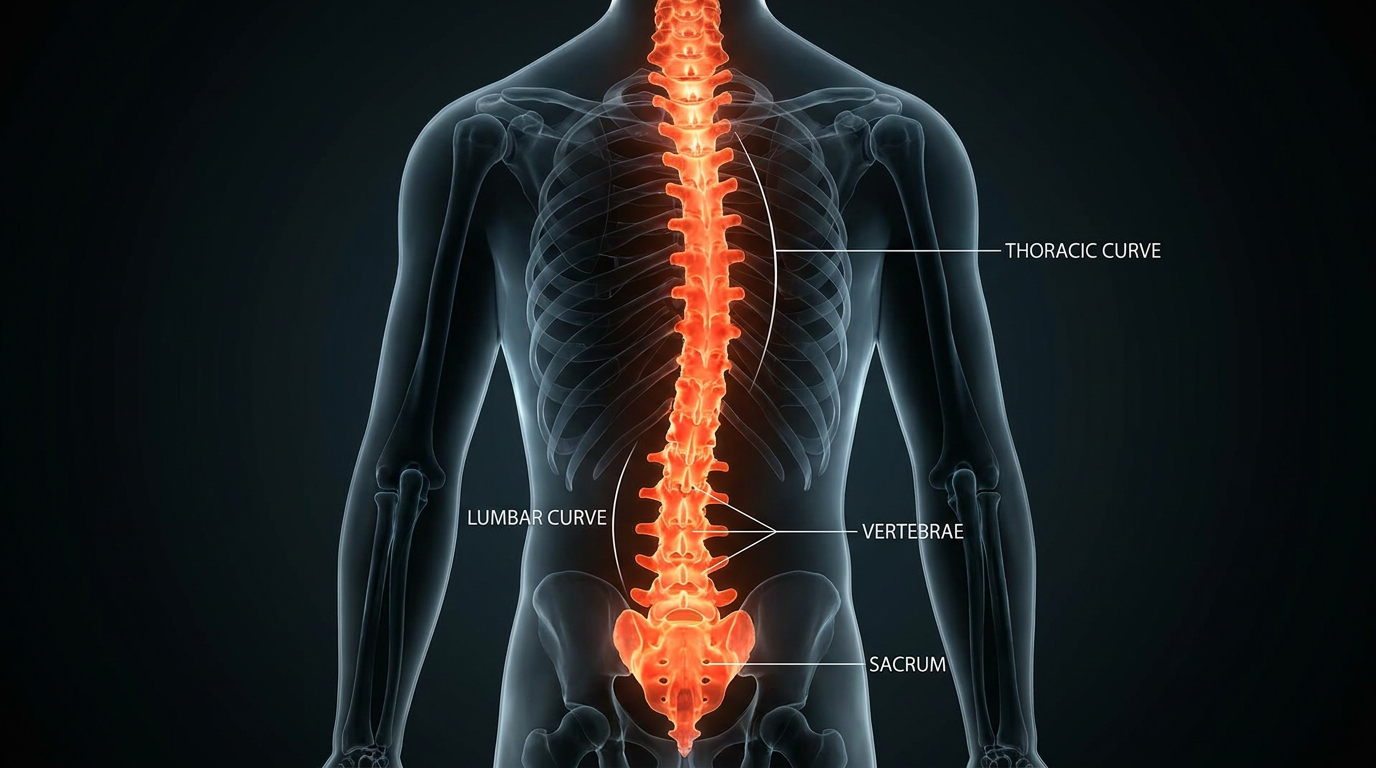
Your X-ray shows two curves in your spine, one bending right in your mid-back and one bending left lower down, and your doctor called it an “S-shape.” That pattern is one form of S-shaped scoliosis, where the spine curves sideways and rotates instead of lining up straight.
A double curve changes how your doctor plans treatment, with decisions based on curve size, flexibility, growth remaining and symptoms. Your doctor measures each curve and tests flexibility on bending X-rays before deciding whether one or both curves need treatment.
Table of Contents
ToggleWhy a Double Curve Raises More Questions
A single curve was already a lot to absorb. Two curves can feel more complicated, especially when you search online and find surgical images that make every case look dire. Most people with an S-shaped spine never need surgery. The idea that an S-shape is automatically worse than a single curve misses the main clinical distinction, which is whether the second curve is structural or compensatory.
What an S-Shaped Curve Actually Looks Like
Scoliosis causes the bones of the spine to twist so that, instead of a straight line down the middle of your back, the spine looks more like the letter C or S. In the classic S-pattern, one curve bends in your mid-back, called the thoracic spine, and a second curve bends the opposite direction lower down, called the lumbar spine.
A “double major” pattern describes scoliosis with two structural curves that usually look similar in size. Among 407 patients with adolescent idiopathic scoliosis, which means a spinal curve in a teenager with no known single cause, single thoracic curves made up 54 percent of cases. True double major curves were among the least common patterns in that group.
Primary Curve vs. Compensatory Curve
Many S-shaped spines aren’t true double majors. They have one structural curve that’s responsible for the deformity and one compensatory curve that the body created to balance it out. A compensatory curve is a secondary curve above or below the main one that develops to maintain normal body alignment.
If your thoracic spine bends right, your lumbar spine may develop a left curve so your shoulders stay centered over your hips and your head stays balanced over your pelvis. Your doctor measures both curves, but plans treatment around the primary structural one, because addressing that curve often lets the compensatory curve correct on its own.
How S-Shaped Scoliosis Is Evaluated
Your doctor starts with a standing full-spine X-ray, where each curve gets its own measurement. That image shows how your spine lines up when gravity acts on it, which gives your doctor a more useful picture than a lying-down image alone.
Standing X-Rays and Cobb Angle
Your doctor measures the Cobb angle of each curve by drawing lines from the most tilted vertebrae at the top and bottom of the curve, then measuring the angle between them. A curve greater than 10 degrees counts as scoliosis, and your doctor usually starts discussing treatment once a curve grows beyond the mild range. The largest curve is the major curve, and it’s always structural.
Bending Films and Flexibility
The X-ray that changes the plan is the bending film. With side-bending views, you bend toward each curve while imaging captures how the spine responds. Bending views separate structural curves from nonstructural ones, which are flexible curves that straighten when your body changes position.
These films also affect which levels a surgeon would include in any fusion. A compensatory curve straightens when you bend toward it, while a structural curve stays rigid.
If the lower curve straightens out on the bending film, your doctor may treat it as compensatory and leave it alone during care. A curve that stays stiff gets treated as structural and given separate attention. Premier Orthopaedics & Sports Medicine’s neck and back specialists offer in-office X-rays across Northern New Jersey. In-office imaging can make spine evaluations more convenient.
Conservative Treatment for S-Shaped Scoliosis
Doctors manage most S-shaped spines without surgery, and the right approach depends on curve size, growth remaining and whether the curves are getting larger, known as progression. Progression matters most while a child is still growing, when curves are most likely to change.
Monitoring Mild Double Curves
The same threshold logic that applies to single curves applies here, with each curve measured separately. In a growing child, your doctor watches curves under 25 degrees closely for progression. Standard guidance calls for observation under 20 degrees, with bracing considered between 20 and 45 degrees if there’s documented progression and growth remaining.
Having two mild curves doesn’t automatically push a child into bracing territory. Double-major curves can fall into a moderate-risk category with a six-month follow-up interval, which means consistent monitoring during growth rather than immediate intervention. When each curve stays under 20 degrees, the plan is usually a standing X-ray every six months while your child is still growing.
Bracing
Doctors consider bracing in growing children once the primary curve reaches roughly 25 degrees. The standard threshold applies to a skeletally immature child with a curve of 25 degrees or greater, or documented progression of at least five degrees. Skeletally immature means your child is still growing, and the goal is to stop the curve from progressing.
An orthotist, the specialist who designs and fits braces, customizes a double-curve brace to the curve pattern so it accounts for how the two curves balance each other. One caveat matters, since double curves have the poorest response to bracing compared with single curves. Bracing still works better than leaving the curve untreated, and longer daily brace wear reduces curve progression toward the surgical threshold.
Physical Therapy and Core Strengthening
Physical therapy supports posture and symptom relief for both adolescents and adults. Scoliosis-specific exercises like the Schroth Method use individualized correction and breathing-based posture training matched to each patient’s curve pattern.
For an S-shaped spine, the exercises matter in a particular way. Your therapist builds a double-curve program that strengthens the major curve while avoiding large compensations in the balanced curve. Aggressively correcting one curve can worsen the opposing curve if the approach doesn’t match your specific spine.
Exercise has limits. Scoliosis-specific exercises have measurable effects on mild-to-moderate curves and can slow progression and improve posture and quality of life, but they don’t straighten established structural curves. For curves large enough to need a brace, exercise fits best as support for the brace plan, and using exercises to replace bracing leaves out the treatment intended to slow progression.
Already been told your child needs spinal fusion?
A second opinion is a normal step before agreeing to fusion for your child, especially with a double curve where the decision involves which levels to fuse. Premier’s pediatric deformity team reviews your child’s prior imaging and bending films before the visit, and can also discuss whether a motion-preserving option like VBT fits your child’s curve pattern.
When Surgery Is Needed for a Double Curve
Surgery becomes an option only after curves cross specific thresholds or symptoms persist despite conservative care. For most people with an S-shaped spine, that point never arrives.
The Surgical Threshold for S-Shaped Scoliosis
The thresholds for a double curve are the same as for a single curve. In adolescents, surgeons generally consider surgery for curves exceeding 45 to 50 degrees, because larger curves tend to keep progressing even after a child stops growing. For adults, the same range applies, and surgery also comes up when symptomatic progression occurs despite an extended course of non-surgical treatment.
Surgeons also decide which curves to include in the fusion. Spinal fusion is surgery that joins selected vertebrae so they heal into one stable section.
Sometimes a surgeon performs a selective fusion, which treats only the primary curve and leaves the compensatory curve unfused and mobile. After a selective fusion, that unfused lumbar curve can correct on its own.
When both curves are structural, as in a true double major, outcomes improve when surgeons fuse both curves. This is a field with genuine clinical judgment, which is why two patients with similar X-rays sometimes get different recommendations.
Fusion and Motion-Preserving Options
Spinal fusion remains the standard for large S-shaped curves. For pediatric patients who still have growth remaining, Vertebral Body Tethering (VBT) may be an option for the right candidates. VBT is a motion-preserving alternative to fusion that uses a flexible cord anchored to screws along the spine, and the curve gradually corrects as the child grows.
Candidacy is specific. VBT generally requires a major Cobb angle between 30 and 65 degrees, enough growth remaining and curves flexible enough to correct on bending films.
A double-curve VBT requires tethering on both sides of the spine. That can mean a longer operation and higher complication rate than single-curve VBT. VBT remains an evolving option, and tether breakage is a documented complication, so families should discuss the tradeoffs directly with their surgeon.
Dr. Reidler performs both VBT and fusion for scoliosis through Premier’s spine surgery program. His pediatric and adult deformity training helps him evaluate which approach fits your child’s specific curve pattern rather than defaulting to one option.
Double-curve surgery can involve more fused levels than single-curve surgery, so more vertebrae are included in the fused section. How low the fusion extends into the lumbar spine affects long-term motion.
Recovery and Long-Term Outlook
Recovery from S-shaped scoliosis care depends on whether you were monitored, braced or treated surgically. Each path has its own timeline and follow-up rhythm.
Monitoring and Activity
For monitored and braced patients, life looks normal in most cases. Staying active does not raise the risk of curve progression, and children with idiopathic scoliosis can play most sports.
The recheck cadence ties to growth in children, with more frequent imaging during a growth spurt and follow-up tied to symptoms in adults. Patients who reach skeletal maturity, meaning they finish growing, with curves under 30 to 40 degrees are at low risk for further progression and typically don’t need monitoring into adulthood.
Surgical Recovery and Long-Term Outlook
For surgical patients, recovery mirrors standard fusion timelines with the added context of more levels. Most children return to school within one to three months, and your surgeon follows bone healing over many months. A return to sport usually comes within six to nine months. Premier’s recovery guidance walks through what to expect at each phase and covers pain management and follow-up physical therapy.
Long-term outcomes are reassuring. Treated patients show no added activity restriction after surgery compared with non-surgical care, and fusion levels did not influence activity level. Most people with treated S-shaped scoliosis return to full activity, and ongoing work to strengthen the back and maintain posture supports symptom management.
Get a Clear Read on Your Double Curve
If your imaging shows a double curve and you want a clear read on what it means, Premier’s spine care team across Bergen, Hudson and Essex counties can help.
Get an Evaluation for S-Shaped Scoliosis
An evaluation measures both curves, checks flexibility on bending films, and clarifies whether one or both need treatment. Premier Orthopaedics & Sports Medicine’s spine team sees families from across Northern New Jersey for this kind of double-curve assessment.
Frequently Asked Questions About S-Shaped Scoliosis
Is S-shaped scoliosis worse than a single curve?
Not necessarily. An S-shape can produce a more balanced posture than a large single curve, since the second curve helps keep your shoulders over your hips. Double major curves are more likely to progress than single curves and respond less well to bracing, which makes them more complex to manage.
Can S-shaped scoliosis be fixed without surgery?
For most people, yes. Doctors generally reserve surgery for the largest or progressive curves, and they manage most double curves with conservative care such as monitoring or bracing, often alongside scoliosis-specific physical therapy. Longer daily brace wear lowers the risk of progression toward surgery, and bracing aims to slow a curve rather than straighten one that already exists.
Does S-shaped scoliosis run in families?
There’s a genetic link, though the exact genes haven’t been pinned down. Many people with adolescent idiopathic scoliosis have a relative with the condition, and roughly one in three children whose parent has scoliosis will develop it. Having a family history doesn’t mean a large curve will develop, and not having one doesn’t rule scoliosis out. Screening siblings is reasonable when one child is diagnosed.
What sports can you play with S-shaped scoliosis?
Without surgery, you can play the same sports as anyone else, rarely with restrictions, and staying active won’t make the curve worse. After fusion surgery, non-contact sports usually resume within four to six months, and unrestricted activity follows once the fusion is fully solid. Your surgeon may discourage contact and collision sports like football because fusion permanently limits spine movement.
This article is for general information only and isn’t a substitute for professional medical advice. Talk to your doctor about your specific situation before making treatment decisions.