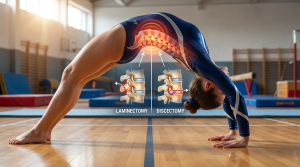

Your MRI showed narrowing in your neck pressing on the spinal cord, and now you’re holding two different recommendations. One surgeon suggested laminoplasty, while the other suggested laminectomy with fusion.
Neither visit made clear why your case points one way or the other. Both operations decompress the spinal cord, but they handle motion and stability differently.
This guide covers what each operation does, who fits each profile and how to compare the recommendations you receive.
Why Cervical Stenosis Sometimes Leads to Surgery
Cervical spinal stenosis narrows the spinal canal in your neck, pressing on your spinal cord and the nerve roots branching off it. When that pressure changes how your cord works, it can lead to cervical myelopathy, spinal cord dysfunction that affects coordination, balance and hand function.
Your hands might feel clumsy or uncoordinated, your balance may feel off, your neck may feel stiff, and your walk may no longer feel like your normal one.
Degenerative cervical myelopathy is the most common cause of spinal cord dysfunction in adults worldwide. Without surgery, 20 to 62 percent of people with myelopathy get worse within three to six years. About two-thirds of patients who have surgery see improvement afterward.
Those numbers are why surgeons act on a case that keeps progressing rather than waiting to see if it stabilizes on its own.
At Premier Orthopaedics & Sports Medicine, we start with conservative care when stenosis hasn’t caused myelopathy or symptoms remain mild and stable.
Options may include physical therapy, anti-inflammatory medication and changes to how you sit, sleep and lift. Epidural injections can also help, as anti-inflammatory medication is placed near irritated spinal nerves to ease pain. It doesn’t open the canal or take pressure off the spinal cord.
Your surgeon may recommend surgery when your MRI shows cord compression with myelopathy or neurological symptoms keep advancing. Both operations compared here open the canal from the back of your neck.
Laminoplasty: Enlarging the Spinal Canal While Preserving the Lamina
Laminoplasty treats multilevel cord compression by making the spinal canal larger while preserving the bony roof. Surgeons use it to avoid fusing the treated levels when your alignment and stability make motion preservation reasonable.
What is Laminoplasty?
The lamina is the bony roof over the back of the spinal canal. In a laminoplasty, your surgeon cuts and hinges the roof open like a door and holds it open with small plates so the canal stays wider.
Open-door and French-door techniques are the two common versions. Open-door hinges the roof toward one side, while French-door splits it down the middle and opens both halves outward. Your surgeon picks between them based on their training and your anatomy.
Who Is Laminoplasty For?
For cervical stenosis, your surgeon uses neck X-rays to determine whether laminoplasty fits your anatomy.
Three words come up in that conversation: lordotic means your neck keeps its normal forward curve, neutral means it’s roughly straight and kyphotic means it has tipped backward into a reversed curve
You’re a likely candidate when:
- Standing X-rays show lordotic or neutral alignment.
- Flexion-extension films show no instability.
- Three or more levels show cord compression.
- Preserving neck motion matters for your work, driving or sport.
A kyphotic neck generally rules out laminoplasty because opening the canal doesn’t correct a reversed curve.
What Are the Outcomes of Laminoplasty?
The operation avoids fusion hardware, but outcomes vary with your anatomy, the number of levels involved and how far your myelopathy has progressed before surgery.
All patients felt improved at three months after open-door laminoplasty, and 91 percent still reported improvement at two years.
Your own recovery depends on how many levels your surgeon treats, how your body responds during and after surgery and how much cord dysfunction you had going in.
Your surgeon will set your activity timeline based on your healing, neurological function and treated levels rather than promise a fixed return date.
Laminectomy: Removing the Lamina and Often with Fusion
Laminectomy removes the vertebral bone (lamina) entirely, and in the neck, that often includes a fusion. Surgeons use it when the neck needs structural support and decompression.
What Is a Laminectomy?
Your surgeon removes the lamina at each compressed level, opening the spinal canal and providing direct access to the cord and nerve roots.
After a multilevel laminectomy, the neck can drift forward into kyphosis once the lamina and its stabilizing structures are removed. A fusion adds hardware that joins the vertebrae so they heal into one solid segment, which helps prevent that drift.
Because of the kyphosis risk, many surgeons avoid isolated cervical laminectomy and add fusion when they decompress from the back.
Who Is a Candidate for Laminectomy With Fusion?
Laminectomy with fusion suits a neck that needs structural help along with decompression. You’re a likely candidate when:
- Standing X-rays show kyphotic alignment or a lost cervical curve.
- Flexion-extension films show instability at one or more levels.
- You have had prior posterior cervical surgery.
- Your anatomy calls for wider surgical exposure than laminoplasty allows.
Laminectomy without fusion remains an option in a narrow group: a normally aligned, stable neck where the surgeon is confident the curve won’t drift after the decompression.
What Are the Outcomes of Laminectomy With Fusion?
Recovery after cervical laminectomy with fusion leads to improvement in 85.5 percent of patients.
Your hospital stay and activity plan depend on the operation, your health and your surgeon’s protocol.
With fusion, your recovery plan also tracks whether your treated vertebrae join into one solid segment. About 98 percent of cases are successful.
How to Decide Between Laminoplasty and Laminectomy
When choosing between laminoplasty and laminectomy, your surgeon weighs several factors: your neck alignment, stability, the number of compressed levels, your surgical history and how each operation compares in recovery and risk.
The table below breaks down each factor and shows how it points toward one operation or the other.
| Factor | Laminoplasty | Laminectomy with fusion |
|---|---|---|
| Neck alignment | Lordotic or neutral | Kyphotic, or lost cervical curve |
| Instability on flexion-extension films | Not present | Present, or expected after decompression |
| Number of compressed levels | Often three or more | Any number, weighed with alignment and stability |
| Prior posterior cervical surgery | Usually rules it out | Preferred, though the plan depends on what was done before |
| Motion and hardware | Neck retains motion, with small plates that hold the hinged bone | Hardware fuses the treated levels, which stop moving |
| C5 palsy risk | Around six percent | Around 10 percent |
| Return to unrestricted activity | Cleared based on healing and neurological function | Also depends on fusion healing |
| Main recurring concern | New or lingering neck ache | Loss of motion or failure to fuse |
No single row in the table settles the decision. A lordotic, stable neck with two compressed levels might still push toward fusion if you’ve had prior posterior surgery, and a neutral neck with borderline instability could go either way depending on how much motion you’re willing to trade for stability.
Your surgeon reads the whole picture, then walks you through which factors carried the most weight for your case.
What to Discuss with Your Doctor Before Choosing
Bring your actual imaging, not a description of it. Your MRI shows the compressed levels, while standing and flexion-extension X-rays show alignment and instability. The neck and back specialists you consult should be able to point to each finding on your own films.
Questions to Bring to Your Consultation
These questions can keep your consultation focused on your anatomy and daily priorities. You can write down the answers or ask whether a family member can join you.
- Is my neck lordotic, neutral or kyphotic on my standing X-rays?
- How many levels are compressed, and does the count change your recommendation?
- Do my flexion-extension films show any instability?
- How many of each procedure do you perform each year, and why does my case fit the one you’re recommending?
- What’s my risk of C5 weakness with each option?
- How much neck motion will I lose, and what does that mean for driving and my job?
- What’s the plan if my numbness or weakness improves only partly?
Specific answers should connect the recommendation to your own films. If an answer stays general rather than pointing to your imaging, ask your surgeon to show you the finding on the screen.
When a Second Opinion Helps
Two surgeons may recommend different operations for the same MRI because they read alignment differently or weigh motion against stability differently.
A second opinion is worth pursuing whenever a surgeon didn’t tie the recommendation to specific findings on your own films.
Dr. Jay S. Reidler, MD, MPH, is a Harvard-, Hopkins-, and Columbia-trained spine surgeon who performs cervical decompression and fusion. He can review your images and walk you through the alignment, level-count and instability reasoning described here.
Talk to Premier’s Spine Team About Your Cervical Stenosis
If you’re weighing laminoplasty against laminectomy for cervical stenosis, we’ll go through the alignment and stability reasoning on your own X-rays and MRI at any of our Northern New Jersey offices. Call 201-833-9500 or request an appointment online.
Frequently Asked Questions About Laminoplasty vs. Laminectomy
Can a laminoplasty be converted to a fusion later if my neck curve changes?
Yes. Follow-up standing and flexion-extension X-rays can show whether your neck has developed a forward curve or instability, and your surgeon may recommend fusion when those changes appear alongside new or worsening symptoms.
Is C5 palsy permanent?
The course of C5 palsy varies, and some people keep weakness in the shoulder or upper arm. If weakness appears, track changes in overhead reach, lifting and work tasks so your surgeon can compare your function over time and decide whether physical therapy belongs in your recovery plan.
How long does laminoplasty recovery take?
Laminoplasty clearance depends on wound healing, neurological function and the demands of each activity. Fusion recovery adds another checkpoint because your surgeon also tracks whether the vertebrae join into one solid segment. Your surgeon can give you separate milestones for driving, desk work, physical work, lifting and unrestricted activity.
How much neck motion will I lose after a fusion?
Fusion stops motion at the treated levels, while the levels outside the fusion still move. The practical difference depends on how many levels your surgeon plans to fuse and which head-turning tasks matter most to you, such as checking a blind spot, working overhead or participating in a sport.
This article is for general information only and isn’t a substitute for professional medical advice. Talk to your doctor about your specific situation before making treatment decisions.