You’ve left the doctor’s office with two procedure names written on a slip of paper, and now you’re trying to figure out what they actually mean for your back. Discectomy and laminectomy sound similar enough that it’s easy to mix them up, but they’re two distinct operations that solve two distinct problems in your spine.
Knowing which one your surgeon is talking about, and why, makes the rest of the conversation a lot clearer. We’ll walk through what each procedure does, who tends to be a candidate for one versus the other, what recovery looks like and how you and your surgeon can figure out which operation fits the cause of your pain.
Table of Contents
ToggleConservative Care Comes Before Either Surgery
Most people with a herniated disc or spinal stenosis don’t start with surgery. Physical therapy, medication, activity modification and injections usually come first, and your surgeon will recommend an operation only after those approaches haven’t brought enough relief.
For a herniated disc, that typically means six to 12 weeks of conservative treatment. For spinal stenosis, your surgeon will often wait three to six months before discussing surgery, since most people improve before then. The main exceptions are neurological emergencies like cauda equina syndrome or rapidly progressing weakness in your legs, both of which need urgent surgical attention rather than another round of physical therapy.
What a Discectomy Treats and How It’s Performed
A discectomy removes the damaged portion of a herniated disc pressing on a nerve root. With a herniated disc, the soft, gel-filled cushion between two vertebrae cracks open and the inner material pushes out through the tear. That fragment can sit directly on a nerve, which is what causes the sharp, radiating pain you’ve been feeling. A discectomy works well for that kind of nerve pain. Plain back pain on its own responds less predictably to surgery.
How a Discectomy Is Performed
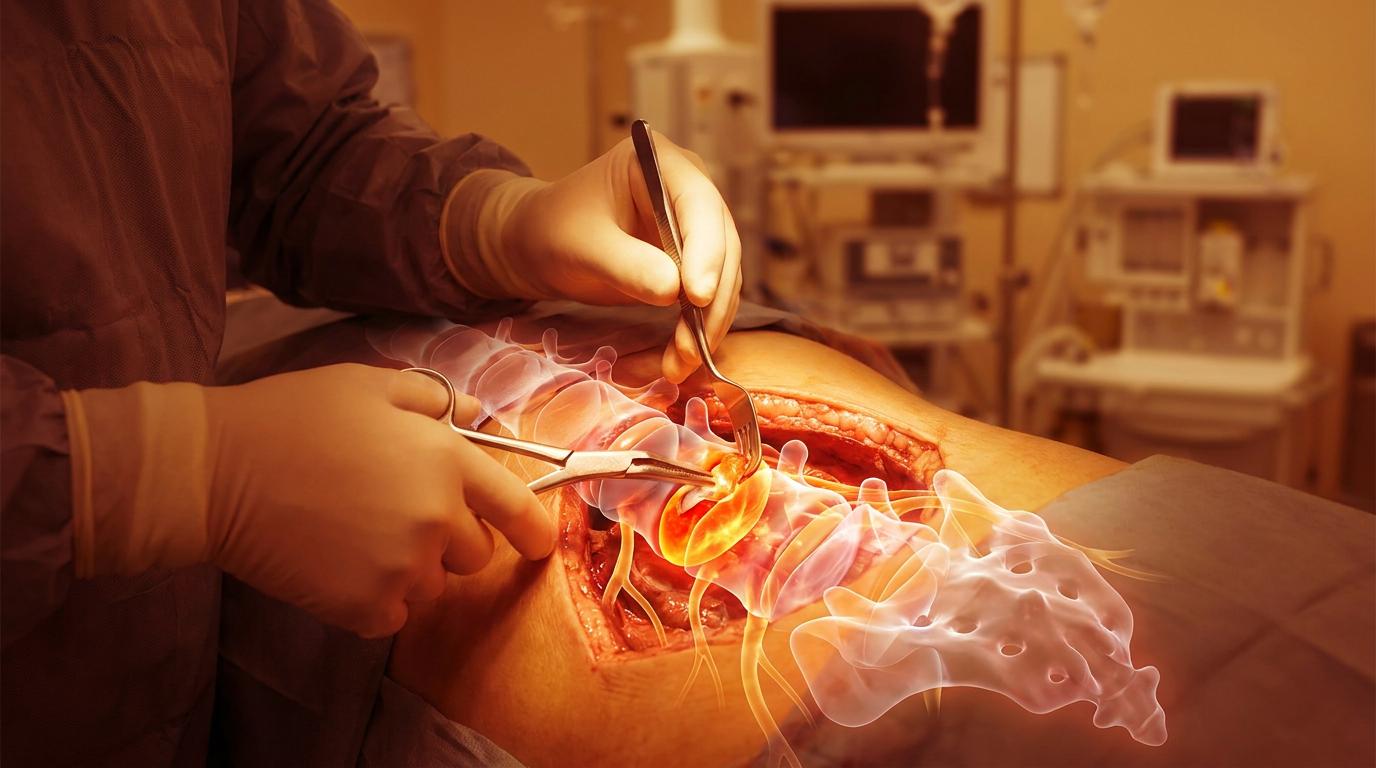
Your surgeon makes a small incision over the affected vertebra and moves the muscle aside to reach the disc. The surgeon then removes only the fragment pushing through the disc wall, not the whole herniated spinal disc. Lumbar discectomies commonly happen as outpatient procedures today, and most people go home the same day.
Microdiscectomy: The Less Invasive Approach
Microdiscectomy is the current standard surgical procedure for a lumbar disc herniation. Your surgeon uses a smaller incision and inserts a tubular retractor with magnification, which gently pushes the muscle aside rather than cutting through it. A surgical microscope or magnification loupes let your surgeon see and remove the herniated fragment through that narrow tunnel, which often means less tissue disruption and a faster early recovery.
When a Discectomy Is the Right Choice
A discectomy makes sense when imaging confirms a herniated disc is pinching a specific nerve and your symptoms match that nerve’s path. Your surgeon may recommend a discectomy if you have any of the following:
- Imaging that matches your symptoms: An MRI confirms a herniated lumbar disc that’s pressing on the exact nerve your pain or numbness follows.
- Sciatica or radiculopathy: Pain, numbness or tingling that radiates down your leg, the nerve symptoms doctors call radiculopathy, is more prominent than your back pain.
- Severe pain or weakness: Your symptoms are bad enough to prevent normal daily activities, or you have numbness and weakness from a disc pressing on nerves.
- Failed conservative care: Your symptoms haven’t responded to six to 12 weeks of physical therapy, medication and injections.
If most of those describe what you’re dealing with, ask your surgeon whether your specific disc level fits a microdiscectomy and what your re-herniation risk looks like at that level. The one urgent exception to the conservative-care timeline is cauda equina syndrome, which can cause loss of bladder or bowel control or saddle numbness in the inner thighs and needs same-day decompression.
What a Laminectomy Treats and How It’s Performed
A laminectomy enlarges the spinal canal to relieve pressure on your spinal cord or nerves. Each vertebra has a bony arch on its back side called the lamina, which acts like a roof over the spinal canal. When that canal narrows from spinal stenosis or thickened ligaments, the nerves inside get squeezed, and removing the lamina creates more room. Spinal stenosis is the most common reason surgeons perform a laminectomy, especially in adults 65 and older.
How a Laminectomy Is Performed
Your surgeon positions you face-down under general anesthesia, makes an incision over the affected vertebra and moves the muscles aside to expose the bone. The surgeon then removes the lamina along with any bone spurs, thickened ligaments or damaged disc material contributing to nerve compression. If removing the lamina reduces spinal support, your surgeon may add a spinal fusion during the same operation. A full laminectomy typically requires a one to two night hospital stay.
Laminotomy: The Partial Alternative
A laminotomy removes only a small piece of the lamina rather than the entire bony arch, which preserves more of the spine’s natural structure. That smaller bone removal reduces the likelihood of instability afterward, since more of the supporting structure stays in place. The procedure is often performed with minimally invasive techniques, and most people go home the same day.
When a Laminectomy Is the Right Choice
Your surgeon may recommend a laminectomy when nerve compression in your spinal canal is driving symptoms that conservative care hasn’t resolved. The specific findings that point toward this procedure include:
- Spinal stenosis with leg symptoms: Narrowing of the canal can cause pain, cramping or weakness in your legs, especially when walking or standing for long periods.
- Bone spurs or thickened ligaments: Bony overgrowth and stiffened ligaments inside the canal can press on nerve roots and reproduce the same leg symptoms as stenosis.
- Spondylolisthesis with nerve compression: Spondylolisthesis, a forward slip of one vertebra over another, can pinch the nerves passing through that level and cause radiating pain or weakness.
- Persistent numbness or weakness: Numbness or weakness in your arms or legs that hasn’t improved with medications, physical therapy or other treatments often signals ongoing nerve pressure that needs decompression.
When that pattern matches what you’re feeling, ask your surgeon how much of the lamina they plan to remove and whether a laminotomy could relieve the pressure with less bone loss. The exceptions to the conservative-care timeline are cauda equina syndrome and rapidly progressing weakness, both of which need urgent decompression.
Already been told you need a discectomy or laminectomy?
A second opinion is a normal step before a spine surgery decision, especially when two different procedures are on the table. Premier’s spine team reviews your prior imaging and records before your visit, not during it, so you can see how your MRI findings match the recommended procedure.
Discectomy vs. Laminectomy at a Glance
A discectomy targets soft tissue, the disc itself, while a laminectomy targets bone and other tissue narrowing the spinal canal. That one difference changes who needs which procedure, what your surgeon removes and what recovery looks like.
| Feature | Discectomy | Laminectomy |
| Target structure | Intervertebral disc (soft tissue) | Lamina, bone spurs, thickened ligaments |
| Primary condition treated | Herniated disc with radiculopathy | Spinal stenosis |
| Bone removal involved | Generally no | Yes, permanent |
| Typical patient age | Often younger than laminectomy patients | Often older adults, especially 65 and up |
| Minimally invasive option | Microdiscectomy (current standard) | Laminotomy |
| Typical setting | Outpatient (same-day) | Inpatient (one to two nights), or outpatient for laminotomy |
| Spinal stability after surgery | Usually maintained | May require fusion |
When Your Surgeon Combines Both Procedures
Yes, surgeons often perform both procedures in the same operation, and it’s a common approach. To reach a disc fragment, your surgeon usually has to remove a small window of bone first, so a focused laminotomy or partial laminectomy is often part of a discectomy. If your imaging shows both bony stenosis and a disc herniation pressing on the same nerve, your surgeon can treat both at the same time rather than staging two operations.
If the bone removal needed to decompress your spine creates instability, your surgeon may add a spinal fusion at the same time. Your imaging and symptoms tell your surgeon whether you need one procedure, both or a combined decompression with fusion.
What Recovery Looks Like for Each Procedure
Recovery varies by procedure, whether fusion was added, your job’s physical demands and your overall health. Two people who have the same surgery can heal on different timelines depending on those factors. Your surgeon will give you a more specific window once they know how the operation went and how you’re moving in the first few days.
After a Discectomy
Most people go home the same day a discectomy is performed. You can usually drive at two weeks once you’re off narcotic pain medication. Desk work often resumes within two to six weeks, while jobs that involve heavy lifting need six to eight weeks before full clearance. Full recovery often takes three to six months.
After a Laminectomy
Most people spend one to two nights in the hospital after a laminectomy. You’ll begin short walks within 24 hours of surgery, which helps your circulation and reduces stiffness. Driving usually becomes possible at one to two weeks, depending on how you’re moving and what medications you’re on. Full recovery takes longer if a spinal fusion was added.
Tips for a Smoother Recovery
A few habits make recovery from either procedure go more smoothly:
- Walk from day one and build up daily: Walking helps with pain, circulation and mood while reducing the risk of blood clots and deconditioning.
- Limit sitting to about 30 minutes at a time: Prolonged sitting puts pressure on your healing spine and can flare your symptoms.
- Start physical therapy on schedule:Structured rehabilitation improves pain and function, and Premier’s physical therapy team can guide your post-op program.
- Avoid bending, twisting and heavy lifting during the healing phase: Your surgeon will tell you when each of those restrictions lifts.
Build these habits into your first two weeks at home, and call your surgeon’s office before changing anything if a symptom catches you off guard. New weakness, numbness or wound drainage warrants a same-day call rather than waiting for your scheduled follow-up.
Risks and Complications to Discuss With Your Surgeon
Both procedures share baseline surgical risks: bleeding, infection, nerve injury, dural tear, blood clots and reactions to anesthesia. Your surgeon will walk you through how each one applies to your case before you sign consent. Dural tear rates also differ between the two operations, with reported rates around 1.0 to 1.1 percent for fully endoscopic discectomies and around four to six percent for laminectomy in large reviews of lumbar stenosis surgery.
Discectomy-Specific Risk: Re-Herniation
The disc can herniate again at the same level, and re-herniation is the most common reason for a second surgery after discectomy. Published rates fall in the two to 18 percent range, and most happen within the first six months after surgery.
Laminectomy-Specific Risk: Spinal Instability
Laminectomy permanently removes bone, which can reduce spinal support over time. Roughly 12 percent of open laminectomy patients develop instability, and some need spinal fusion later to restore support.
How to Decide Between a Discectomy and a Laminectomy
The right procedure depends on what’s compressing your nerve. An MRI shows whether the pressure is coming from a disc, bone, ligament or a combination of those structures. Your surgeon reads that image together with your symptoms to figure out which procedure fits. Three steps help you and your surgeon get to the right plan:
- Start with accurate imaging: An MRI shows what’s pressing on the nerve and helps your surgeon pick the right procedure.
- Ask your surgeon specific questions: Examples include whether you’re a candidate for a minimally invasive approach, your personal risk of re-herniation or instability and what recovery looks like for your specific job.
- Match the procedure to the cause: Discectomy treats a herniated disc compressing a nerve root, laminectomy treats spinal stenosis narrowing the canal and a combined approach treats both at once.
Bring these questions and a copy of your MRI report to your surgical consult, and ask your surgeon to walk you through the imaging findings out loud rather than just reading the report summary. The time you spend matching the procedure to your specific anatomy pays off later in a smoother recovery.
Get Expert Guidance on Discectomy and Laminectomy at Premier
Premier Orthopaedics & Sports Medicine treats herniated discs, spinal stenosis and nerve compression at offices across Northern New Jersey, including Englewood, Union City and Bloomfield. Dr. Jay S. Reidler, Premier’s Director of Spine, Neck and Back Specialists, trained at Johns Hopkins and NewYork-Presbyterian Och Spine Hospital/Columbia University and performs both discectomy and laminectomy along with microdiscectomy, spinal fusion and minimally invasive decompression. Bring your MRI to your visit so your surgeon can review the imaging in front of you, and ask whether you’re a candidate for a minimally invasive approach or whether physical therapy, medication or injections are worth trying first.
If radiating leg pain, numbness or weakness hasn’t responded to conservative care, Premier’s spine team can review your imaging and walk you through your options. Call 201-833-9500 or schedule an appointment online to set up a consultation.
Get Clarity on Your Discectomy or Laminectomy Recommendation
If your surgeon has recommended a discectomy, a laminectomy, or both, an evaluation with Premier’s Northern New Jersey spine team can walk you through how your MRI and symptoms point to that choice. You’ll leave with a clear understanding of what the procedure involves and what recovery looks like for your situation.
Frequently Asked Questions About Discectomy and Laminectomy
Is a Discectomy or Laminectomy More Successful?
Both procedures produce strong results when matched to the right condition. Across more than 39,000 patients, microdiscectomy and classical laminectomy or discectomy produced about 79 percent good or excellent results with no meaningful difference between techniques.
Will I Need Spinal Fusion After a Discectomy or Laminectomy?
Most people who have a straightforward discectomy or laminectomy don’t need fusion. Your surgeon can estimate your personal likelihood based on your imaging and the number of levels involved. Premier’s spine team can review your case and tell you whether fusion is likely to come up in your plan.
Can a Disc Re-Herniate After a Discectomy?
Yes. Re-herniation rates are commonly reported in the three to 18 percent range. Most recurrences happen within the first six months after surgery.
How Do I Know Which Procedure I Need?
Your MRI plus your symptoms point to the answer. A discectomy treats a disc pressing on a nerve, and a laminectomy treats bony or ligament narrowing in the canal. Premier’s spine team can review your MRI and walk you through your options. Call 201-833-9500 to schedule a consultation.
This article is for general information only and isn’t a substitute for professional medical advice. Talk to your doctor about your specific situation before making treatment decisions.