
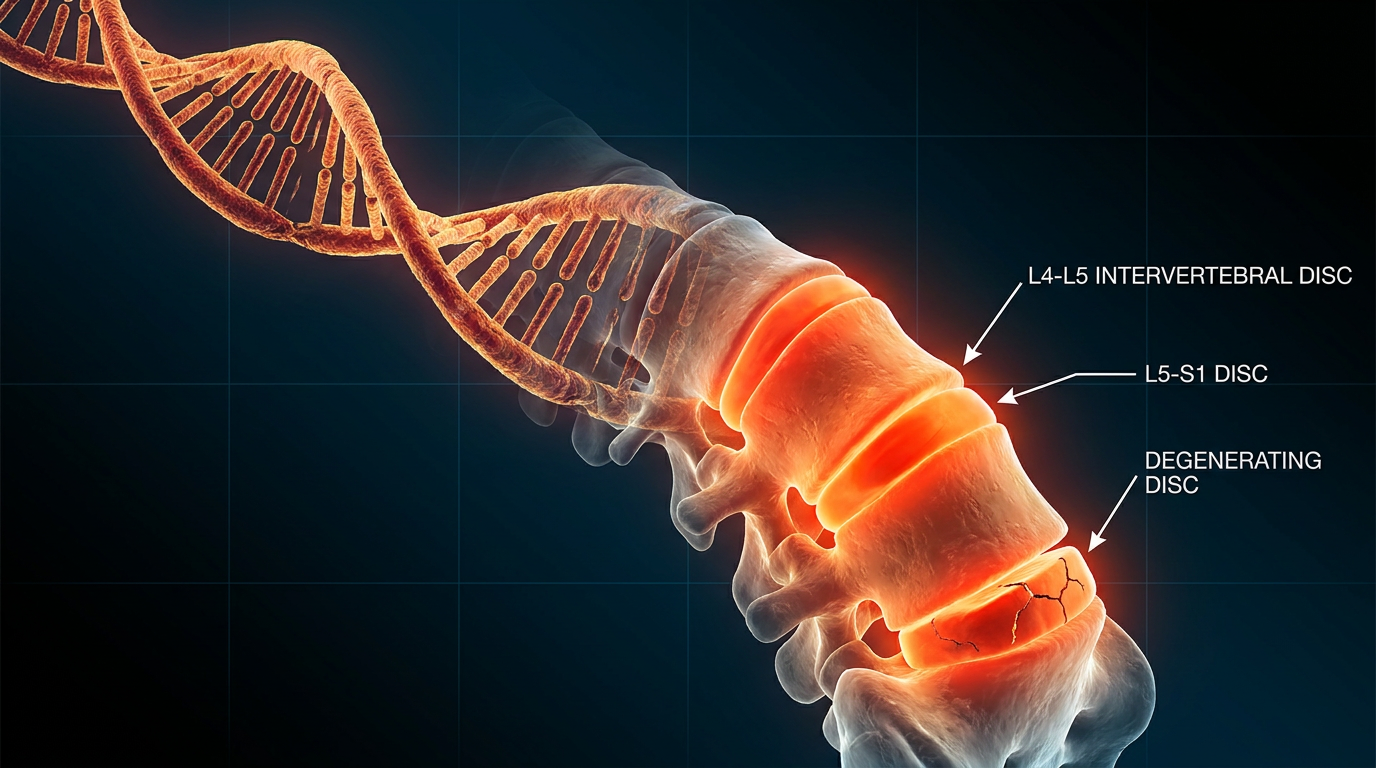
Many people with multilevel degenerative disc disease feel better with the right plan, even when imaging shows wear at more than one disc level. What you see on the MRI doesn’t always match how you feel, and most people improve without surgery once they know which level is actually driving the pain.
If neck or back pain has been showing up in more than one area of your spine, multilevel degenerative disc disease may be part of what’s going on. We’ll cover what the condition is, why it shows up in more than one disc, how your doctor sorts out which level is causing your pain and what your options look like from physical therapy through surgery.
Table of Contents
ToggleWhat Is Multilevel Degenerative Disc Disease?
Multilevel degenerative disc disease (DDD) means two or more of the cushioning discs between your vertebrae have worn down, lost height or cracked. Disc changes become more common with age, though many people stay pain-free even when imaging shows degeneration. The involved levels can sit side by side, like L4-L5 and L5-S1 in your lower back, or show up across regions, with wear in both your neck and lumbar spine at the same time.
Why the Number of Levels Matters
More affected levels make your diagnosis harder to sort out, since your doctor has to figure out which worn level is actually generating your pain and which findings are incidental. Multilevel cervical surgery also carries higher adjacent-segment degeneration rates than single-level surgery, with degeneration at neighboring discs reported in 15.4 percent of single-level, 28.6 percent of two-level and 39.5 percent of three-level fusions after anterior cervical discectomy and fusion (ACDF).
How Degeneration Can Spread
Wear at one disc often pulls the discs next to it into the same pattern, since neighboring segments absorb more mechanical load when a degenerated disc loses height. The same thing happens above and below a spinal fusion, where symptomatic adjacent-segment problems reach about 16 percent at five years and 36 percent at 10 years.
Symptoms of Multilevel Degenerative Disc Disease
Pain from multilevel DDD often shows up in more than one part of your spine and depends on which discs are wearing down and whether any are pressing on a nerve root.
Symptoms in Your Neck
Neck symptoms usually start with stiffness that feels worse after rest and eases once you’ve been moving. If a worn disc presses on a nerve root, pain, tingling or weakness can radiate into your arm, often following the path of the affected nerve into specific fingers. Spinal cord compression in the neck, called cervical myelopathy, can cause hand clumsiness, balance trouble and walking difficulty, and untreated cervical myelopathy can lead to permanent loss of function.
Symptoms in Your Lower Back
Lower back symptoms tend to feel like a steady ache that may spread into your buttocks, groin or upper thighs, and sitting for long stretches or bending forward often makes it worse. When degeneration narrows the space around a lumbar nerve root, you may feel sharp pain, numbness or weakness running down one leg.
What Causes Multilevel Degenerative Disc Disease?
Multilevel DDD usually comes from a mix of age-related wear, inherited disc structure, lifestyle and old injuries that stack up over decades. The reasons matter because some risk factors you can change and others you can plan around.
Age-Related Disc Changes
Your discs start losing water content around age 20, long before pain typically shows up. As they dry out, they absorb less shock and lose height, and on MRI dehydrated discs look darker. The structural breakdown tends to follow a sequence: dehydration first, then fibrosis, annular tears, height loss and bone spurs. Multilevel involvement isn’t rare in younger patients either, and among symptomatic adults aged 20 to 30 with lumbar disc degeneration on MRI, 41.4 percent already have changes at more than one level.
Genetics and Lifestyle Factors
Genetics are the strongest single predictor, with inherited factors explaining about 74 percent of the variation in lumbar disc degeneration. Lifestyle drives most of the rest. Weight adds load to your discs, and people in the overweight range have a 30 percent higher likelihood of disc degeneration, climbing to 80 percent for those in the obese range. Smoking reduces oxygen delivery to the discs and damages disc cells directly, and repetitive motion or awkward positioning at work speeds up cervical wear.
Injury and Prior Surgery
A single back injury can start a cycle of frustrated healing inside the disc, where small tears in the outer wall never close properly. The discs above and below a prior spinal fusion also wear faster because they take on more mechanical work once the fused level stops moving, which is why your surgeon will think carefully about how many levels to fuse.
How Multilevel Degenerative Disc Disease Is Diagnosed
Your doctor diagnoses multilevel DDD by combining your symptom pattern, a hands-on exam and imaging that maps the worn segments to the affected nerves. Imaging changes are common with age: 80 percent of asymptomatic 50-year-olds and 90 percent of those over 60 have lumbar disc degeneration on MRI, so pinpointing which disc is actually generating your pain takes more than a scan. Your evaluation usually includes:
- Medical history: Your doctor maps where your pain is, what makes it better or worse and which treatments you’ve already tried.
- Physical and neurological exam: Strength, reflexes, sensation and range-of-motion testing help match your symptoms to specific discs.
- MRI: Imaging shows disc hydration, soft tissue changes and any nerve compression at the affected levels.
- X-rays: Plain films show alignment, disc space height and bone spurs that MRI doesn’t capture as well.
- Selective diagnostic injections: When several levels look worn on imaging, a nerve root block or facet injection can sometimes pinpoint the segment driving your pain.
Before your first visit, write down where the pain shows up, what positions trigger it and which treatments you’ve already tried so your doctor can move straight to the right level. Bring any prior imaging too, since older scans often show how fast your discs have changed and shift the conversation toward what treatment to try next.
Been told you need multilevel fusion or decompression?
Deciding how many levels to treat, and whether surgery is the right step at all, is a big decision, and a second opinion is a normal part of working through it. Most people with multilevel DDD improve without surgery once the right level is identified, and Premier’s spine team reviews your prior imaging and records before your visit, not during it.
Non-Surgical Treatment Options
Conservative care is the starting point for almost everyone with multilevel DDD. Symptoms ease in 60 to 80 percent of patients within six to 12 weeks of structured non-surgical treatment, and 80 to 90 percent over a year. Your doctor will usually layer several approaches together rather than counting on one to do all the work.
Physical Therapy and Targeted Exercise
Exercise is the first-line treatment for chronic low back pain, including pain driven by multilevel disc degeneration. A good program builds the muscles around your spine so they can carry more of the load your worn discs no longer absorb, and core stabilization work can reduce pain. Most programs add flexibility, posture training and low-impact aerobic activity over four to six weeks.
Medication and Pain Management
NSAIDs like ibuprofen and naproxen are the first-line drug therapy when medication is needed for chronic back pain. They work best when they bring your pain down far enough that you can stretch and stick with physical therapy. Muscle relaxants and short courses of nerve-pain medications like gabapentin help with specific symptoms, and your doctor will shape the plan around what you’re feeling.
Epidural and Facet Joint Injections
Injections deliver anti-inflammatory medication straight to the irritated tissue when oral medication and therapy aren’t enough on their own. For lumbar nerve pain, epidural steroid injections show roughly 40 to 80 percent success rates, and caudal injections can reach several levels at once. Facet joint injections target the small joints behind the discs and help when arthritis at those joints is part of the picture.
Chiropractic and Alternative Therapies
Spinal manipulation paired with exercise and standard medical care has short-term benefit for some people with chronic low back pain, and massage, acupuncture or yoga can help with symptom relief too. None of them change the underlying disc structure. Forceful neck manipulation isn’t safe if you have signs of nerve compression, so check with your doctor before starting any hands-on therapy.
Surgical Treatment Options for Multilevel Degenerative Disc Disease
Surgery comes up when conservative care hasn’t given you enough relief after several months, or when you develop progressive weakness, balance issues or signs of spinal cord compression. The right procedure depends on whether nerve compression, instability or both are driving your symptoms.
Minimally Invasive Decompression
Decompression removes the bone or disc material pressing on a nerve through smaller incisions, with less muscle disruption than open surgery. It works best when nerve compression is the main issue and your spine is otherwise stable, with good or excellent results in many patients and shorter recoveries than traditional decompression.
Artificial Disc Replacement
Artificial disc replacement swaps the damaged disc for an implant that preserves motion at that level, which can take pressure off the segments above and below. At seven years, the adjacent-segment reoperation rate runs about 4.2 percent for cervical disc replacement versus 14.7 to 16 percent for ACDF. Candidacy is stricter than for fusion, and fewer than 43 percent of surgical candidates qualify under FDA criteria.
Multilevel Spinal Fusion
Fusion permanently joins two or more vertebrae with bone graft and hardware, and it’s often the better option when instability, deformity or facet arthritis rules out a motion-preserving procedure. Cervical fusion achieves success rates up to 94 percent, and your surgeon will weigh how many levels actually need fusion against the higher adjacent-segment risk that comes with each added level.
Living with Multilevel Degenerative Disc Disease
You can’t undo the structural disc changes, but daily habits drive how often the pain flares and how bad it gets. The goal is to take pressure off your discs, build the muscles that support your spine and skip the patterns that speed up wear. What helps most:
- Core and back strengthening: Plank, bird dog and glute bridge work train the muscles that hold your spine in better positions.
- Weight management: Each extra pound adds load to your lumbar discs, and dropping even a few pounds eases pressure across multiple levels.
- Smoking cessation: Nicotine reduces blood flow to your discs and speeds wear, so quitting slows damage at every level.
- Movement breaks: Stand, stretch and walk about every 30 minutes of sitting to keep the discs from staying loaded in one position.
- Sleep position: Side-lying with a pillow between your knees, or back-lying with one under your knees, keeps your spine in a neutral curve overnight.
Pick one or two of these to focus on first instead of changing everything at once, since the habits you actually stick with are the ones that move your pain levels. Keep a simple log of how your back feels each morning for a couple of weeks, and the patterns will point you toward which change is doing the most work.
When to See a Spine Specialist at Premier Orthopaedics
Most multilevel DDD responds to conservative care, but a handful of symptoms need urgent evaluation. Get medical help right away if any of the following show up:
- New bladder or bowel changes: Loss of control or sudden retention can signal cauda equina syndrome, a surgical emergency.
- Progressive weakness: Loss of strength in your arms or legs that’s worsening week to week points to nerve or cord compression.
- Balance and walking trouble: Stumbling, hand clumsiness or legs that aren’t responding can reflect myelopathy.
- Saddle numbness: Numbness in the groin, buttocks or inner thighs needs same-day evaluation.
- Severe radiating pain: Arm or leg pain that hasn’t responded to four to six weeks of conservative care needs imaging and a closer exam.
Bladder or bowel changes, saddle numbness and rapidly worsening weakness belong in the emergency room the day you notice them, since cauda equina and cord compression do better the faster they’re treated. The other symptoms still need same-week evaluation with a spine specialist before the pattern locks in.
Premier Orthopaedics & Sports Medicine treats multilevel disc disease across Northern New Jersey, with offices in Bloomfield, Englewood and Union City. Our spine team starts with non-surgical care, including physical therapy, medication management and targeted injections, and moves to surgery only when those options haven’t worked. Dr. Jay S. Reidler trained at NewYork-Presbyterian Och Spine Hospital/Columbia University and Johns Hopkins, and for multilevel cases he weighs motion-preserving approaches like cervical disc replacement before fusion when your anatomy allows.
If multilevel neck or back pain has been wearing on you, our spine team can map your levels and walk you through the treatment options that fit. Call 201-833-9500 or schedule an appointment online.
Get an Evaluation for Multilevel Degenerative Disc Disease
A visit lets your doctor map your pain pattern, exam findings and imaging together to find which level is actually driving your symptoms and build a plan around it. Premier’s Northern New Jersey spine team offers this evaluation whether you’re just starting conservative care or weighing surgical options.
Frequently Asked Questions About Multilevel Degenerative Disc Disease
Can Multilevel Degenerative Disc Disease Be Reversed?
No, you can’t reverse the disc changes themselves, but you can change how much pain they cause day to day. Most people with multilevel DDD don’t need surgery, and Premier’s plans combine physical therapy, weight management, smoking cessation and targeted injections to bring pain down.
Is Exercise Safe With Multilevel Degenerative Disc Disease?
Yes, and exercise is one of the strongest treatments you have. Low-impact movement like walking, swimming and cycling protects your discs, and a structured core program from a physical therapist trains the muscles that share the load with your spine. Premier’s pain management team can help you figure out which movements to scale back during a flare.
What’s the Difference Between Single-Level and Multilevel Disc Disease?
Single-level DDD affects one disc and multilevel DDD affects two or more, which makes diagnosis and surgical planning more involved. Your doctor has to sort out which worn level is actually generating your symptoms when imaging shows changes at several. Our office maps your pain pattern, exam findings and imaging together before recommending treatment.
How Fast Does Multilevel Degenerative Disc Disease Progress?
Most cases progress slowly, with about three to five percent measurable change over five-year follow-up periods. Genetics, weight, smoking and old injuries influence the pace. Periodic imaging and follow-ups with Premier’s spine team track whether your condition is stable or shifting in a way that means revisiting the plan.
This article is for general information only and isn’t a substitute for professional medical advice. Talk to your doctor about your specific situation before making treatment decisions.