You heard Scheuermann’s disease at a pediatrician visit or a school screening, and now you’re trying to figure out whether your child’s rounded upper back will keep getting worse. Adults who have lived with that curve for years may also wonder whether anything can still change posture and pain.
Understanding Scheuermann’s disease before and after treatment starts with knowing that treatment response depends mostly on curve severity, whether growth remains and how much pain also affects daily life. Each treatment option changes symptoms and alignment in a different way.
What Scheuermann’s Disease Is
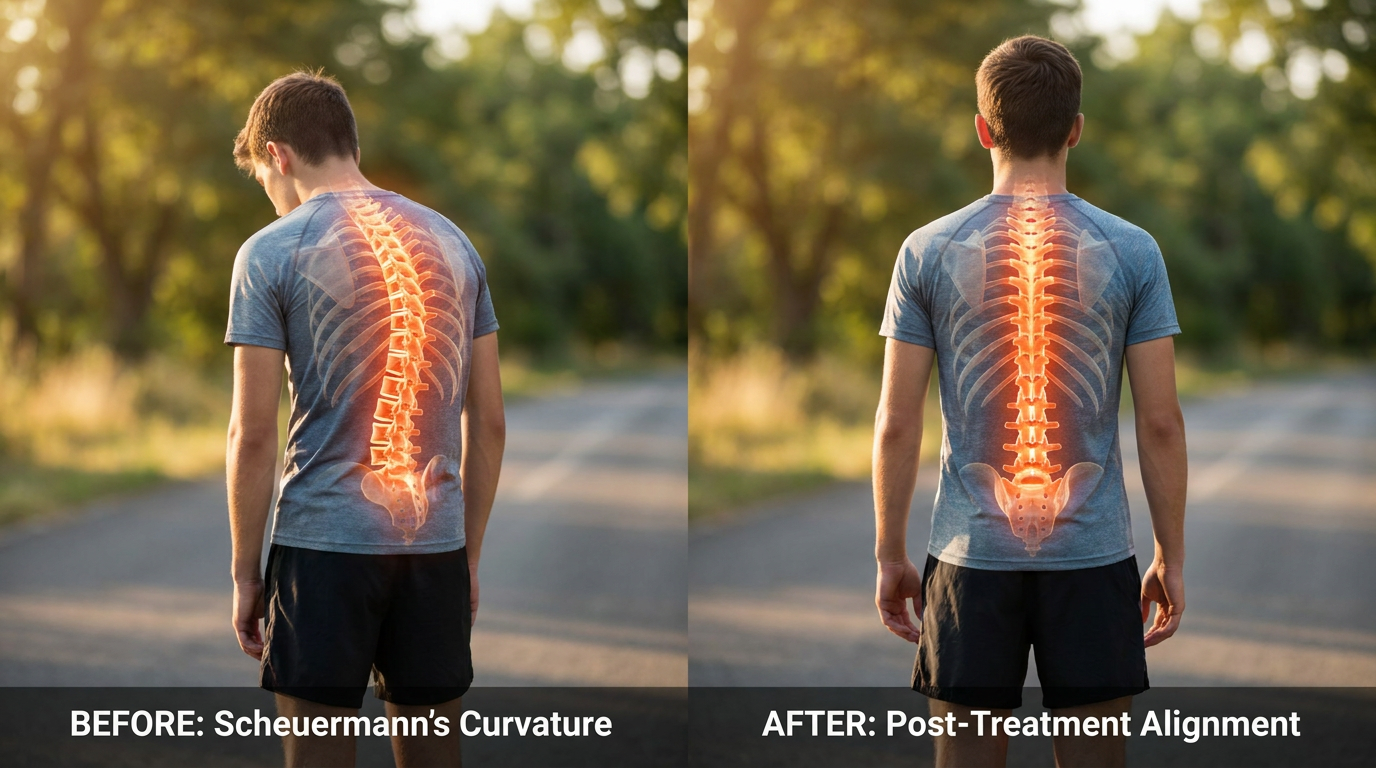
Scheuermann’s kyphosis is a rigid, exaggerated forward rounding of the upper spine. Kyphosis means a forward curve of the spine, which everyone has to some degree in the mid-back. In Scheuermann’s, the curve becomes fixed because the bones grow into a wedged shape. The condition develops when three or more consecutive vertebrae become wedged, with each vertebra tilting forward by at least five degrees.
Doctors often notice cases during adolescence, while the spine is still growing. That timing matters because growth shapes what treatment can accomplish. Structural kyphosis differs from postural kyphosis because it stays curved even when you stand tall or lie down. Exercise can build strength, ease pain and improve how you carry yourself, but it usually can’t reshape bone that has already finished growing.
What Scheuermann’s Disease Looks Like Before Treatment
Doctors use your history and a physical exam, then confirm the diagnosis with imaging. Many families start with the neck and back specialists because they notice visible posture or nagging pain before they have a diagnosis. The exam and X-rays help sort out whether the curve is flexible or fixed and how far it has progressed.
Visible Postural Changes
A rounded upper back that doesn’t fully straighten when you stand tall is the most recognizable sign. The shoulders often roll forward, the head sits slightly ahead of the torso and the lower back may curve more to compensate. Common signs families notice before treatment include:
- A rounded upper back that stays curved when standing straight
- Shoulders that roll forward
- Fatigue or aching across the upper back
- Tight hamstrings that limit bending
Mild changes can look subtle from the side and be easy to miss. Severe rounding may show through clothing. Conservative care improves how well you control and hold your posture, while surgery changes the underlying alignment more dramatically.
Pain and Functional Limitations
Pain in Scheuermann’s varies widely from one person to the next. You or your child may have a noticeable curve with little discomfort, or you may ache between the shoulder blades, tire quickly when sitting or standing and feel hamstring tightness. The pain often tracks with how long you hold one position.
Your child may struggle to sit through a full class or carry a loaded backpack, while you may find desk work harder as the day goes on. When pain is a main concern, the evaluation may include pain management treatments, which can ease symptoms, but they don’t correct the structural curve itself.
Imaging Findings Before Treatment
An X-ray measures the curve and confirms whether the vertebrae are wedged. The Cobb angle, which doctors calculate from the tilt of the top and bottom vertebrae in the curve, puts a number on how severe it is. Imaging may also show Schmorl’s nodes, which are spots where disc material pushes up into the flat surface of a vertebra. Narrowed discs and vertebral wedging may appear too.
Scheuermann’s kyphosis pushes the curve beyond the normal thoracic range, past roughly 45 degrees. In the most severe curves, doctors may also look for heart or lung strain, though that is uncommon. Skeletal maturity means whether the bones have finished growing, and it matters because bracing works differently when growth remains.
Non-Surgical Treatment and What It Can Achieve
Most people start with non-surgical care unless the curve is severe or disabling. Conservative care focuses on comfort, function, endurance and better posture control while your doctor monitors whether the curve stays stable. Your plan looks different depending on your age and how much growth is left.
Physical Therapy and Exercise
A good physical therapy program targets the muscles and mobility that support an upright posture. Thoracic extension means gently moving the mid-back backward to counter the forward curve. Program elements usually include:
- Thoracic extension to counter the forward curve
- Core strengthening for trunk support
- Scapular stabilization, which means strengthening the muscles that control the shoulder blades
- Hamstring stretching and hip mobility work
- Postural endurance training
With exercise, the before-and-after changes are functional first. You can often sit longer with less fatigue and have fewer pain flares after a consistent program. Exercise doesn’t reverse fixed wedging in the bone, so you keep the gains longer when you keep doing the exercises.
Bracing in Growing Adolescents
Bracing is mainly for growing adolescents with moderate curves, and it works best before skeletal maturity. If your child still has growth remaining, your doctor may recommend bracing for a moderate, progressive curve; severe curves may also need a surgical discussion. Success depends on how flexible the curve is, how much growth remains, how well the brace fits and how consistently it’s worn.
Expect follow-up X-rays to track the curve during treatment. Bracing aims for curve control and a lower risk of progression; the curve may not disappear. Patients can lose part of the brace correction after the brace comes off in at least 30 percent of cases, which is why monitoring continues after bracing ends.
Before-and-After Expectations Without Surgery
Conservative care has a practical before-and-after frame. Before treatment, you may have a rigid rounded posture, back fatigue, pain with prolonged sitting and concern about appearance. After a good program, you may gain strength, flexibility, endurance, less pain and more confidence in how you carry yourself.
If you’re done growing, the goal shifts away from correcting the curve toward preventing progression and reducing symptoms. Conservative care may not fully normalize a structural curve. That gap, between what you want the curve to look like and what non-surgical care can deliver, is often when a surgical opinion becomes worth considering.
Surgical Treatment and What It Can Achieve
Surgeons reserve surgery for curves that are severe, keep worsening, involve severe pain, create cosmetic distress or remain painful or limiting after conservative care hasn’t done enough. At Premier Orthopaedics & Sports Medicine, our spine surgery team evaluates these cases. Dr. Jay Reidler assesses complex alignment. Our team brings deformity-fellowship training in both pediatric and adult spine care to that conversation.
When Surgery Is Considered
Your surgeon may discuss surgery when an adolescent curve becomes severe or continues to worsen, but that factor alone doesn’t make the decision. The decision also includes skeletal maturity, where the curve sits, neurologic status, which means nerve function, symptoms and your own goals. A frank conversation about trade-offs comes first, because a straighter spine after fusion isn’t the same as a normal, fully mobile spine.
What the Procedure Usually Involves
Your surgeon usually performs a posterior spinal fusion with instrumentation, which means joining the curved spinal levels from the back and holding them with screws and rods. Through the back, your surgeon places screws, rods and bone graft, material that helps the fused bones grow together.
For especially rigid curves, a surgeon may consider an anterior release, a procedure that loosens tight structures at the front of the spine. Planning technology has a role here, and if you’re learning about surgical options, you can read more about robotic spine surgery, which can include robotic planning tools.
Expected Correction, Trade-Offs and Recovery
Surgery usually creates a more visible before-and-after than non-surgical care. In selected cases, your surgeon may correct a noticeable portion of the deformity and create a more upright profile with less rounding. Fusion makes those spinal levels permanently stiff because they no longer move.
Recovery takes months, with early limits on lifting and trunk movement, then gradual return to school, work, walking and low-impact activity when your surgeon clears you. Premier’s recovery guidance walks through general post-op preparation. Surgery also carries considerations, including junctional kyphosis, a curve that can develop above or below a fusion as a recognized complication after surgery. This comparison shows the main differences between conservative care and surgical correction.
| Dimension | Non-Surgical Care | Surgical Correction |
| Typical candidate | Growing adolescents with moderate curves; adults managing symptoms | Severe, progressive or painful curves unresponsive to conservative care |
| Main goal | Comfort, function, posture control, slowing progression | Correcting alignment and reducing deformity |
| Expected before/after change | Better strength, endurance and posture control | A visibly straighter, more upright spine |
| Main trade-off | May not normalize a structural curve | Permanent stiffness in the fused segment |
| Recovery | Ongoing exercise and monitoring | Months of healing with activity restrictions |
Long-Term Outlook After Treatment
Long-term outlook depends on the starting curve, skeletal maturity, symptoms, which treatment you choose and how well you keep up with follow-up. You can keep learning between visits through patient education resources, which cover conditions, treatments and recovery.
Monitoring After Bracing
Follow-up imaging confirms whether the curve stays stable after bracing ends. Monitoring matters most during skeletal growth. Once the spine is mature and stable, visits can space out.
Life after bracing still includes regular exercise to hold the gains. If pain returns or posture worsens, that’s a reason to re-evaluate rather than assume the treatment failed or that surgery is now automatic.
Life After Surgical Correction
Many people return to school, work and sports their surgeon clears once they’ve healed. Long-term satisfaction depends heavily on realistic expectations set before surgery: better alignment and less deformity, alongside permanent stiffness in the fused levels. Your outlook tends to be better when residual kyphosis, the curve left after treatment, remains mild to moderate at maturity.
The unfused levels keep carrying motion, and junctional kyphosis remains a long-term consideration after fusion. If pain, posture or function changes years later, your surgeon can compare updated imaging with your earlier films.
Schedule a Kyphosis Evaluation
A spine evaluation can clarify the next step for a rigid rounded upper back, worsening posture or questions about Scheuermann’s disease before and after treatment. Our spine team sees patients across Northern New Jersey; call 201-833-9500 to schedule an appointment.
Frequently Asked Questions About Scheuermann’s Disease Treatment
Can Scheuermann’s disease be corrected without surgery?
Bracing during growth can help control the curve and may improve alignment while there’s still growth left to work with. Physical therapy can reduce pain while improving strength-related function, including for adults managing symptoms. At the visit, ask whether the curve is flexible, whether growth remains and what change your doctor expects from each non-surgical option.
How much correction can surgery achieve for Scheuermann’s kyphosis?
Your surgeon can estimate correction only after reviewing the curve pattern, rigidity and levels that may need fusion. In selected surgical cases, a noticeable posture change may be possible, but the goal isn’t to make the spine perfectly straight. Ask which levels would be fused, how much motion you’ll keep and what restrictions apply during recovery.
Can Scheuermann’s disease get worse in adulthood?
Progression is most concerning during growth, which is why monitoring adolescents closely matters. If you’re an adult, pain and stiffness can still change even when the curve itself stays stable. Bring prior X-rays or reports to a re-evaluation so your doctor can compare the curve over time. If your symptoms change, it’s worth a re-evaluation rather than assuming nothing can be done, and the spine care FAQ covers more common spine questions.
This article is for general information only and isn’t a substitute for professional medical advice. Talk to your doctor about your specific situation before making treatment decisions.