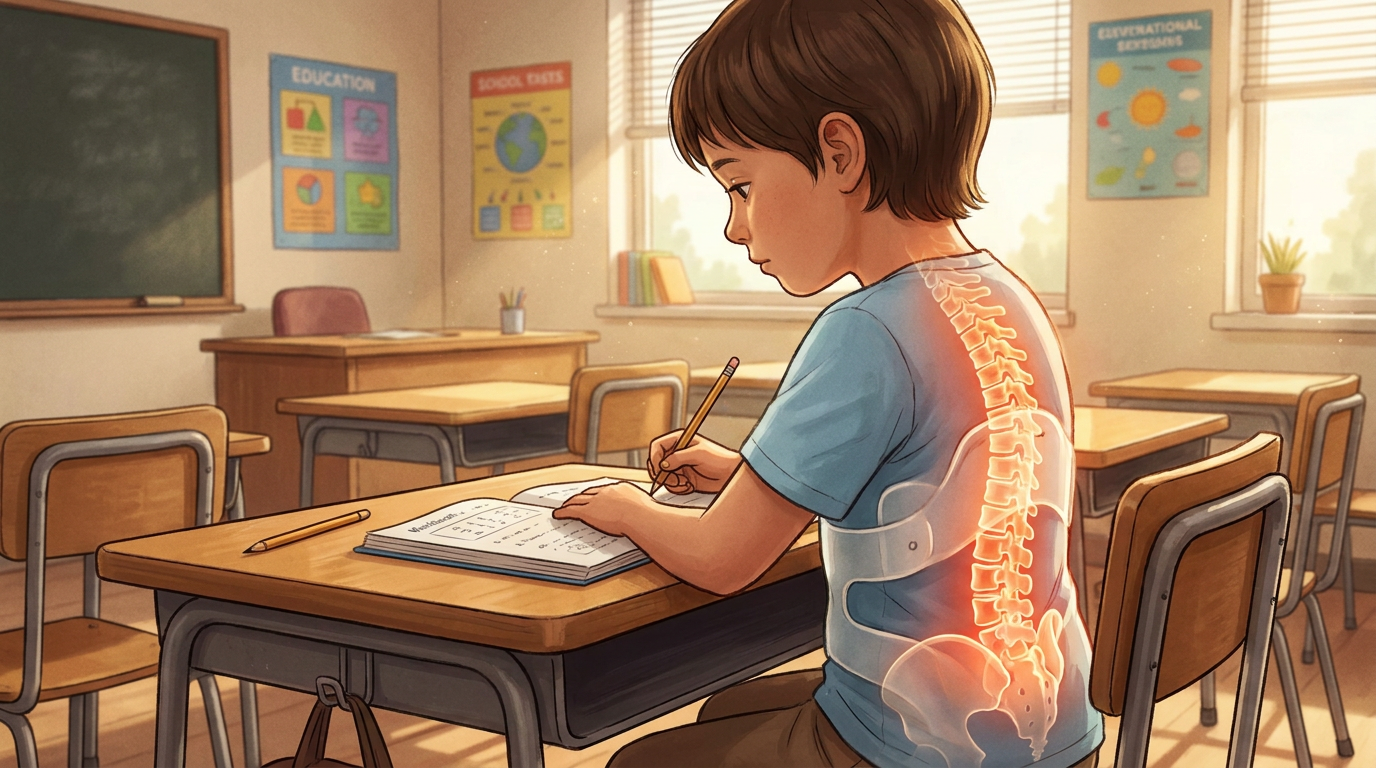
You noticed one shoulder sitting higher than the other, or the school nurse sent home a note flagging your child’s spine, and now you’re trying to figure out what it means. Scoliosis in children is common, and most curves are mild and stay that way. An evaluation can confirm whether the curve is scoliosis and whether it needs monitoring, bracing or treatment.
What Scoliosis in Children Looks Like
Scoliosis is a side-to-side curve of the spine that measures 10 degrees or more on an X-ray. Instead of running straight down the middle of the back, the spine curves to one side, so it can look like a C or an S. That curve can make the shoulders or waist look uneven, which a parent often notices first.
What Scoliosis Means
A curve under 10 degrees doesn’t meet the definition of scoliosis. Once the curve reaches 10 degrees or more, doctors label it scoliosis and track it over time. The number matters because it sets the baseline your child’s care team will measure against at future visits.
Many children with scoliosis feel well and stay active. The curve itself is usually painless, which is why a parent, pediatrician, coach or school screening tends to spot it before the child does. Poor posture and carrying a heavy backpack do not cause scoliosis.
Visible Signs Parents May Notice
Scoliosis often shows up as small asymmetries in how your child’s body lines up. These changes can be subtle at first. Signs include:
- Uneven shoulders, with one sitting higher than the other
- One shoulder blade that sticks out more than the other
- Uneven hips or a waistline that looks tilted
- Clothes that hang unevenly or fit differently on each side
- One side of the rib cage looking higher when your child bends forward
If you notice one or more of these signs, have a doctor take a closer look. A pediatrician can decide whether your child needs imaging or a specialist referral.
What a School Screening Result Means
If a school screening flags your child’s spine, your child needs an evaluation. Screenings typically use the Adam’s forward bend test, where the child bends forward at the waist so a screener can check for asymmetry in the back and ribs. A doctor must measure the curve before diagnosing scoliosis.
What Causes Scoliosis in Children
Doctors classify childhood scoliosis as idiopathic, congenital or neuromuscular. The category guides how doctors evaluate the curve and what the care team watches for. For the most common type, the main concern is whether the curve grows during the years your child has left to grow.
Idiopathic Scoliosis (Most Common)
Idiopathic scoliosis is the most common form. “Idiopathic” means there is no single known cause. Doctors suspect genetics and many contributing factors, which is why it can run in families. It most often appears during the adolescent growth spurt.
With an idiopathic curve, care focuses on whether it will progress. Care teams weigh curve size and remaining growth, with sex also affecting progression risk. Sex matters because girls are about 10 times more likely than boys to progress to a curve of 30 degrees or more.
Congenital Scoliosis
Congenital scoliosis happens when the bones of the spine form differently before birth. Your child’s doctor may describe the specific bone pattern on the X-ray. The care team evaluates these curves with that anatomy in mind because the difference involves the spine’s structure.
Neuromuscular Scoliosis
Neuromuscular scoliosis is related to conditions that affect muscle control or nerve function. The care team evaluates the curve in the context of that broader diagnosis. Doctors manage this type alongside the underlying condition, so care usually involves the broader medical team already following your child.
How Scoliosis in Children Is Diagnosed
Diagnosing scoliosis starts with your child’s history and physical exam, then moves to imaging that confirms and measures the curve. None of it should feel like a surprise on the day of the visit. Diagnosis usually includes:
- A history and physical exam checking posture, shoulder height, waist symmetry, hip level, gait and a basic neurologic check
- The Adam’s forward bend test, where your child bends forward so the doctor can see any asymmetry in the back
- A scoliometer, a small handheld tool that measures trunk rotation during the forward bend
- A standing full-spine X-ray, which is the standard way to confirm scoliosis and measure the curve
- An MRI in select cases, when the doctor wants a closer look at the spinal cord or an unusual curve pattern
For many children, the exam and the X-ray provide the main information the doctor needs. The X-ray measurement guides later decisions. That number is the Cobb angle, which your doctor measures by drawing lines along the most tilted vertebrae at the top and bottom of the curve and measuring the angle between them.
Understanding Curve Severity and What It Means
Curve size is one of the main factors in what happens next, and doctors sort curves into mild, moderate and severe ranges. Smaller curves and curves close to the end of growth usually need watching. Doctors may recommend bracing for moderate curves in children who are still growing, and severe or progressing curves may need surgery. Your child’s exact plan depends on more than the number, but the number is where the conversation starts.
| Curve Range | Typical Management | Main Goal |
| Mild, 10 to 25 degrees | Monitoring with periodic exams and X-rays | Catch any progression early |
| Moderate, 25 to 45 degrees | Bracing, especially if the child is still growing | Stop the curve from getting worse |
| Severe, 45 degrees and above | Doctors typically consider surgery | Correct and stabilize the curve |
Bracing aims to stop progression while your child is still growing. The care team monitors curves over time because curve behavior varies.
When Your Child Needs to See a Spine Specialist
A spine specialist can confirm the curve and set a plan. Most consultations end with a plan to monitor or brace, not operate.
When a Referral Makes Sense
A referral makes sense when the situation calls for someone who evaluates and manages spinal curves regularly. Your child’s pediatrician may use these signs to decide when specialty care should guide the next step. Referral triggers include:
- A confirmed curve near or above the moderate range
- A curve that is progressing between visits
- A lot of growth still remaining, since growth potential and curve size are the main drivers of progression
- Symptoms outside the usual scoliosis pattern that your doctor wants reviewed
- A curve pattern your doctor considers unusual
- A flagged school screening that a doctor hasn’t evaluated yet
If any of these apply, an evaluation gives you a clear picture and a plan rather than more uncertainty. The specialist can also explain whether your child needs observation, bracing or a surgical discussion.
What to Expect at the Specialist Visit
The visit centers on the exam and imaging your specialist reviews, and then your specialist explains what the curve size and your child’s remaining growth mean together.
At Premier Orthopaedics & Sports Medicine, our neck and back specialists handle this evaluation, and Dr. Jay Reidler completed a complex pediatric spine fellowship at Shriners Hospital for Children in Philadelphia, as well as an adult and pediatric spine fellowship at NewYork-Presbyterian/Columbia. He evaluates children across Northern New Jersey. Most pediatric scoliosis patients he sees continue with monitoring or bracing.
Treatment Overview for Childhood Scoliosis
Care for childhood scoliosis usually starts without surgery. Your child’s care team starts with conservative care and bases treatment on your child’s curve and growth. Care usually involves monitoring or bracing; doctors reserve surgery for cases where it’s genuinely needed.
Observation and Monitoring
For mild curves, watching is the treatment. Your child comes back for periodic exams and X-rays so the team can see whether the curve is holding steady or growing. Many mild curves stay stable, especially as a child nears the end of growth, and monitoring is how the team confirms that before anyone considers doing more.
Bracing
Bracing is the main option for moderate curves in a child who is still growing. Your child wears the brace while the spine is still growing, and its purpose is to hold the line and keep the curve from reaching the surgical range. In high-risk adolescents, bracing lowers risk that a curve will progress to the point where surgery is needed. Scoliosis-specific exercise and physical therapy may help with strength, posture and comfort, but your child still needs a brace when your child’s doctor recommends one.
Surgical Options When Needed
Surgery becomes the conversation when a curve is severe or keeps progressing despite bracing. Our spine surgery team approaches these cases with the goal of correcting and stabilizing the spine while preserving as much function as possible.
Dr. Reidler performs both spinal fusion, surgery that joins selected vertebrae to stabilize the curve, and Vertebral Body Tethering (VBT), a motion-preserving surgery that uses a flexible cord anchored to screws along the curve of the spine, for pediatric patients. Doctors consider VBT for selected adolescents, depending on growth remaining and curve pattern.
For fusion cases, Dr. Reidler may include robotic spine surgery in the surgical plan when appropriate, and Premier gives families recovery guidance on what to expect afterward. After surgery, your child’s recovery may include pain management, activity restrictions, physical therapy and regular follow-ups.
Schedule a Pediatric Scoliosis Evaluation
If you’ve noticed uneven shoulders, gotten a flagged school screening, or are watching a confirmed curve, our spine team across Northern New Jersey can tell you what the curve means and what to do next. Call 201-833-9500 or schedule an appointment online.
Frequently Asked Questions About Scoliosis in Children
Does scoliosis in children always get worse?
No. Progression risk is highest when the curve is larger and the child still has a lot of growth remaining. Many mild curves close to skeletal maturity, meaning the point when a child is nearly done growing, stay stable, which is why doctors monitor curves with periodic X-rays and treat only when needed.
Can exercise fix scoliosis in a child?
Exercise can help with strength, flexibility, posture and comfort. A structural curve, meaning a curve in the bones of the spine rather than posture alone, needs medical monitoring and, when recommended, bracing. Scoliosis-specific exercise may keep a curve from getting worse, though a brace your child’s doctor has recommended remains necessary.
At what age should scoliosis be checked?
Screening matters most through the late-childhood and adolescent growth years, and it may happen at school or during a pediatrician visit. You may also notice asymmetry at home. Your child’s doctor can tell you whether a screening result needs follow-up imaging or specialist evaluation.
Is back pain common with childhood scoliosis?
Most childhood scoliosis is usually painless. Your child’s doctor should evaluate persistent, severe or unusual pain rather than assume scoliosis is the cause. For more, you can browse our spine care FAQ or our patient education resources.
This article is for general information only and isn’t a substitute for professional medical advice. Talk to your doctor about your specific situation before making treatment decisions.