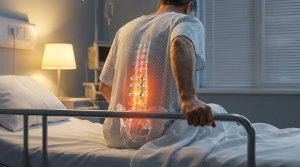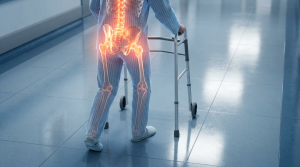

You’ve finished months of physical therapy for degenerative spondylolisthesis, and walking a single block still sends pain down your leg. At your last appointment, your doctor mentioned surgery for the first time.
Below, you’ll learn about the symptoms, diagnosis, treatment options and when degenerative spondylolisthesis leads to surgery.
Table of Contents
ToggleWhat Degenerative Spondylolisthesis Does to Your Spine
Degenerative spondylolisthesis means one of the bones in your lower spine has slipped forward over another. It occurs most often at L4-L5, the level above the bottom of your lumbar spine.
Doctors describe the extent of the slip on a Grade I–IV scale based on the percentage of forward displacement, with Grade I (up to 25 percent) being by far the most common in degenerative cases. In these low-grade slips, the vertebra has shifted only slightly, so the bones remain connected but sit slightly out of line.
That intact bone separates this condition from isthmic spondylolisthesis, which begins with a defect in the small bony bridge at the back of the vertebra and typically occurs at L5-S1 rather than L4-L5. In the degenerative form, that bridge stays intact, while imaging may show worn discs and joints.
What Causes the Vertebra to Slip in Degenerative Spondylolisthesis
Over decades, disc and joint degeneration can weaken the structures that hold your vertebrae in line, allowing one bone to drift forward over the one below it.
Gradual wear and tear defines degenerative spondylolisthesis and sets it apart from types caused by a stress fracture or injury. This type of disc wear, also called degenerative disc disease, often sits behind the slip.
Degenerative spondylolisthesis tends to show up after age 50 and may occur more often in women. However, your symptoms and imaging matter more to your treatment decisions than age or sex alone.
Symptoms That Point to Degenerative Spondylolisthesis
There are several symptoms that point to degenerative spondylolisthesis. Many people first notice it when they find themselves leaning on a shopping cart or sitting down partway through an errand. Common symptoms include:
- Low back and leg pain that worsens with standing or walking and eases with sitting or leaning forward
- Pain, numbness or tingling traveling into one or both legs, especially while walking
- Leg weakness or heaviness, including trouble rising from a chair
Not everyone with a slip has symptoms. Degenerative spondylolisthesis is sometimes found incidentally on imaging done for another reason, and an incidental finding alone doesn’t require treatment.
At Premier Orthopaedics & Sports Medicine, our neck and back specialists evaluate this condition and guide patients through diagnosis, conservative care and, when appropriate, surgery.
How Doctors Diagnose Degenerative Spondylolisthesis
Diagnosis relies on two things: a physical exam that maps your symptoms to a nerve pattern, and imaging that shows the slip and any pressure on nearby nerves. Doctors check whether your reported pain, walking limits and neurologic findings match what the scans show.
Physical Exam Includes History, Pain, Walking Tolerance and Neurologic Checks
Diagnosis starts with a physical exam and a discussion of when the pain appears, how far you can walk, and what position relieves it. The examination may include checks of nerve function in your legs to look for signs of nerve involvement.
The examination then moves to a focused neurologic check of your legs, including strength, sensation and reflexes testing of individual muscle groups (such as ankle dorsiflexion and great toe extension), sensation across the dermatomes and deep tendon reflexes at the knee and ankle.
A gait assessment and simple maneuvers like heel and toe walking can reveal subtle weakness.
The exam also helps your doctor determine whether your leg pain comes from a nerve pinched in your back or from another source, such as your hip, sacroiliac joint or vascular disease that mimics the same walking-limited pattern.
Imaging: X-rays, MRI and CT
Standing X-rays can show your alignment while your spine bears weight. X-rays that the imaging team takes while you bend forward and backward help your doctor assess whether the vertebra moves.
An MRI can show pressure on nerves and soft-tissue detail. When MRI isn’t possible, or you need more detail, a CT scan (with contrast injected into the spinal canal (CT myelography) can serve the same purpose, especially for surgical planning.
None of these images decides anything on its own. The exam also helps your doctor determine whether your leg pain comes from a nerve pinched in your back or from another source, such as your hip.
Matching findings support a treatment plan that usually starts without surgery, while a mismatch prompts your doctor to investigate other sources of the pain.
Already been told you need decompression or fusion?
A recommendation for spine surgery is worth a second look, and most patients come away with a clearer sense of which procedure actually fits their anatomy and symptoms. Premier’s spine team reviews your prior imaging and exam findings before your visit, not during it, so the conversation starts with a plan already in mind.
Signs It’s Time to Consider Surgery
Doctors generally reserve surgery for degenerative spondylolisthesis when symptoms substantially reduce day-to-day function. A few functional signs typically indicate that a surgical consultation is worth having.
Walking Tolerance Has Collapsed
If you can’t walk a block without stopping, or you plan errands around where you can sit down, the slip is limiting your mobility in a way conservative care hasn’t fixed. This is often the single most objective marker your surgeon will ask about.
Sleep and Work Are Slipping
Pain that wakes you at night, prevents a full night’s rest or keeps you from finishing a workday points to symptoms that have outgrown nonsurgical management. The impact on sleep and work is a reasonable reason to seek a surgical opinion.
Basic Daily Tasks Are Off the Table
Standing long enough to cook a meal, do dishes, shower comfortably or get through a grocery store are the kinds of everyday tasks doctors listen for. When these become difficult, the condition’s functional cost becomes significant.
Get Evaluated Right Away for These Symptoms
Some symptoms shouldn’t wait for a scheduled consultation. Worsening leg weakness, numbness that’s spreading or getting worse, or any change in bladder or bowel control can signal significant nerve compression and a surgical emergency. If you notice any of these, your doctor will want to evaluate you immediately rather than waiting to see if conservative care helps.
Surgery Options: Decompression, Fusion or Both
The two core procedures for degenerative spondylolisthesis are decompression and fusion. Some patients need one, some need both, and the choice depends on whether nerves are being pinched, whether the vertebra is unstable and what the imaging shows.
Decompression: Relieving Pressure on the Nerves
Decompression, sometimes called a laminectomy, removes bone and thickened ligament from the back of the vertebra to open up the space around the compressed nerves.
By taking pressure off the nerve roots, it targets the leg pain, numbness and walking-limited symptoms rather than the slip itself.
Decompression alone is typically preferred when leg symptoms dominate and X-rays show a stable, nonmobile slip.
Fusion: Stabilizing an Unstable Vertebra
Fusion permanently joins two adjacent vertebrae using screws, rods and bone graft so the unstable level can no longer shift against each other. The flexion-extension X-rays described in the diagnosis section are what your surgeon uses to judge that instability.
Decompression Plus Fusion
Some patients need both: decompression to relieve the nerve compression driving leg pain, and fusion to stabilize a level that moves too much.
In patients with a stable, nonmobile single-level Grade I slip, adding fusion led to better follow-up physical function. The decision ultimately depends on your anatomy, symptoms, stability and what your surgeon sees on those images.
What Recovery Looks Like After Degenerative Spondylolisthesis Surgery
Recovery timelines differ depending on whether you had decompression, fusion or both, since each surgery heals in a different way.
Decompression Recovery
If you had decompression alone, you can recover fully within four to six weeks. There’s no bone healing to wait on, since decompression removes tissue rather than joining bones.
Most people progress steadily through that window as swelling and irritation around the nerve settle down.
Fusion Recovery
Fusion takes longer because the bone itself has to grow solid. Bone growth and healing after fusion generally continues for several months, and your surgeon will use follow-up imaging to confirm the vertebrae have fused before clearing you for higher-impact activity.
Physical therapy plays a role throughout this stretch, building strength and mobility around the fused segment while the bone finishes healing.
What Shapes Your Recovery
Your age, overall health, and the extent of your procedure shape your timeline, and your surgeon will walk you through what to expect for your specific case.
Our spine surgery team covers the surgical and recovery process in detail, including what to expect before and after your operation.
Talk Through Your Options with Premier’s Spine Team
If symptoms persist after conservative care or reduced walking tolerance affects daily life, Premier’s spine team can review your symptoms and help determine whether surgery is appropriate.
Frequently Asked Questions About Degenerative Spondylolisthesis
Is spondylolisthesis the same as spondylolysis?
No. Spondylolysis is a stress fracture or defect in a small bony bridge at the back of a vertebra. Spondylolisthesis means one vertebra has slipped forward over another. The two can be related, since spondylolysis can lead to a slip, but they describe different findings, and having one doesn’t mean you have the other.
Can the slipped vertebra move back into place without surgery?
Nonsurgical treatment focuses on relieving symptoms and improving function rather than returning the vertebra to its original position. To track whether treatment is helping, write down how far you can walk, how long you can stand and which positions reduce your pain.
Will exercise make the slip worse?
For most people with degenerative spondylolisthesis, appropriate exercise doesn’t worsen the slip and is a core part of treatment. Your physical therapist typically emphasizes core and hip strengthening, cardiovascular conditioning and positions that open the spinal canal.
Your team will more often ask you to modify heavy-loaded extension (arching backward under weight) and high-impact activities. Ask your doctor or physical therapist which specific activities are appropriate for your situation.
What should I ask about cost and insurance coverage?
Coverage varies by plan and by whether a procedure is considered medically necessary. Useful questions include: Is prior authorization required for imaging, injections or surgery? What’s my expected out-of-pocket cost? Are the surgeon, facility and anesthesia team all in-network?
Premier’s office staff can help you work through these questions before you schedule.
This article is for general information only and isn’t a substitute for professional medical advice. Talk to your doctor about your specific situation before making treatment decisions.