
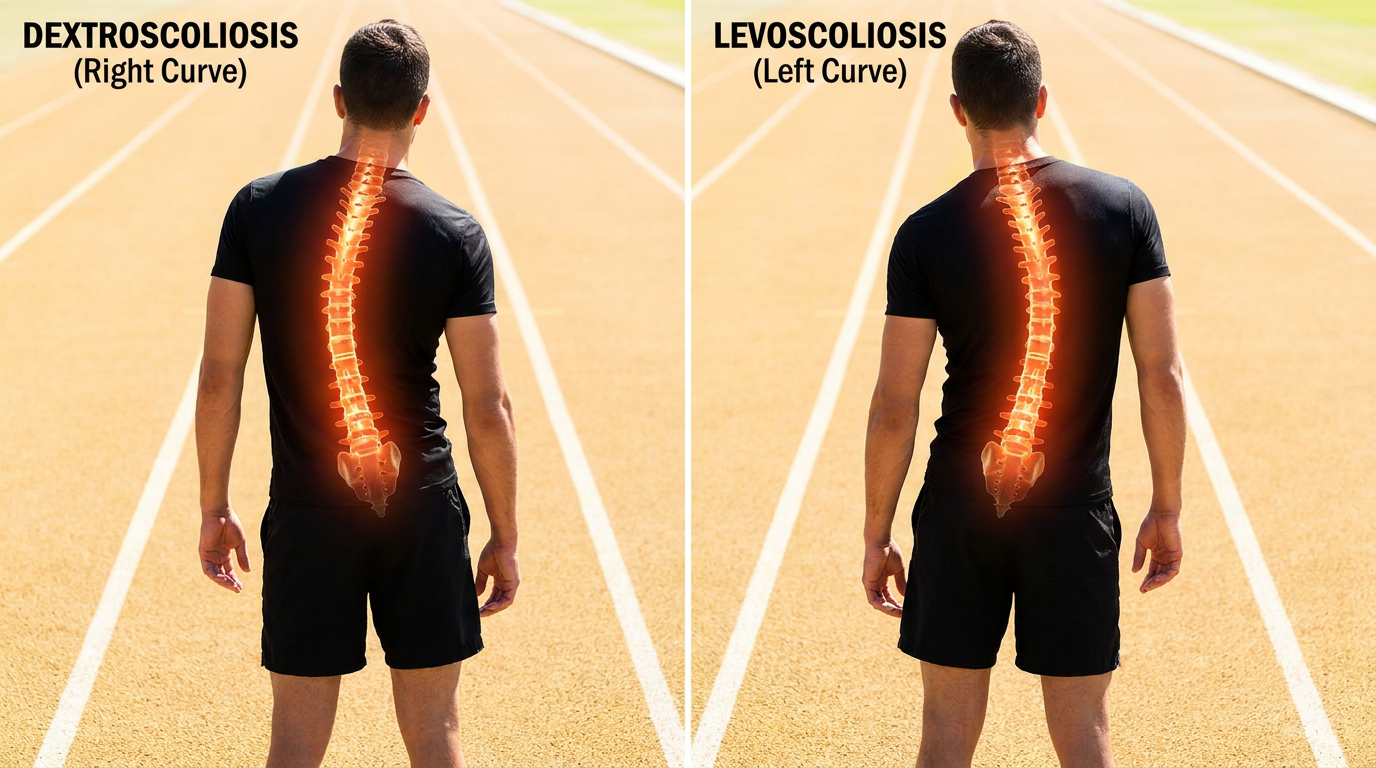
You’re reading an X-ray report, yours or your child’s, and one line says “dextroscoliosis,” a right-curving scoliosis, or “levoscoliosis,” a left-curving scoliosis. The unfamiliar word describes a single detail: which way the spine curves. When you compare dextroscoliosis vs. levoscoliosis, direction is the entire difference between the terms.
At Premier Orthopaedics & Sports Medicine, our spine specialists focus on Cobb angle, the X-ray measurement of curve size, and progression over time to judge what these curves mean for you.
What Dextroscoliosis and Levoscoliosis Mean
Dextroscoliosis is a spinal curve that bends to the right, and levoscoliosis is a curve that bends to the left. The label on your report describes direction only. It says nothing about how large the curve is, whether it will cause symptoms or what treatment, if any, you’ll need.
Direction in Imaging Reports
Imaging reports usually compare a few basic details about curve direction and location. The table below shows how doctors use the two labels.
| Comparison Point | Dextroscoliosis | Levoscoliosis |
| Curve direction | Right | Left |
| Most common spinal region | Thoracic spine (mid to upper back) | Lumbar spine (lower back) |
| How common | The more common of the two | Less common |
The direction label is the only real difference between the labels; everything else about a curve comes down to the curve’s size and how it changes over time. A small curve and a large curve can share the same direction label, but need very different follow-up plans.
Curves in More Than One Direction
One report can sometimes carry both labels at once because each direction label describes which way one curve bends. If your doctor describes an S shape, your report may use dextroscoliosis for one spinal region and levoscoliosis for another. Your doctor can show you which part of the curve pattern each word describes.
What Causes These Spinal Curves
Most scoliosis in children and teens is idiopathic. Doctors never identify a cause for idiopathic scoliosis, and these curves most often develop around the adolescent growth spurt. Genetics play a part: about 30 percent of people with scoliosis have an immediate relative with it, though only a small share of people develop scoliosis at all.
Larger curves also skew heavily female, with the female-to-male ratio rising from a ratio of 1.4:1 in smaller curves to a ratio of 7.2:1 in larger curves.
In adults, curves often develop as spinal discs and joints wear down over time, which is why a curve can appear on imaging for the first time later in life. Your doctor reviews the cause and curve direction as separate parts of the imaging picture.
Symptoms of Dextroscoliosis and Levoscoliosis
Symptoms of dextroscoliosis and levoscoliosis depend more on curve size, curve location and age than on direction alone. Mild curves may cause no symptoms, while larger curves can create visible changes in posture or body balance.
Visible Changes
The visible signs of scoliosis show up as asymmetry you might notice in a mirror or a photo. Common ones include:
- Uneven shoulders or shoulder blades
- Uneven hips, or one hip sitting higher than the other
- Ribs that stick out more on one side
- A head that doesn’t appear centered over the body
These signs can appear with either curve direction, but an X-ray is what shows how large the curve is. Your doctor uses that measurement to decide whether the curve needs monitoring, bracing or another step.
Pain and Breathing Symptoms
Curve direction alone doesn’t tell your doctor the whole pain picture, and mild curves may cause no symptoms at all. Large progressive curves are a different story: breathing symptoms can develop when a curve becomes severe enough to affect the chest. Adults whose curves come with persistent pain often work with pain management specialists alongside a spine doctor.
How Doctors Diagnose Curve Direction and Severity
A standing X-ray of the full spine confirms which way the curve bends and where it sits. From there, neck and back specialists focus on the curve’s size and rate of change more than its direction.
Measuring the Cobb Angle
The Cobb angle is the standard scoliosis measurement. Your doctor draws a line along the top vertebra of the curve and another along the bottom vertebra, then measures the angle between them.
A Cobb angle over 10° is the threshold for a scoliosis diagnosis. Doctors commonly group curves as mild, moderate or severe based on that measurement, so two people can share the same word on their reports and land in different severity bands.
Why a Left Thoracic Curve Gets a Closer Look
Most thoracic curves bend to the right, so left thoracic curve scoliosis stands out as the less typical pattern. When a curve has an atypical pattern or progresses quickly, especially with pain or neurologic symptoms, doctors often order an MRI to check for underlying spinal cord issues they’ll want to rule out.
Your doctor may recommend MRI based on the curve pattern, symptoms and how quickly the curve is changing. New numbness, weakness or rapid changes are the symptoms that move the timeline up.
Treatment Options for Dextroscoliosis and Levoscoliosis
Doctors usually monitor mild curves every few months to confirm the curve is holding steady. The first active treatment step usually begins with conservative care. For either curve direction, doctors base the next step on curve severity and remaining growth.
Monitoring and Conservative Care
Mild dextroscoliosis treatment often starts with observation and may not need more than follow-up. For growing patients with small curves, doctors typically recommend monitoring at regular intervals with repeat X-rays, which catches progression early enough to keep every option open.
Physical therapy can be part of non-surgical care during this phase. Adults with painful degenerative curves often add pain management treatments such as targeted injections to stay active without surgery.
Bracing for Growing Spines
Bracing is the next step for young patients with curves of 25° to 45° who still have growth remaining. When children wear it for the prescribed hours each day, a brace can stop curve progression for many children. A brace works by guiding the spine while it grows, so doctors use bracing while the skeleton is still growing. That window matters because larger curves in growing children can keep progressing into adulthood.
When Surgery Enters the Conversation
Surgery becomes an option for curves over 50°, or curves that worsen past that point despite bracing. The most common procedure is spinal fusion with rods and screws, which straightens the curve and holds the correction in place.
When a child’s curve reaches surgical range, the spine surgery team at Premier can also discuss Vertebral Body Tethering (VBT), a pediatric scoliosis option for select children who are still growing. VBT uses a flexible tether attached to screws along the curved part of the spine to guide growth, and Dr. Reidler performs VBT as part of Premier’s pediatric spine program.
Recovery and Long-Term Monitoring
Daily life with scoliosis depends on the treatment plan. Monitored mild curves mean periodic X-rays and, for most people, normal activity in between. For braced patients, success means the curve doesn’t progress beyond the target range your doctor sets by the time bracing ends. After bracing ends, follow-up visits check whether the curve stays stable as growth slows or finishes.
Surgical patients follow a structured recovery plan based on the procedure and number of spinal levels involved, and Premier’s recovery guidance explains what to expect before and after spine surgery. Your surgeon may discuss whether you need same-day discharge or an inpatient stay, how to use pain medication and ice therapy, when to start physical therapy and which activities to avoid until your surgeon clears you.
Common restrictions include strenuous activity, heavy lifting and twisting movements until your surgeon says they’re safe. If you’d like broader background on spine conditions and treatments, our patient education resources are a good place to keep reading.
When to See a Spine Specialist
A scoliosis finding deserves a clear measurement and follow-up plan, even when it doesn’t need treatment right away. Timing matters most when the curve appears during the growth years, changes quickly or comes with new nerve symptoms.
Incidental Imaging Findings
A curve that shows up incidentally, on a chest X-ray or CT your doctor ordered for something else, is worth a conversation with your doctor even though it wasn’t the reason for the scan. Your doctor can decide whether a spine-specific X-ray or a specialist referral makes sense. After reviewing the finding, your doctor may recommend a baseline measurement, a follow-up plan or a referral.
Changes That Need Faster Evaluation
A sooner specialist visit makes sense for certain findings. These changes can affect how quickly your doctor orders imaging or refers you to a spine specialist.
- A curve that’s clearly changing, or any curve in a child during the growth years
- New or worsening back pain, especially with numbness or weakness, or a left thoracic curve that doctors haven’t evaluated with MRI
For each finding, your doctor should measure the curve and make a plan. Dr. Jay Reidler, a Harvard, Johns Hopkins and Columbia-trained spine surgeon, reviews deformity findings and provides second opinions for adults and children. For broader questions, our spine care FAQ covers the ones patients ask most.
Schedule a Scoliosis Evaluation With Premier
If a curve showed up on your imaging and you want it explained by a spine specialist, we can evaluate it at our offices across Northern New Jersey. Call 201-833-9500 or schedule an appointment online.
Frequently Asked Questions About Dextroscoliosis vs. Levoscoliosis
Is levoscoliosis more serious than dextroscoliosis?
Curve degree and progression matter far more than the direction it bends. A left-curving thoracic spine may prompt doctors to order additional imaging because it’s the less typical pattern; doctors use that extra step to rule things out. At your visit, ask what the Cobb angle is and whether the curve’s location changes the follow-up timeline.
Can you have dextroscoliosis and levoscoliosis at the same time?
You can. If your doctor describes an S-shaped pattern, your report may use one direction label for one region and the other label for another region. Your doctor may track each curve with a separate Cobb angle, then compare those measurements over time to see whether one curve is changing faster than the other.
Does a mild curve found on an unrelated X-ray need treatment?
Monitoring is usually the standard response to a mild curve. It helps to bring the imaging report and any prior films to your follow-up visit so your doctor can compare measurements over time. A single X-ray is a snapshot, and the comparison helps your doctor decide whether the curve looks stable.
Which doctor should I see for a scoliosis finding?
Your primary doctor is the right starting point, since they can put the finding in context and order a spine-specific X-ray if needed. Parents of growing children should ask specifically about pediatric spine experience, because remaining growth changes both the risks and the options.
This article is for general information only and isn’t a substitute for professional medical advice. Talk to your doctor about your specific situation before making treatment decisions.