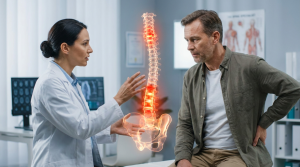

Your neck has been stiff and sore for months, and now a tingling feeling runs down into your shoulder or hand. An imaging report used the phrase cervical degenerative disc disease, and the word “degenerative” can sound like a verdict.
Below, you’ll learn what cervical disc degeneration means, what causes it, which symptoms to watch for and how doctors treat it.
What Is Cervical Degenerative Disc Disease?
Degenerative disc disease is the gradual drying, thinning and stiffening of the discs in your neck, which leaves less cushion between the bones. “Cervical” simply refers to the neck region of your spine.
As your disc loses height, the vertebrae above and below it move closer together. Your body responds by forming bone spurs to stabilize the area, and those bone spurs can narrow the small openings where nerve roots exit your spine. That narrowing can turn a stiff neck into pain, numbness or tingling that runs into your shoulder or arm.
Disc degeneration can occur without pain and becomes more common with age, while only some adults develop pain from degenerative disc disease.
Imaging can show disc degeneration, with 37 percent of 20-year-olds and 96 percent of 80-year-olds showing damage. This is why your exam matters as much as your imaging when identifying the source of your pain.
What Causes Cervical Disc Degeneration?
Cervical disc degeneration is caused by normal aging. Discs lose water content over time, which makes them thinner, stiffer and less able to absorb shock between the vertebrae.
Wear and tear in the disc’s outer layer over the years also contributes. Repeated stress on the neck from everyday movement can lead to small tears and cracks in that outer layer, and those cracks speed up the same breakdown that aging causes on its own.
Health and lifestyle factors that impact cervical disc degeneration include:
- Smoking has been linked to faster disc breakdown and more neck pain
- Long hours of desk work, especially with your head in a forward position
- Physically demanding work that involves repeated heavy lifting
These details can help your doctor understand the demands on your neck, but they don’t predict your symptoms on their own.
The Four Stages of Cervical Disc Degeneration
Degeneration can progress gradually through different stages of disc disease, and your symptoms, exam and imaging help your doctor determine which treatments fit your situation:
- Stage 1. Early dysfunction: Subtle loss of the spine’s normal curve and minor changes in disc hydration. Symptoms are often mild or absent, and posture-related stiffness may be the first clue.
- Stage 2. Dehydration and narrowing: The disc loses water content and height, and small bone spurs may begin to form. You may notice more frequent neck pain, stiffness or reduced range of motion.
- Stage 3. Instability and nerve involvement: Continued disc thinning increases stress on surrounding joints and can narrow the openings where nerve roots exit. Radiculopathy symptoms such as arm pain, tingling or weakness are more likely at this stage.
- Stage 4. Stabilization with structural changes: The body forms more bone spurs, and the affected segment may fuse naturally, which can reduce motion but also cause chronic pain.
Not everyone moves through every stage, and progression isn’t always predictable.
At Premier Orthopaedics & Sports Medicine, our spine specialists use your symptoms, exam findings and imaging to pinpoint where you are and build a treatment plan that fits your stage.
Symptoms of Cervical Degenerative Disc Disease
Symptoms range from a stiff, achy neck to nerve problems in the arm. Some people have a low-grade ache that flares with certain positions or activities, while others mostly notice tingling or weakness in a hand.
There are also specific warning signs that indicate spinal cord involvement and require a prompt doctor visit.
The symptom pattern helps your doctor evaluate which structures the narrowed space may be pressing on.
Common Neck and Arm Symptoms
A thinning disc can narrow the nerve openings where nerve roots exit the spine. Pressure on that nerve root can cause radiculopathy, which is pain, tingling or numbness that follows the nerve’s path from your neck into your shoulder, arm or hand.
Common symptoms of cervical disc degeneration may include:
- Neck pain and stiffness that change with posture or movement
- Aching or sharp pain radiating into the shoulder blade or arm
- Tingling or numbness in the arm, hand or fingers
- Arm or grip weakness
- Headaches that may begin near the base of your skull
You may notice these symptoms changing from day to day, so tracking when they appear can help you describe the pattern to your doctor.
Symptoms often get worse when you tilt your head back or turn it toward the affected side, since that position narrows the nerve opening even further. Many people find some relief by resting their hand on top of their head, which takes pressure off the nerve.
Warning Signs of Spinal Cord Involvement
Some symptoms indicate the degeneration may be compressing your spinal cord, a condition called myelopathy, and these require prompt evaluation by your doctor.
Less often, degeneration narrows the canal around the spinal cord, a form of spinal stenosis, which interferes with the signals traveling between your brain and the rest of your body.
Warning signs include:
- Reduced hand dexterity, such as trouble buttoning shirts, handling coins or typing
- A feeling of clumsiness in the hands or dropping objects
- Balance problems or an unsteady walk
- Weakness or heaviness in the arms or legs
- Numbness that spreads beyond one arm
- Bladder or bowel changes
Early signs can be subtle and easy to dismiss as normal aging, but myelopathy symptoms tend to worsen without treatment. If you notice any of these changes, see your doctor promptly.
Treatment Options for Cervical Degenerative Disc Disease
Many people with cervical degenerative disc disease don’t need surgery, so doctors usually begin with conservative care and escalate only when your symptoms don’t respond.
However, surgery may be necessary in some cases, and the right procedure varies based on your anatomy, symptoms and how many spinal levels are involved.
Conservative Treatments Come First
Your plan will usually combine several options that address symptoms and build stronger support around the worn disc:
- Physical therapy, with exercises that stretch and strengthen the muscles in your neck and shoulders. Your therapist’s home exercise plan should explain how often and how intensely you’ll exercise
- Cervical traction, a gentle pulling technique that stretches the neck, which may create more space for pinched nerve roots
- Anti-inflammatory medication, when appropriate, to help ease pain and inflammation
- Activity modification, such as adjusting how you sit, sleep and set up your monitor or workstation
- Epidural injections deliver medication near an irritated nerve root, while nerve blocks are injections used to numb or test a pain-carrying nerve
- Radiofrequency ablation may be considered when evaluation identifies pain from the facet joints, the small joints at the back of your spine. It interrupts nerves carrying pain signals but doesn’t repair a degenerated disc or relieve spinal cord compression
Most people find meaningful relief by combining several of these approaches over weeks to months. Many conservatively treated patients see real improvement within the first four weeks of treatment. Your doctor will adjust the mix based on what’s working and what isn’t.
When Cervical Spine Surgery Becomes an Option
Surgery is typically considered in the following situations:
- Conservative treatment has been fully tried for several months without meaningful relief
- Imaging confirms spinal cord compression (myelopathy), even if symptoms are mild
- Progressive neurological symptoms, such as worsening arm or hand weakness
- Loss of hand dexterity, balance problems or an unsteady walk
- New bladder or bowel dysfunction
- Severe, persistent radiculopathy (nerve root pain) that limits daily function
- Instability of the cervical spine seen on imaging
Our spine surgery team will discuss which procedure best fits your anatomy and symptoms. The most common options include:
| Procedure | What It Does | Best Suited For |
|---|---|---|
| Anterior Cervical Discectomy and Fusion (ACDF) | Removes the damaged disc through the front of the neck and fuses the vertebrae above and below with a bone graft and hardware | Disc herniation, severe degeneration or instability at one or more levels |
| Cervical Disc Replacement | Removes the worn disc and replaces it with an artificial disc that preserves motion at that level | Younger patients with single or two-level disc disease and healthy facet joints |
| Posterior Cervical Foraminotomy | Removes bone or disc material through the back of the neck to relieve pressure on a single nerve root | Isolated nerve root compression without significant disc collapse |
| Posterior Cervical Laminectomy | Removes part of the vertebral bone (lamina) to open up the spinal canal | Multi-level spinal cord compression, especially with stenosis |
| Laminoplasty | Reshapes the lamina to enlarge the spinal canal while preserving more of the natural bone structure | Multi-level myelopathy where motion preservation is preferred over fusion |
| Multi-Level ACDF or Fusion | Combines discectomy and fusion across two or more disc levels | Widespread degeneration or instability across multiple segments |
Your surgeon will recommend a procedure based on which levels are affected, whether nerve roots or the spinal cord are compressed and whether preserving motion is a priority.
ACDF and cervical disc replacement are the most common options for single or two-level disease. Posterior approaches like foraminotomy, laminectomy or laminoplasty are often better suited to nerve root compression or multi-level stenosis.
When to See a Doctor About Neck Pain
Brief neck stiffness may improve with simple measures, but persistent or worsening symptoms deserve medical evaluation. Schedule an appointment if your pain persists despite rest, if pain or tingling radiates into your shoulder, arm or hand or if weakness makes everyday tasks harder. Those patterns may point to nerve involvement that’s worth sorting out early. The spinal cord warning signs warrant the most urgent evaluation by a doctor.
If another doctor has recommended neck surgery and something about the recommendation doesn’t sit right, getting a second opinion is a normal part of making a decision this big. Bringing your existing imaging to that visit saves time.
Schedule an Evaluation With Premier’s Spine Team
If months of neck pain or new arm symptoms have you searching for answers, Premier evaluates and treats cervical degenerative disc disease in Northern New Jersey. You can request an appointment online or call us at 201-833-9500, and bring any recent neck imaging.
Frequently Asked Questions About Cervical Degenerative Disc Disease
What’s the difference between cervical degenerative disc disease and a pinched nerve?
Cervical degenerative disc disease describes the wear-related changes to the discs themselves, while a pinched nerve (radiculopathy) is one possible consequence when a thinning disc, bone spur or herniation presses on a nerve root.
You can have disc degeneration without a pinched nerve, and you can have a pinched nerve from causes other than degeneration, which is why your doctor uses both your symptoms and imaging to identify the source of your pain.
Is exercise safe if I have cervical degenerative disc disease?
For most people, staying active is part of the treatment plan rather than something to avoid. Your physical therapist or doctor can help you identify movements that aggravate your symptoms and suggest safer alternatives. They may recommend avoiding high-impact activities or heavy overhead lifting during flare-ups.
Can cervical degenerative disc disease be reversed?
No. The wear-related changes to the disc itself can’t be undone, but that doesn’t mean your symptoms are permanent. Treatment focuses on reducing pain, protecting nerves and improving function, and many people manage their condition well for years without progression to surgery.
Can I still work and drive with cervical degenerative disc disease?
Your doctor can help you match work and driving decisions to your symptoms, job demands and treatment plan. You can ask whether a modified workstation, more frequent breaks or temporary duty changes would reduce strain on your neck. If treatment includes surgery, discussing driving and work restrictions before the procedure can help you plan transportation and time away.
This article is for general information only and isn’t a substitute for professional medical advice. Talk to your doctor about your specific situation before making treatment decisions.