You know you’re facing a five-level lumbar fusion, and now you’re wondering what the months ahead actually look like. This guide walks through what the surgery involves, the recovery timeline by stage, normal symptoms, warning signs and the long-term outlook.
What Is a Five-Level Lumbar Fusion?
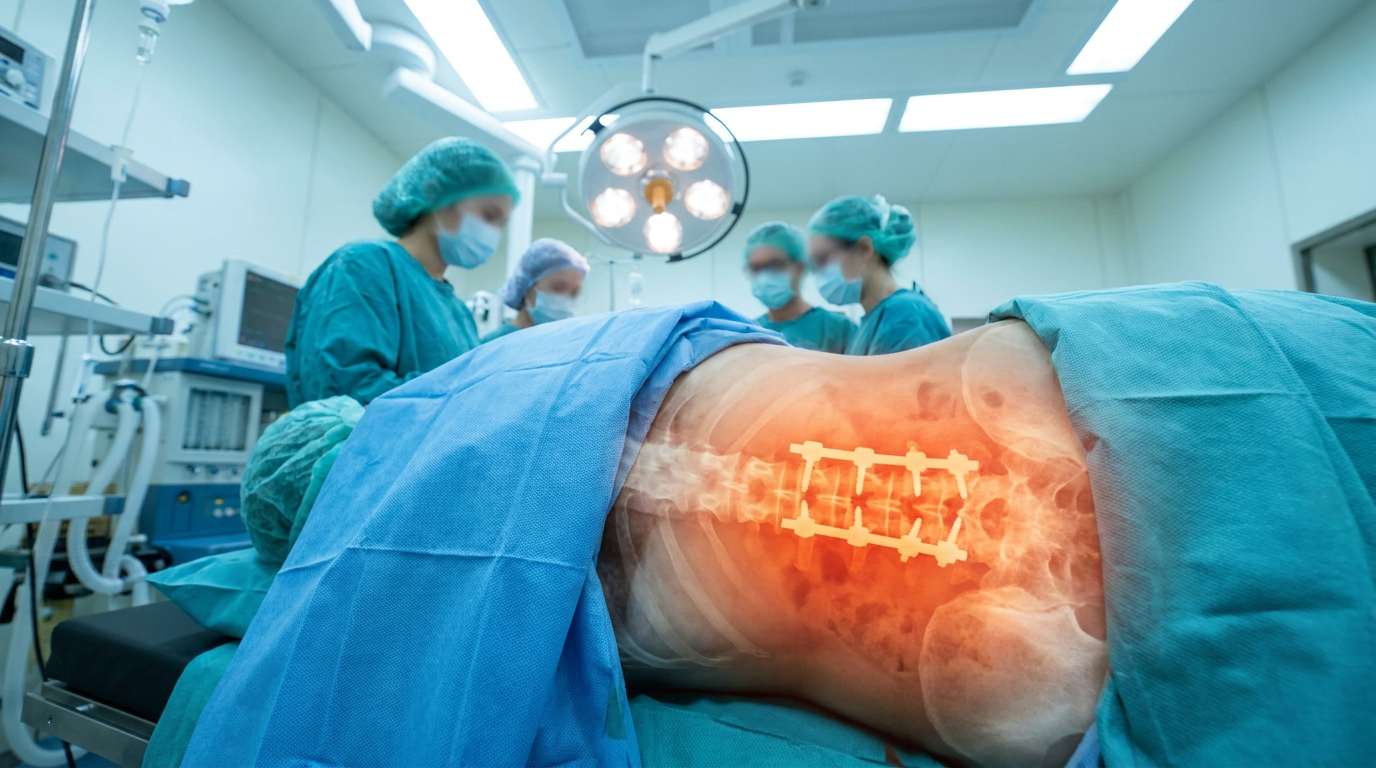
A five-level lumbar fusion is a spine surgery that permanently joins five adjacent motion segments in the lower back so they heal into one continuous piece of bone.
A motion segment is the joint and disc space between two neighboring vertebrae, so “five-level” describes motion segments rather than five vertebrae.
The lumbar spine has only five vertebrae and four motion segments on its own, so a five-level construct usually crosses the thoracolumbar junction (around T11 or T12) or the lumbosacral junction, and often extends to the sacrum or pelvis.
To hold the segments still while bone grows across them, your surgeon places instrumentation such as screws, rods and interbody spacers, along with bone graft.
A fusion this large is reserved for conditions that affect multiple levels at once, such as adult degenerative scoliosis, sagittal-imbalance deformity, multilevel spondylolisthesis, revision of a prior fusion, or long-segment degenerative changes that haven’t responded to non-surgical care.
How Long Five-Level Fusion Recovery Takes
If you have elected, or need to undergo, five-level fusion surgery, it often takes a minimum of 6–12 months to recover after a multilevel fusion.
Recovery time depends on the surgical approach, your diagnosis, bone quality, age, complications and your surgeon’s protocol.
Follow-up visits usually happen at roughly two weeks, six weeks, three months, six months and 12 months. Your surgeon may add or move visits based on your imaging and symptoms and at each visit the team updates your restrictions, imaging and rehab progress.
Premier Orthopaedics & Sports Medicine’s recovery guide gives date ranges and adjusts the plan at each follow-up instead of handing you a fixed calendar.
Recovery Stage by Stage After a Five-Level Lumbar Fusion
Each subsection below covers only what is new at that stage. Earlier restrictions carry forward unless your surgeon lifts them.
The Hospital Stay
Your hospital stay depends on the complexity of your fusion, other health conditions and any complications.
A five-level construct counts as a complex fusion for most surgical teams, so yours may recommend a longer stay with more help for first walks. The surgical team will decide when it’s safe for you to get up and walk and whether a physical therapist should assist.
They can also show you how to get out of bed without twisting, including whether to use log-rolling.
Blood-clot prevention often begins in the hospital through early walking, compression devices and, when your surgeon orders it, anticoagulant medication.
Before discharge, arrange your ride home, identify who will be with you the first week and plan for stairs, bathing, meals and help getting socks on. The discharge team can walk you through each of these.
The First Two Weeks at Home
Your surgeon may limit early exercise to walking, with short walks during the first two weeks. The discharge plan will tell you how long to avoid heavy lifting and carrying items above your head.
If your surgeon provides a brace, wear it as instructed and check the skin beneath it on the schedule they give you.
- Sleeping: your surgeon can suggest positions and pillow placement that keep the spine neutral
- Sitting: limit continuous sitting time and change positions often
- Car transfers: enter and exit without twisting, using the log-roll technique from the hospital
- Incision care: follow discharge instructions on showering, dressing changes and when staples or sutures come out
Expect a taper from prescription opioids to non-opioid options as pain eases. Your discharge sheet will explain the schedule and how to manage constipation, nausea and other side effects.
Early Recovery (Weeks Two to Twelve)
Restrictions begin to ease during this window. Bending, twisting and lifting limits loosen gradually based on your surgeon’s protocol, and walking distance builds, often by a few minutes at a time.
If you have a brace, use your follow-up visits to discuss when you may stop wearing it.
Research on lumbar fusion rehab suggests that starting formal physical therapy earlier or later in the first few months tends to produce similar outcomes, so if your surgeon holds you back from rehab for a few extra weeks, it isn’t necessarily a setback.
Months Three to Six
Imaging timing varies by surgeon and procedure, and a check often lands in this window. CT can show early signs of new bone forming by three months, with maturation continuing over the following months.
Bridging means new bone visible on imaging is starting to cross between the fused vertebrae, and your surgeon will explain what the images show at each of the five levels.
The same visit can cover when to add hip and core strengthening and which restrictions stay in place until the next visit.
Six to Twelve Months & Beyond
Fusion continues to mature through this window. Later images help your surgeon assess continued bridging across the construct, and clearances usually follow the scan, which is why two people with the same operation may be cleared months apart.
After a year, the conversation shifts to any permanent activity limits, adjacent-level surveillance and long-term conditioning. Most patients move to an annual or as-needed visit schedule.
What’s Normal, What’s a Concern and When to Call Your Surgeon
Your surgeon can explain whether pain that fades week over week, whole-back stiffness, fatigue that outlasts your patience and leg numbness that improves slowly fit your expected five-level recovery.
Your discharge sheet should also explain how your surgeon wants you to handle possible postoperative warning signs. Keep it somewhere you and anyone helping you can find it quickly, and contact the surgical team if the instructions aren’t clear.
Call 911 or go to the ER:
- Cauda equina symptoms, which include new saddle or groin numbness, new loss of bladder or bowel control, or new weakness in both legs
- Chest pain, shortness of breath or coughing up blood (possible pulmonary embolism)
- Rapidly worsening weakness in either leg
Same-day call to your surgeon:
- Returning pain that stays after a period of improvement (may prompt imaging to rule out pseudarthrosis, which means a fusion that has failed to unite into solid bone at one or more levels)
- Calf pain, swelling or tenderness in one leg (possible DVT)
- Fever, wound drainage or spreading redness at the incision
- Pain medication no longer controls your pain
- Persistent nausea or vomiting, inability to keep fluids down, or trouble urinating
- Severe constipation not relieved by discharge-sheet instructions
- Medication side effects that concern you
Raise at your next visit or per your discharge sheet:
- A fall
- A brace strap that rubs or fits poorly
- Questions about resuming a specific activity
- Persistent low mood, anxiety or sleep disruption (also raise with primary care)
Expected, monitor and mention at your next visit:
- Incision soreness or tightness that eases week over week
- Stiffness on waking that loosens with a short walk
- Old leg numbness that fades slowly as nerves recover
- Tiredness after activity that improves with rest
- An occasional bad day after increased activity
Track these symptoms as they come up, including when they started, what makes them better or worse and how they change day to day. Bringing that log to your appointment helps your surgeon spot patterns and decide whether anything needs a closer look.
Long-Term Outlook After Fusing Five Lumbar Levels
After your fusion has largely matured, the focus moves from healing milestones to living with the construct year after year.
- Return to work: Your return-to-work date depends on your recovery, your surgeon’s clearance and your job’s physical demands. The extent of your construct may also affect when you can safely resume full duties. If your fusion followed a work injury, your treating surgeon coordinates the timing and light-duty details, and Premier’s workers’ compensation program can walk you through that process.
- Permanent activity limits: After a five-level fusion, some patients keep long-term restrictions such as avoiding heavy lifting, repetitive bending or high-impact activities like running or contact sports. Your surgeon decides which, if any, apply to you based on your imaging and construct.
- Adjacent segment disease: Adjacent segment disease is extra wear and tear that develops in the spinal segments just above or below a fusion, since those levels now absorb the motion the fused levels gave up. Across shorter fusions, the incidence is 2 to 3 percent per year, and risk may be higher after a long-segment construct. Your surgeon can explain how the number of fused levels affects your risk and whether core strength work belongs in your plan.
- Supporting bone healing long-term: Adequate protein, calcium and vitamin D support bone health, and your surgeon may recommend a bone-density (DEXA) evaluation with your primary care doctor if osteoporosis is a concern. Staying nicotine-free protects both the original fusion and adjacent levels.
At Premier, one surgeon plans, performs and follows long-segment and revision complex spine cases at every imaging checkpoint. Dr. Jay S. Reidler, Doctor of Medicine (MD), Master of Public Health (MPH), completed his orthopedic residency at Johns Hopkins and spine fellowship training at Columbia, with a focus on complex and revision spinal reconstruction.
Talk with Premier’s Spine Team About Your Recovery
If you’re preparing for a multilevel fusion or unsure whether your recovery is on track, our spine team can review your imaging and answer stage-specific questions at any of our Northern New Jersey offices. Call 201-833-9500 or request an appointment online.
Frequently Asked Questions About 5-Level Lumbar Fusion Recovery
Is a five-level fusion less likely to heal than a one-level fusion?
Nonunion risk climbs once a fusion reaches three or more levels, which means a multilevel fusion like this one may carry a greater risk that the fused bones won’t heal into one solid segment.
Your surgeon can tell you how they’ll track healing at each of the five fused motion segments and what preparation they want you to do before surgery.
When can I drive after a multilevel lumbar fusion?
Safe driving clearance depends on being off prescription opioids and able to brake hard and check mirrors without hesitating. Your surgeon sets that date, so add it to your first follow-up visit.
Does smoking or vaping affect my fusion?
Nicotine from smoking, vaping or smokeless tobacco disrupts healing and bone rebuilding, so your surgeon can tell you when to stop nicotine and how long you need to remain nicotine-free. Your surgeon’s office can also point you to cessation support before your surgery date.
How soon after surgery can I fly or take a long car trip?
Long periods of sitting increase blood-clot risk in the early weeks after surgery. Your surgeon will advise on timing, seat setup, break frequency and any compression stockings or medication to use for travel.
This article is for general information only and isn’t a substitute for professional medical advice. Talk to your doctor about your specific situation before making treatment decisions