
What is Spondylolisthesis?
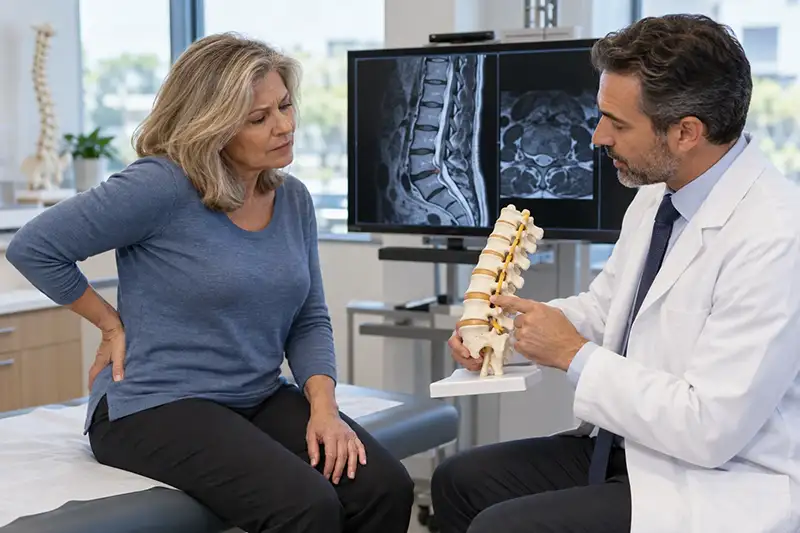
Spondylolisthesis is a forward slip of one vertebra out of line with the bone below it. On radiology reports, it often appears as “anterolisthesis,” as in “grade 1 anterolisthesis of L4 on L5.” Your spine specialist grades the slip by how far the bone has moved, measured as a percentage of its width.
Grade 1: 1% to 25%, the mildest and most common grade.
Grade 2: 26% to 50%.
Grade 3: 51% to 75%.
Grade 4: 76% to 100%.
Grade 5 (spondyloptosis): greater than 100%, a rare form in which the vertebra has moved fully past the bone below.
Most people have a grade 1 or grade 2 slip, and those low grades respond well to nonsurgical care.
Types, Symptoms and Causes of Spondylolisthesis?
Degenerative Spondylolisthesis: Age-Related Wear (Adults 50+)
Degenerative spondylolisthesis develops slowly as discs flatten and the small joints at the back of the spine loosen, letting the vertebra above creep forward, most often at L4-L5. A large Framingham Heart Study analysis found these slips 3 times as often in women as in men.
The hallmark sign is leg heaviness, aching, or tingling that builds the longer you stand or walk, then eases when you sit or lean on a shopping cart. It mirrors lumbar spinal stenosis, and the two often appear together because the slip narrows the space around your nerves. Many adults never need surgery, and a stable slip that does need it may require only a minimally invasive decompression, not a fusion.
Isthmic Spondylolisthesis & Pars Defects: Active Adults & Teens
Isthmic spondylolisthesis starts with a crack in the pars, a thin bridge of bone at the back of the vertebra. Gymnasts, divers, football linemen, and dancers who arch their backs over and over are at the highest risk. The crack is called spondylolysis, or a pars defect, and when it forms on both sides the bone can slide, most often at L5-S1. Some adults first feel an old childhood pars crack in their 20s to 40s, after heavy lifting or a fall.
Teens usually notice low back pain that worsens with arching, along with very tight hamstrings. Most return to sport after about 3 to 4 months: 8 to 12 weeks of rest, often with a brace, followed by 4 to 6 weeks of sport-specific rehab.
When to See a Spine Specialist Near You for Spondylolisthesis
Schedule an evaluation if any of these apply to you or your child:
- Back or leg pain lasting more than 6 weeks despite rest and home care
- Walking distance that keeps shrinking before your legs tire or ache
- New numbness or weakness in a leg or foot
- Sports or work-related back pain that hasn’t settled after a few weeks of rest
- A surgery recommendation you want to double-check
Many adults have a slip on an X-ray and never feel pain. Standing X-rays show the slip under your body weight, and flexion-extension X-rays, taken as you bend forward and backward, show whether it moves. A slip that moves is unstable, which shapes your treatment plan.
Already have an MRI, CT scan, or X-rays? Upload your imaging or a photo of your radiologist’s report, and a Premier spine specialist will review it and call you to explain what it shows, at no cost.
Treatment Options for Spondylolisthesis

Conservative Care
A physical therapist strengthens your deep core and glutes and restores hamstring flexibility with stretches done lying on your back, which protect the lower spine. Gentle exercises that round the lower back, such as knee-to-chest stretches and pelvic tilts, give irritated nerves more room.
Exercises to avoid: Spondylolisthesis usually feels worse when the back arches and better when it rounds. Until you’re cleared, skip backbends, cobra poses, Roman chair extensions, standing toe touches, heavy overhead pressing, and high-impact running or jumping.
Targeted Injections
When leg pain lingers despite therapy, an epidural steroid injection from our pain management team places anti-inflammatory medicine next to the irritated nerve and live X-ray guidance keeps the needle precisely inserted.
Minimally Invasive and Robotic Spine Surgery
Surgery is reserved for nerve pressure that doesn’t respond to therapy and injections, or for progressive leg weakness. The right operation depends on how stable your spine is.
Minimally invasive decompression. For a stable slip, the surgeon removes only the bone or tissue pressing on the nerves through a small incision, and you avoid a fusion. Most patients walk within hours, go home the same day, and return to desk work within 1 to 2 weeks.
Minimally invasive fusion. For an unstable slip, a spinal fusion holds the vertebra in place. Robotic guidance helps Dr. Reidler place screws precisely through smaller incisions with less muscle disruption. Most patients walk within 24 hours and return to light office work in 3 to 6 weeks, while the bone continues to solidify over 6 to 12 months.