
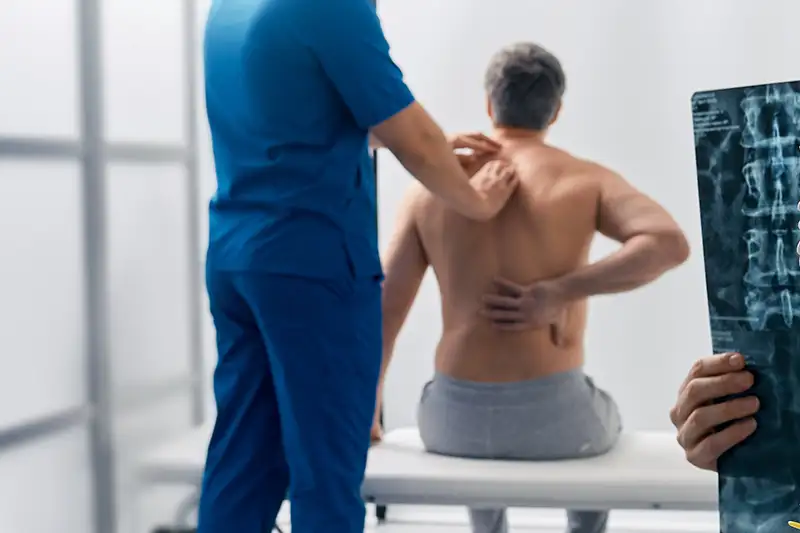
What is Spinal Deformity?
Spinal deformity is any abnormal spinal curvature or shift in how the spine lines up. Seen from behind, a healthy spine runs straight down the middle of your back. Seen from the side, it has gentle natural curves at the neck, mid back and lower back. A deformity happens when the spine bends to the side, and it also happens when those natural curves get too large or too flat.
Spine specialists group the types of spinal deformities by the direction of the curve:
- Scoliosis is a sideways curve that often twists the spine as well. Scoliosis curves can form a C or S shape and are the most common spinal deformity.
- Kyphosis is a forward curve in the upper back that is larger than normal. Scheuermann’s kyphosis is a type that starts in the teen years when some vertebrae grow into a wedge shape.
- Lordosis is an inward curve in the lower back that is larger than normal. Too much lumbar lordosis is sometimes called swayback.
- Kyphoscoliosis combines a sideways curve with a forward curve.
Spinal deformity can start either in childhood or in adulthood. In kids, most curves have no known cause, and some are present at birth. Adult spinal deformity is often degenerative, meaning it forms as discs and joints wear down unevenly over time.
What are the Symptoms of Spinal Deformity?
Symptoms of spinal deformity depend on the size of the curve, where it is and whether it presses on nerves. Mild curves often cause no symptoms and many people only find out from a school screening or an X-ray taken for something else. Signs of a spinal deformity to watch for include:
- One shoulder or hip sitting higher than the other
- Back pain or stiffness that gets worse as the day goes on
- Tiring quickly when you stand or walk
- Leaning forward or to one side to feel comfortable
- Leg pain, numbness or weakness when the curve pinches a nerve
In children, a curve is often painless, which is why it can grow before anyone notices. In adults, pain and fatigue are more common because worn discs and joints are often part of the problem. Very large curves in the chest area can, in rare cases, make breathing harder.
Who Does Spinal Deformity Impact?

Spinal deformity can affect people at any age, but it tends to show up during two stages of life: the teen growth years and the years after age 50.
Children and Teens
Most childhood curves appear between age 10 and the end of growth. A curve can get worse quickly during a growth spurt, so regular checks matter while a child is still growing. Scheuermann’s kyphosis also tends to appear in the early teen years.
Older Adults
As discs and joints wear down, the spine can start to tilt or curve. It can happen even if your spine was straight before. A 2020 review in the European Spine Journal found that this type of new adult scoliosis affects about 36% of people over 60, compared with 13% of those under 60.
Adults with Past Spine Problems
A spine fracture, osteoporosis or an earlier spine surgery can change how the spine carries weight and lead to a curve over time.
How do you know when to see a specialist? A mild curve that stays the same may only need regular X-rays. See a spine surgeon when a curve is growing, when it causes pain that limits your day, or when you feel numbness or weakness in your legs. If you have already been told you need fusion, a second opinion can confirm the plan before you decide.
What are the Treatment Options for Spinal Deformity?

Treatment for spinal deformity depends on the size of the curve, how fast it is changing, your age and how much it affects your day. Most people start with nonsurgical care. Spinal deformity surgery is saved for curves that keep getting worse or cause ongoing pain or nerve problems.
Diagnosis
Your specialist looks at how you stand and checks your strength, reflexes and feeling. A standing X-ray of the full spine shows the curve, and doctors measure it in degrees using the Cobb angle. An MRI may be added if a nerve seems pinched. Already have scans? Send them in for a Free MRI Review.
Monitoring
Small curves are often watched with X-rays every few months to a year, especially in children who are still growing.
Bracing
A brace can help keep a moderate curve from getting larger while a child grows. Bracing does not straighten the spine. It can lower the chance that surgery will be needed later.
Physical Therapy and Pain Care
Exercises that build core and back strength can ease pain and help you stand and move more easily. Our pain management team can add injections or other care when nerve pain gets in the way.
Minimally Invasive Spine Surgery
Surgery may be an option when a curve keeps growing, causes pain that has not improved with other care, or presses on nerves. The most common spinal deformity surgery is spinal fusion, which joins vertebrae in a better position so the curve stops growing. Some growing children may be candidates for vertebral body tethering, which corrects the curve while keeping more motion. Premier’s surgeons use minimally invasive spine surgery when the curve allows, and larger or more rigid curves may call for complex spinal reconstruction.
Why See Premier Orthopaedics for Spinal Deformity?
Frequently Asked Questions About Spinal Deformity
Is spinal deformity genetic?
Genes play a role in some curves. Idiopathic scoliosis and Scheuermann’s kyphosis both tend to run in families, so if a parent or sibling has a curve, it is worth having a child’s back checked during growth spurts.
Can spinal deformities get worse in adults?
Yes, some adult curves slowly grow over the years as discs and joints keep wearing down. Regular X-rays help your surgeon track the curve and plan care before it causes bigger problems.
Does every spinal deformity need surgery?
No. Most curves are managed with monitoring, bracing for growing children, physical therapy and pain care. Surgery is usually considered only for large curves, curves that keep getting worse, or curves that cause nerve problems.
What is the difference between kyphosis and lordosis?
Kyphosis is a forward curve in the upper back, and lordosis is an inward curve in the lower back. Both are normal in small amounts. Each becomes one of the abnormal spinal curvatures doctors treat when it grows too large.
At what curve size is surgery considered?
For teens with scoliosis, surgery is often discussed once the curve reaches about 45 to 50 degrees. For adult spinal deformity, the choice depends more on pain, nerve symptoms and balance than on one number.
Have a question we did not cover here? Our spine care FAQ answers more of what patients ask before a visit in Bloomfield, Englewood, or Union City.
Can spinal deformity cause leg pain?
Yes. When a curve narrows the space around the nerves in the lower back, it can cause pain, numbness or weakness that travels into the legs. Treating the pressure on the nerve often eases those symptoms.
Get Spinal Deformity Care in New Jersey
A curve in your spine, or your child’s spine, does not have to limit what you can do. Whether you need a first evaluation, a second opinion or a review of X-rays you already have, Premier Orthopaedics can help you understand your spinal deformity and choose the right next step.