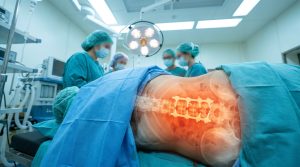

When an MRI shows a herniated disc, it means the soft center of a spinal disc has pushed through its outer wall, which can press on a nearby nerve.
Your doctor mentioned microdiscectomy surgery as the likely option if your symptoms don’t improve, and you have practical questions before you commit to a consultation.
This guide explains what microdiscectomy does, who it helps, how it compares with nonsurgical care and what to expect before, during and after the procedure.
What Microdiscectomy Surgery Is
A microdiscectomy is a minimally invasive procedure within minimally invasive spine surgery that removes the fragment of a herniated disc pressing on a spinal nerve. Taking that pressure off the nerve relieves the leg pain and sensory symptoms the herniation causes.
Your surgeon works through a small incision and uses a surgical microscope to see the nerve and the disc fragment clearly. When the problem sits in your lower back, your surgeon may call it a lumbar microdiscectomy.
How the Disc Pinches the Nerve
The trouble the surgery fixes starts inside the disc itself. Every disc in your spine has a soft center and a tougher outer wall, and a herniated disc develops when that soft center pushes through a weak spot in the outer layer and lands on a nearby nerve.
During microdiscectomy, most of the disc stays right where it belongs. Your surgeon removes only the escaped fragment that’s pinching the nerve. With that focused goal, surgeons use the approach to limit disruption to nearby tissue.
Who Is a Candidate for Microdiscectomy
Most people with a herniated disc improve without an operation. Surgeons usually consider microdiscectomy for a herniated disc only after conservative care, meaning nonsurgical treatment such as physical therapy and anti-inflammatory medication, hasn’t brought enough relief.
In many cases, epidural injections and nerve blocks are part of the plan too. Epidural injections deliver anti-inflammatory medicine around the irritated nerve, and nerve blocks use targeted medication to calm or identify a pain-generating nerve. Surgeons suggest these options because many patients improve without surgery.
Signs Your Surgeon Looks For
When those steps haven’t worked, your surgeon looks for a specific set of signals before recommending surgery. These findings help connect your symptoms to the disc level shown on your MRI:
- Leg pain that has persisted despite six or more weeks of nonsurgical treatment
- An MRI-confirmed disc herniation pressing on a spinal nerve
- Muscle weakness or numbness that matches what the imaging shows
- Daily activity limits you want to discuss, including work or sleep
The more of these that apply, the stronger a candidate for microdiscectomy you’re likely to be. Neurologic findings, meaning exam signs such as weakness, numbness or reflex changes that show how the nerve works, carry particular weight when they line up with the MRI.
When Symptoms Make Surgery Urgent
Not every case can wait for conservative care to run its course. A small set of situations changes the timeline entirely: new bowel or bladder problems, or pain so severe that strong medication can’t control it, indicate it might be cauda equina syndrome. This makes surgery urgent rather than elective. You should call your doctor right away for those symptoms.
How Your Surgeon Decides
Even when symptoms aren’t urgent, the decision to operate rests on more than imaging alone. Your surgeon determines candidacy by reviewing your MRI, physical exam, symptom duration and daily limitations with you. How long you’ve hurt and how much the symptoms are taking from your daily life belong in that conversation too.
Microdiscectomy vs. Continuing Nonsurgical Treatment
Patients who chose surgery for a herniated disc had greater improvement within three months in pain and physical function than those who continued nonsurgical treatment.
Nonsurgical care can still hold up over the long run for many people, and patients tend to see more improvement in leg pain than back pain after the operation. The character of your symptoms matters when you weigh the trade-off.
Surgery usually offers faster relief, while nonsurgical care may reach similar long-term outcomes for many people.
| Consideration | Microdiscectomy | Continuing nonsurgical care |
|---|---|---|
| What it involves | An outpatient operation to remove the disc fragment pressing on the nerve | Ongoing physical therapy and medication while the herniation settles; your doctor may use injections |
| How quickly symptoms tend to improve | Faster, with measurable gains in pain and function within the first three months | More gradually, over months, with no guarantee of matching surgery’s early relief |
| How longer-term results compare | Good results for well-selected patients, especially for leg pain | Long-term outcomes can be similar for many people |
| When it’s usually the right path | Persistent leg pain with a matching MRI, especially with weakness or numbness | Milder symptoms, no neurologic deficit and room to give healing more time |
The main difference is faster leg-pain relief from surgery versus giving nonsurgical care more time when symptoms are milder. Your surgeon can help you weigh that tradeoff against your MRI findings, nerve exam and daily activity limits.
How to Decide
In practice, many people base the decision on daily limitations, including work and sleep, and whether weakness or numbness is present.
It also helps to think about how long you’re willing to keep trying nonsurgical care, whether your symptoms are steady, improving or getting worse and how much your current limits are affecting the things you care about most.
Weighing the pace of relief you want against the risks of surgery is part of the same conversation, and bringing a family member or partner to the visit can make it easier to talk through those trade-offs together.
An evaluation with neck and back specialists who offer both paths will tell you more than imaging alone.
What to Expect Before, During and After Microdiscectomy
Microdiscectomy is typically an outpatient procedure, and knowing what happens at each stage takes much of the mystery out of surgery day. For outpatient candidates, the process usually moves from preparation through surgery day and early recovery.
Before Your Surgery
Your surgeon will review your MRI with you and confirm the exact disc level for the operation. The surgical team will give you instructions on which medications to pause and when to stop eating and drinking, and they’ll review the anesthesia plan with you before the day of surgery.
Since outpatient microdiscectomy means leaving the same day, you’ll need someone to drive you home. It also helps to prepare your home in advance by moving everyday items within easy reach and stocking a few days of meals, so bending and lifting stay off your agenda early on.
During the Procedure
Once you’re under anesthesia, your surgeon works through a small incision over the affected disc level, uses a surgical microscope for magnification and removes the fragment of disc pressing on the nerve before closing the incision. After the procedure, most people head home the same day.
At Premier Orthopaedics & Sports Medicine, Dr. Jay Reidler, a Harvard, Johns Hopkins and Columbia-trained spine surgeon, can perform microdiscectomy using microscopic and minimally invasive techniques. He’ll also tell you plainly if your exam suggests nonsurgical care still deserves more time.
Risks Your Surgeon Will Review
Serious complications are uncommon, with reported rates for events such as dural tears and infections often cited below 1.5 percent. However, overall complication rates vary by study and by what is counted. The risks your surgeon will review typically include:
- Dural tear, which is a small leak of spinal fluid from the covering around the nerves
- Infection at the incision or, more rarely, deeper in the spine
- Nerve injury that can cause new weakness, numbness or pain
- Bleeding or blood clots during or after the procedure
- Reherniation of the same disc, which can bring symptoms back
- Incomplete relief of leg pain or lingering back pain
- Anesthesia-related risks tied to your overall health
Your surgeon will walk you through the risks that apply to your specific health picture.
After Surgery: A Brief Look at Recovery
You’ll stay in the recovery area while the anesthesia wears off. The care team plans same-day discharge for nearly everyone, though people with certain serious medical conditions sometimes stay overnight for monitoring. Your surgeon will give you early activity instructions before you leave.
After surgery, your surgeon will define recovery stages for you. How quickly you move through them depends on your overall health and the physical demands of your daily life, which is why following your post-op instructions is important.
Many people walk before going home; desk work usually needs less restriction than physical work, and jobs that require lifting, bending, climbing or long hours on your feet often need a longer surgeon-cleared restriction period. Return-to-work timing varies with your job, since a desk role and a physical trade come with different clearances, and your surgeon’s guidance sets both.
For detailed post-op expectations, restrictions and follow-up care, see Premier’s recovery guidance.
Questions to Ask Your Surgeon About Microdiscectomy
A consultation goes better when you arrive with questions that could actually change your decision. These cover candidacy, alternatives, experience and logistics:
- Have I truly exhausted the conservative options, or is more nonsurgical treatment worth trying first?
- What exactly does my MRI show, and at which disc level?
- How many microdiscectomies do you perform, and with which techniques?
- What outcome is realistic for someone with my symptoms and imaging?
- If the disc herniates again after surgery, what would you recommend?
- How would my treatment plan change if my injury happened on the job and falls under workers’ compensation?
- What would recovery look like given the physical demands of my work?
It helps to write the answers down during the visit, because you’ll want them when you talk the decision over at home. For broader questions about herniated discs, imaging and spine treatment, our spine care FAQ is a good next stop.
Schedule a Microdiscectomy Consultation in Northern New Jersey
If leg pain from a herniated disc hasn’t improved with nonsurgical care, our spine team can evaluate whether microdiscectomy is right for you at our offices across Northern New Jersey. You can call 201-833-9500 or request an appointment online.
Frequently Asked Questions About Microdiscectomy
Can a herniated disc come back after microdiscectomy?
Yes, the same disc can herniate again. Reherniation happens in roughly 5 to 15 percent of patients over long-term follow-up, and smoking raises that risk. Quitting before surgery is one of the few reherniation factors within your control.
Does microdiscectomy relieve back pain or mainly leg pain?
The operation targets the pinched nerve, so leg symptoms respond best and back pain improves less predictably. Recovery timelines vary as some patients regain strength before sensation. At the same time, numbness or tingling may persist for weeks to months as the nerve heals, so lingering numbness during the first few weeks doesn’t mean the surgery failed.
Will I need to stay overnight in the hospital after microdiscectomy?
Most people don’t. You’ll likely head home once the anesthesia wears off and you’ve walked with the care team, though some people with serious medical conditions need a short hospital stay. Your surgeon can tell you before surgery whether anything in your history points toward staying overnight.
What symptoms after microdiscectomy should I call my surgeon about?
You should call your surgeon for new or worsening weakness in your leg, any change in bladder or bowel function and severe pain that doesn’t match what your care team described. Some soreness around the incision is normal in the first days, but symptoms that escalate rather than ease are worth reporting promptly.
This article is for general information only and isn’t a substitute for professional medical advice. Talk to your doctor about your specific situation before making treatment decisions.