
Your MRI report says “foraminal stenosis at L4–L5,” or your doctor said “spinal stenosis,” and now you’re searching for which is worse.
Spinal stenosis means narrowing in the spaces of your spine, while foraminal stenosis means narrowing in the small side openings where nerve roots leave the spine. The location of the narrowing and its effect on your nerves matter more than the diagnosis name.
This article compares where each condition happens, how symptoms usually differ, what treatment often looks like and which warning signs need urgent medical attention.
Which Is Worse: Spinal Stenosis or Foraminal Stenosis?
Neither condition is universally “worse”; what matters is which one is actually compressing a nerve and how much it’s affecting your function.
Central spinal stenosis tends to be more serious when it narrows the canal enough to affect the spinal cord or the cauda equina, because it can involve both legs, limit how far you can walk and, in rare cases, threaten bowel or bladder control.
Foraminal stenosis tends to be more serious when it pinches a single nerve root hard enough to cause progressive weakness, numbness or unrelenting radiating pain down one arm or leg. It is technically a type of spinal stenosis.
This term covers spinal canal narrowing that presses on the spinal cord as well as narrowing of the openings, which doctors call neural foramina, where nerves exit the spine.
That’s why an MRI report can list both, and why the label alone doesn’t tell you how serious things are. The diagnosis that’s worse for you is the one driving your symptoms.
Severity on imaging also doesn’t equal severity of symptoms. Moderate stenosis shows up on scans in up to 30 percent of adults over 55 who have no symptoms at all, so that the same imaging finding can be silent in one person and disabling in another.
Doctors diagnose these conditions from your history and physical exam, and imaging confirms how the anatomy lines up with your symptoms. The neck and back specialists at Premier Orthopaedics & Sports Medicine sort that out when they compare your symptom pattern against your scan.
What Spinal Stenosis Is and Who It Affects
When doctors say “spinal stenosis” without qualifiers, they usually mean central canal stenosis: narrowing of the main channel that houses your spinal cord and, in the lower back, the cauda equina nerve roots that continue below where the cord ends.
As discs dry out and shrink with age, they lose height, the disc spaces settle and collapse, and the facet joints enlarge while the ligamentum flavum thickens, all of which crowds the canal from several directions at once.
What Central Stenosis Feels Like Day to Day
The condition is common in the age group most likely to be holding an MRI report. About 11 percent of U.S. adults have lumbar spinal stenosis (LSS) as a clinical syndrome, while most people with symptoms are over 50 and the condition is somewhat more common in older women.
Central stenosis follows a position-dependent rhythm that repeats across your day. In daily life, you may be able to push a shopping cart around a store for a while because leaning on the handle eases symptoms, while standing upright in a checkout line feels miserable.
Your doctor will want to know if walks or long stretches of standing bring on crampy or heavy leg aching and whether sitting down or bending forward at the waist brings relief. Numbness or tingling also matters, especially when it involves both legs rather than one.
Together, these clues help a doctor connect what you feel to the narrowing on your MRI far faster than an exam alone would allow.
What Foraminal Stenosis Is and Who It Affects
Foraminal stenosis is narrowing of the foramen, the small bony opening on each side of each spinal level where a nerve root exits on its way to an arm or a leg.
Bone spurs from spinal wear, disc degeneration, a herniated disc, thickened ligaments and spondylolisthesis (a forward slip of one vertebra over another) can all crowd that opening.
Degenerative change from age often causes foraminal narrowing, which is why this diagnosis often appears alongside other wear-related findings on the same report. The finding sounds alarming, but many cases cause no symptoms, even with severe narrowing.
What Foraminal Stenosis Feels Like Day to Day
Trouble starts only when the opening tightens enough to compress the nerve root passing through it. Symptoms then follow a single nerve pathway. Pain may come with tingling or weakness in that nerve’s territory and radiation down one leg in a sciatica-like pattern that follows a single nerve root.
A compressed nerve root announces itself along one route. You might feel sharp or burning pain from your lower back into one buttock and down the back of one leg, or tingling and weakness in the parts of a hand or foot that a single nerve supplies.
That one-sided, traceable pattern is the practical contrast with central stenosis. Central stenosis more often involves both legs and rises and falls with walking and standing.
Comparing the Symptom Patterns
A spine doctor looks past the diagnostic label at specifics: where your symptoms sit and how they behave, whether you have weakness or numbness, how far you can walk before you stop, whether things are progressing and whether the pain pattern matches the narrowing on your imaging.
Your doctor uses this kind of pattern-matching to figure out which finding on your MRI is actually driving your symptoms, and that finding becomes the treatment target.
| Dimension | Spinal (central) stenosis | Foraminal stenosis |
|---|---|---|
| Where the narrowing is | The central canal around the spinal cord and nerve bundle | The opening where a single nerve root exits |
| Typical symptom pattern | Leg pain, heaviness or cramping with walking or standing | Radiating pain, tingling or weakness along one nerve’s path |
| One side or both | Often both legs | Usually one side |
| What eases it | Sitting or leaning forward | Varies by the nerve involved |
| First-line treatment | Physical therapy first, with medication and activity changes as needed | Same conservative steps; transforaminal (nerve-root) injections may be added if needed |
Start With Conservative Care
For both conditions, your doctor may start with nonsurgical treatments through conservative care, and those treatments often include physical therapy. In contrast, your doctor may add pain medications or change painful activities as needed. That plan needs time, because about one-third of people improve over three years without any operation.
If symptoms persist, your doctor may consider epidural injections and nerve blocks for short-term to intermediate-term relief.
At Premier, our pain management specialists handle this part of treatment and choose the injection approach based on whether your symptoms follow one nerve root or a walking-related claudication pattern.
When Surgery Enters the Conversation
Surgery becomes part of the conversation when symptoms remain despite conservative care.
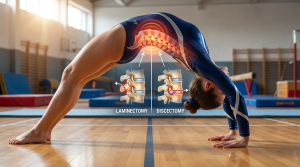
For central stenosis, a laminectomy, the most common surgery for spinal stenosis, removes bone and ligament to open the central canal; if the spine also needs stabilizing, fusion may be part of that operation. For symptoms from a narrowed foramen, a foraminotomy widens the foramen where the nerve root exits.
Our spine surgery team can walk you through which procedure fits your findings, and Premier’s recovery guidance covers what to expect afterward.
Symptoms That Can’t Wait
Loss of bowel or bladder control requires immediate medical attention. Severe or increasing numbness between your legs or inner thighs also needs urgent evaluation, as does weakness spreading into one or both legs.
These signs can point to cauda equina syndrome, compression of the bundle of nerve roots (cauda equina) that extends below the end of the spinal cord in the lower spinal canal, where earlier surgical decompression, generally within 24 to 48 hours of onset, is associated with better recovery of bladder function, sensation and strength.
What to Discuss With Your Doctor
Your doctor can turn level numbers and severity grades into a plan once you ask questions that connect the MRI report to symptoms and treatment choices. The goal is to leave the visit knowing which finding matters most and what would move you from one treatment step to the next.
- Which levels are narrowed, and is the narrowing central, foraminal or a combination of the two?
- Do my symptoms actually match what the imaging shows?
- What’s likely to happen if we watch and wait for a few months?
- Which conservative treatments fit my symptom pattern?
- What would make you recommend surgery, and which procedure would it be?
It’s worth writing the answers down, since they’ll frame every decision that follows. Before you commit to anything major, an independent evaluation can be part of your plan.
First and second opinions on a lumbar stenosis diagnosis agree only 58 percent of the time, so a second look is a normal part of careful decision-making.
Dr. Jay Reidler, a spine surgeon and founder of Spine, Neck & Back Specialists, provides that kind of independent surgical evaluation, with a fresh read of your imaging against your symptoms, whatever direction the recommendation takes.
Get a Clear Answer About Your Spine
If you’re not sure which type of narrowing is driving your leg or arm symptoms, you can meet with Premier’s spine team at offices across Northern New Jersey. To schedule, call 201-833-9500 or make an appointment online.
Frequently Asked Questions About Spinal Stenosis and Foraminal Stenosis
Can you have both spinal stenosis and foraminal stenosis at the same time?
Yes, both can appear on a single MRI report, sometimes at the same level. When that happens, symptoms may reflect central narrowing, foraminal narrowing or both, and treatment targets whichever finding matches the symptoms bothering you most.
Can foraminal stenosis turn into central spinal stenosis?
Not exactly. Central canal stenosis and foraminal stenosis are distinct patterns of narrowing that develop from the same age-related wear, and both can appear in the same spine or develop independently over time. Your doctor can monitor whether narrowing progresses in other areas over the years.
Is severe stenosis on my MRI an emergency?
Severity grades on a scan describe anatomy. Your symptoms determine urgency, so a severe reading by itself doesn’t create an emergency, and plenty of people have marked narrowing without symptoms.
New bladder or bowel changes need emergency care. If weakness progresses quickly, you need urgent evaluation, no matter what your last scan showed.
Does foraminal stenosis always need surgery?
No. Most people start with therapy, with activity changes and targeted injections when appropriate, and a foraminotomy stays in reserve for a compressed nerve that doesn’t respond to care.
Your doctor will also look at whether weakness, numbness or worsening function changes the timing of that decision. Premier’s spine care FAQ explains when surgical treatment makes sense.
This article is for general information only and isn’t a substitute for professional medical advice. Talk to your doctor about your specific situation before making treatment decisions.