
What is Scoliosis?
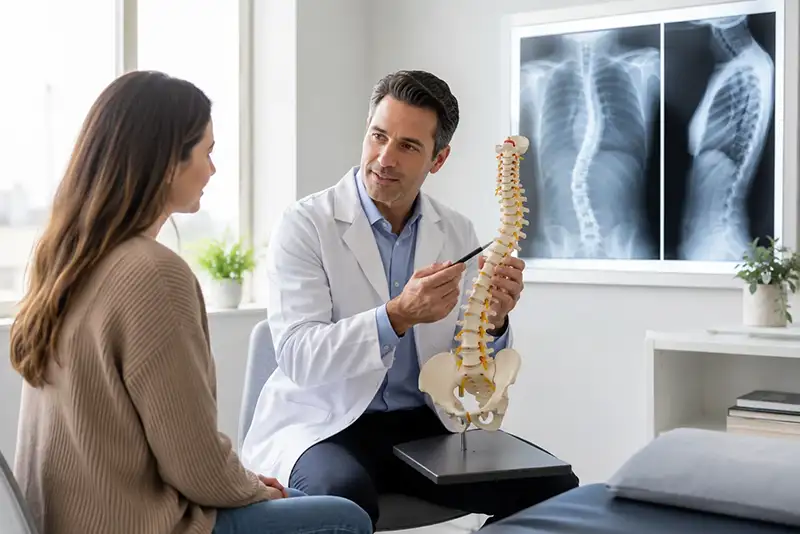
Scoliosis means the spine curves off to the side instead of running straight down the back. In some cases, it can twist slightly as it curves, which is why scoliosis can change the shape of the ribs and waist. From behind, a healthy spine runs straight down the middle of the back. Scoliosis bends it into one of two shapes. A C curve leans to a single side, tracing the letter C. An S curve has two bends, where the spine tips one way and then swings back the other to keep your head centered over your hips, tracing the letter S. The shape and location of the curve guide how your doctor measures it and plans treatment.
Our spine specialists will typically use a standing X-ray to measure the degree of curvature in your back. This is called the Cobb angle, and a curve of 10 degrees or more is considered to be scoliosis. There are different common causes depending on age. For teens, a curve typically appears during a growth spurt, whereas in adults the spine slowly begins to tilt as cushions and joints in the spine begin to wear down.
What are the symptoms of Scoliosis?
Scoliosis shows up differently depending on your age. In children and teens, it rarely causes pain, so a parent or coach usually spots it by how the body looks. In adults, it is often the reverse, and the pain, stiffness, or trouble standing is what brings people in.
The visible signs are much the same at any age:
- One shoulder sitting higher than the other
- One shoulder blade sticking out more
- An uneven waist, with a bigger gap between one arm and the body
- Hips that look uneven, or a body that leans to one side
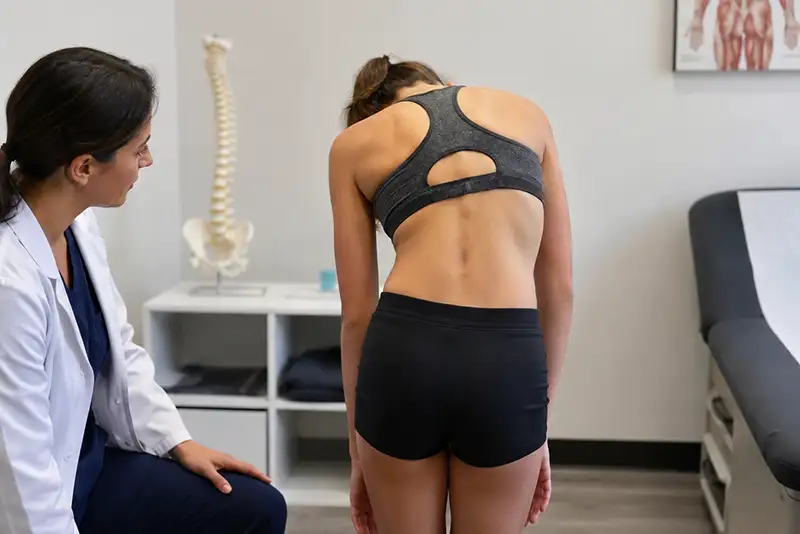
- One side of the back rising higher when bending forward to touch the toes
- Clothes that stop hanging straight
For adults, scoliosis is something you feel more than see. Most people come in for lower back pain and stiffness. When the curve pinches a nerve, that pain can turn into numbness or an ache running down one leg. Other changes creep in slowly. Standing and walking get harder, a little height slips away, and posture starts to lean forward or to one side.
Checking for scoliosis is quick and painless. You bend forward while the doctor looks along your spine from behind, and a standing X-ray confirms the size of the curve. If a nerve is involved, an MRI shows what the curve is pressing on.
Who does Scoliosis impact?
Scoliosis affects two very different groups, and it affects their bodies in different ways.
Kids and teens who are still growing come first. A national panel of medical experts reports that 1 to 3 out of every 100 children aged 10 to 16 have a curve. At this age, a curve rarely hurts, so what it affects most is how the body lines up. One shoulder or hip sits higher, the waist looks off center, and one side of the back rises when the child bends forward. Boys and girls get small curves at about the same rate, but girls are far more likely to see a curve keep growing. The bigger issue in this group is not today’s curve but where it is headed, since a spine that is still growing can bend further, and quickly.
Adults over 60 come second, and for them a curve tends to change how they move, not just how they look. A 2005 study of healthy older volunteers found that 68% had curves large enough to count as scoliosis, and most of them felt fine. Problems start when the tilt throws off your posture and pinches the nerves leaving the spine. Posture is often the first thing to shift, and some people settle into a stooped, forward lean that is hard to straighten. Standing tall and holding steady balance gets harder than it used to be, and the change carries into how you walk. Legs grow heavy after a block or two, walking distance shrinks, and a leg may ache or go numb along the way. Many people end up sitting more just to ease it, and the loss of balance raises the risk of a fall.
What are the treatment options for Scoliosis?

Three factors decide your treatment: how big the curve is, how much growth you have left, and how much it affects daily life. Premier Orthopaedics, we match the treatment to your curve. For most people, that means starting with nonsurgical care. When a curve is large or keeps getting worse, surgery may become an option. If surgery is the right step, Dr. Reidler talks the plan through with you first and uses minimally invasive methods where he can.
Watching and waiting is a real plan, not a brush-off. Kids return every 4 to 6 months for a quick exam and X-ray, because catching a curve while it is still changing is what makes a brace work. Physical therapy will not straighten a curve, but it builds core strength and balance, which eases pain and keeps people active.
Braces only help while a child is still growing, since a brace guides growth rather than pulling a curve straight. In a large national study of kids with curves between 20 and 40 degrees, a brace kept 72% from ever reaching the point of surgery, compared with 48% who were only watched. For adults, a shot of anti-inflammatory medicine near the irritated nerve, called an epidural steroid injection, often calms leg pain enough to move comfortably again.
Scoliosis surgery is usually a spinal fusion, which connects the curved bones so they heal together in a straighter position. Dr. Reidler uses minimally invasive methods with computer guidance and robotic tools where the anatomy allows, meaning smaller incisions and a faster recovery than older open surgery.
|
How big is the curve? |
Pediatric Scoliosis |
Adult Scoliosis |
|
Under 20 degrees |
Recheck every 4 to 6 months |
Usually nothing needed |
|
20 to 25 degrees |
Keep rechecking, add physical therapy |
Physical therapy and activity changes |
|
25 to 45 degrees |
A brace, as long as growth remains |
Therapy, injections, or pain management |
|
Over 45 degrees |
Time to discuss surgery, since curves this large keep growing |
Surgery if pain or nerve pressure limits daily life |
Recheck every 4 to 6 months
Usually nothing needed
Keep rechecking, add physical therapy
Physical therapy and activity changes
A brace, as long as growth remains
Therapy, injections, or pain management
Time to discuss surgery, since curves this large keep growing
Surgery if pain or nerve pressure limits daily life
Why choose Premier Orthopaedics for Scoliosis care in New Jersey?
Whether you are 15 or 70, you want the same thing: less pain, and the freedom to get through your day without your back setting the limits. Easing that pain, and getting you back to what the curve made you give up, is what Premier Orthopaedics works toward with every scoliosis patient. Dr. Reidler is a board-certified spine surgeon who treats scoliosis in children and adults, so your care comes from someone who works with these curves every day.
Hearing that you need surgery is a lot to take in. You are entitled to a second look before you commit. If another doctor has told you that you need an operation, you can get a second opinion or a free MRI review first. When you are ready, set up a visit at our Bloomfield, Englewood, or Union City office. Call 201.833.9500 or request an appointment.
Frequently asked questions About Scoliosis Treatment in New Jersey
Can I keep exercising or playing sports with scoliosis?
Does scoliosis run in families?
How long does recovery take after scoliosis surgery?
Can a large scoliosis curve affect breathing?
What can I do day to day to ease scoliosis pain?
Gentle, steady movement usually eases scoliosis pain better than rest. Short walks, a simple stretch and core routine, and changing position keep the back from locking up. Heat loosens sore muscles, and a store-bought anti-inflammatory can calm a flare. Call your doctor if pain shoots down a leg or you feel numbness, since that points to a pinched nerve. More answers are on our spine care FAQ page