
You had an X-ray or MRI for back pain, and the report came back with a phrase nobody explained: “mild levoscoliosis of the lumbar spine.”
An unfamiliar medical term associated with your spine is unsettling, but in most adults, this finding is manageable and often requires only monitoring.
Premier Orthopaedics & Sports Medicine evaluates lumbar levoscoliosis with a conservative-first approach that matches treatment to the curve measurement, symptoms and change over time. This guide walks through what the term means, what causes it in adults and how doctors decide between monitoring and treatment.
What Levoscoliosis of the Lumbar Spine Means
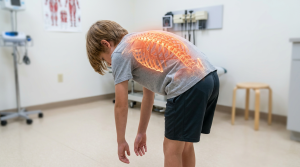
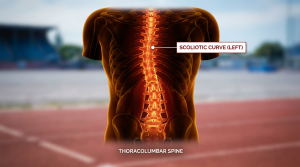
Scoliosis is a sideways curve of the spine that measures 10 degrees or more on an X-ray after your skeleton finishes growing. The curved section takes a C- or S-shape when you look at the spine from behind, while a healthy spine forms a straight vertical line.
“Levo” tells you the curve bends left, and “lumbar” places it in your lower back, the section between your ribs and your pelvis. A rightward curve gets the mirror-image name, dextroscoliosis.
In adults, this finding usually shows up as part of degenerative lumbar scoliosis, and leftward curves are slightly more common there: 56 percent of curves in that group bend left, and the average curve measures about 25 degrees.
The phrase on your report describes the direction and location of the curve. Severity and treatment decisions are based on the Cobb angle, along with symptoms and any changes in the curve over time.
What Causes a Leftward Curve in the Lower Spine
In adults, lumbar levoscoliosis usually develops on its own through asymmetric wear of the discs and facet joints, the small joints that link each vertebra to the next.
Doctors call this degenerative (de novo) scoliosis: when one side of a disc or joint wears down faster than the other, the spine gradually curves.
Onset averages around age 70, and slightly more than half of these curves bend left. Adult-onset scoliosis falls into four categories:
- De novo degenerative scoliosis, the wear-driven type above
- Progression of scoliosis that began in childhood or adolescence
- A systemic disease, meaning a body-wide condition that affects bones, joints or connective tissue and contributes to a curve
- Curves that develop after previous spine surgery
Your doctor uses the category to frame the rest of the evaluation. A leftward curve in an adult usually reflects degenerative wear, while a curve carried over from youth is another category your doctor considers.
Across scoliosis as a whole, including adolescent cases, doctors don’t find a clear cause in more than 80 percent of cases. Other causes include disc degeneration, arthritis and osteoporosis as bones lose density.
Symptoms of Lumbar Levoscoliosis
Many mild lumbar curves cause no symptoms at all and turn up incidentally on imaging your doctor ordered for something else. Curves themselves get more common with age.
When a lumbar curve causes symptoms, they tend to include:
- Uneven hips or a waistline that sits higher on one side
- Shoulders that don’t line up evenly
- An aching lower back, often worse on one side
- Leg pain, numbness or tingling when the curve narrows the passageways nerves travel through
Back pain in someone with a curve can come from several lower back problems that produce similar pain.
Your doctor may check for other sources, such as a herniated disc, a problem where the soft center of a spinal disc pushes through its outer layer, before attributing your symptoms to the levoscoliosis and choosing a treatment. That check changes what happens next, since care for a herniated disc differs from the monitoring plan for a small curve.
The pain pattern and the movements that worsen it help your doctor decide whether the curve is driving the symptoms, especially if symptoms radiate into your leg.
How Doctors Diagnose and Measure the Curve
Your doctor often starts with a physical exam and standing X-rays to measure the curve. Your doctor measures the curve using the Cobb angle.
On the image, one line follows the upper margin of the topmost tilted vertebra in the curve, and a second line follows the lower margin of the bottom one. The angle between those two lines is your measurement.
Doctors group Cobb angle measurements into three severity bands, and adult care generally lines up with them like this:
| Cobb angle | What it’s called | Typical management in adults |
|---|---|---|
| 10 to 25 degrees | Mild | Routine monitoring |
| 25 to 45 degrees | Moderate | Active nonsurgical care |
| Over 45 degrees | Severe | Specialist evaluation |
“Mild levoscoliosis” on your report means a real, small curve. Sometimes an MRI report notes the curve while your doctor is evaluating another back problem, which is how the phrase lands on a report you were reading for another reason.
An evaluation with neck and back specialists turns that phrase on a report into an actual plan for your spine.
How Lumbar Levoscoliosis Is Treated
Doctors usually start scoliosis care without surgery. Your doctor builds conservative care around your symptoms. Your doctor adds options based on your curve and pain level, then adjusts the plan according to your response.
Nonsurgical Treatment Options
For a mild curve without much pain, monitoring often comes first. Your doctor rechecks the curve on imaging at intervals they set and watches for change.
When symptoms need more than observation, adult care usually draws on a few options, including injections when nerve-related leg pain persists:
- Physical therapy to strengthen muscles that support your spine
- Activity modification to reduce the movements that flare your pain
- Anti-inflammatory medication for pain and stiffness
- Facet injections, which place anti-inflammatory medicine near the small spine joints
- Epidural steroid injections, which place anti-inflammatory medicine around irritated spinal nerves, as part of pain management treatments
Your doctor chooses among these options based on your pain level and where the pain shows up. Physical therapy can strengthen supporting muscles, and activity modification can reduce the movements that aggravate your symptoms.
Bracing usually focuses on symptom control rather than permanently correcting the curve. Care centers on controlling symptoms and keeping you functional.
When Surgery Enters the Conversation
Your surgeon usually raises surgery only after you’ve worked through conservative care. It comes up most often when the curve reaches a severe range or when conservative care hasn’t controlled significant symptoms.
A spine that tips noticeably out of balance from front to back can also prompt the discussion. For most adults with lumbar levoscoliosis, conservative care and monitoring remain the plan.
When your surgeon recommends an operation, spinal fusion may come up: your surgeon uses rods and screws, along with bone graft, the bone material that helps the vertebrae heal together, to straighten the curved section and hold it in position while the bones heal together.
Your surgeon weighs your symptoms and overall health, then factors in what conservative care has already achieved.
At Premier, our spine surgery team handles these cases. Dr. Jay Reidler, trained at Harvard, Johns Hopkins and New York-Presbyterian Och Spine/Columbia, evaluates scoliosis and spinal deformity.
What Recovery and Long-Term Monitoring Look Like
For most people with lumbar levoscoliosis, monitoring means periodic imaging at intervals your doctor sets. Your plan may also include continued exercise to keep the muscles supporting your spine strong and treatment adjustments if the curve or symptoms change.
Progression varies from person to person, so your plan may stay unchanged for years or shift after a single follow-up X-ray. If a follow-up X-ray shows the curve holding at the same measurement and your pain hasn’t changed, your doctor may keep monitoring rather than changing care.
When surgery does happen, recovery timing depends on the procedure, the number of spinal levels involved, your bone health and how your early healing progresses.
Recovery continues after you leave the hospital through pain control, activity restrictions, physical therapy and follow-up visits.
Your surgical team will walk you through each phase using Premier’s recovery guidance, from pre-operative preparation through activity restrictions that your surgeon lifts gradually as you heal.
When to See a Spine Specialist
If a lumbar curve appears on a report, review it with a doctor. Book a visit if any of these apply:
- Lower back pain that doesn’t improve with rest or over-the-counter medication
- New numbness, tingling or weakness in your legs
- A visible change in your posture, waistline or the way your clothes fit
- An imaging report that notes a curve nobody discussed with you
Numbness, tingling or weakness in your legs that’s new or getting worse warrants a prompt call to your doctor. For ongoing symptom care, our pain management specialists can build a plan around injections and medication, with therapy added when appropriate, and Premier’s spine care FAQ answers broader questions about spine conditions and treatment.
Get Your Lumbar Curve Evaluated at Premier
If your imaging report mentions levoscoliosis or your lower back pain isn’t improving, our spine team across Northern New Jersey can evaluate the curve. You can call 201-833-9500 or schedule an appointment online.
Frequently Asked Questions About Levoscoliosis of the Lumbar Spine
Is levoscoliosis more serious than dextroscoliosis?
In adults, treatment decisions rest on the size of the curve and the symptoms it causes. Curve direction describes how it bends and where it sits, which is what makes today’s image comparable to the next one. Leftward lumbar curves are common in adult degenerative scoliosis.
Can mild levoscoliosis of the lumbar spine get worse over time?
It can, which is why doctors track changes in the curve. Your doctor rechecks the curve on follow-up imaging and compares each measurement with the last. If the curve or symptoms change, your treatment plan changes with them.
What exercises should I avoid with lumbar levoscoliosis?
Your doctor or physical therapist can tell you which movements are safe, since safe limits depend on your curve, symptoms and nerve findings. They can help you adjust movements that bother your back and build a program around what your spine can tolerate.
Does levoscoliosis found on an MRI for something else need treatment?
Usually, an incidental mild curve needs an evaluation and a monitoring plan. Immediate treatment depends on your symptoms, nerve problems or a change in your curve. If the curve causes no pain or nerve problems, a watch-and-wait plan is often the whole plan, and treatment starts only if that changes.
This article is for general information only and isn’t a substitute for professional medical advice. Talk to your doctor about your specific situation before making treatment decisions.