You may open a report of your or your child’s X-ray and find an unfamiliar phrase: levoscoliosis of the thoracolumbar spine. This guide explains the possible causes, symptoms, diagnosis, treatment choices and when to see a spine specialist.
What Does Levoscoliosis of the Thoracolumbar Spine Mean?
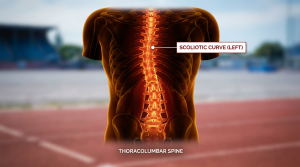
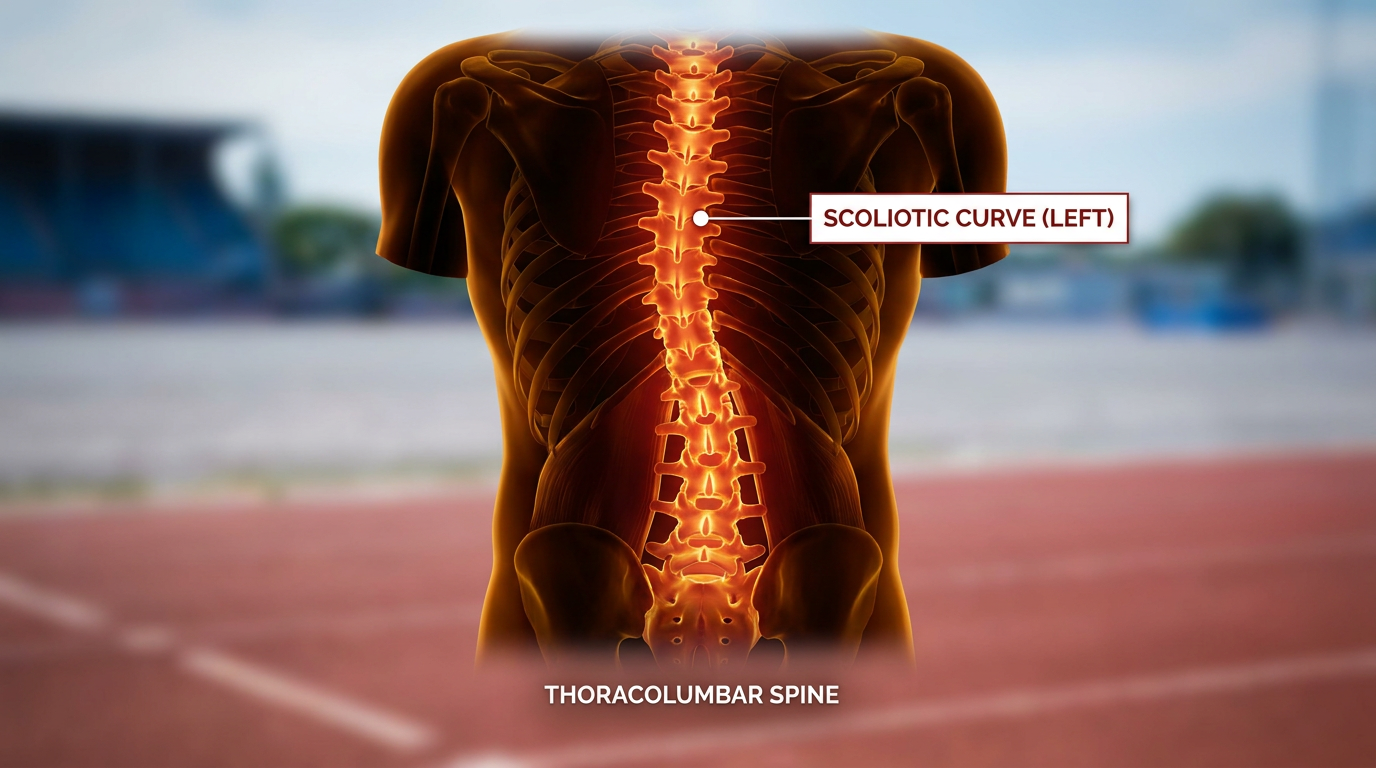
Levoscoliosis of the thoracolumbar spine is a left-bending curve at the junction between your rigid thoracic spine and flexible lumbar spine (T10 to L2).
What ‘Levo’ Tells You
The term levoscoliosis specifically means your spine curves to the left. Direction alone doesn’t determine severity, but it can shape which follow-up questions your specialist asks.
Our overview of levoscoliosis covers causes and symptoms across the whole spine, and this article stays on the thoracolumbar location.
Where the Thoracolumbar Junction Sits
The thoracolumbar junction is the stretch of spine spanning roughly T10 to L2, where the more rigid thoracic spine meets the more flexible lumbar spine.
In your report, thoracolumbar means the curve is centered at this junction rather than in one region alone.
Why a Curve Forms at the Thoracolumbar Junction
The cause often varies by age. A growing child’s spine often curves for no reason anyone can find, while an adult’s curve may follow years of wear in the discs and joints.
Curves in Growing Spines
For most growing children, doctors can’t find a specific cause, so they call the curve idiopathic, meaning it arose without an identifiable reason. For a growing child, that doesn’t mean anyone missed something on imaging or in the exam.
Curves That Develop with Age
A curve can also develop later in life as degenerative disc disease affects the discs and joints. Degenerative disc disease means the cushioning discs between your vertebrae wear down over time.
A specialist may consider several possible causes, including:
- Congenital vertebral differences, or spinal bones shaped differently before birth
- Neuromuscular conditions, which affect the nerves and muscles that support the spine
- Genetic syndromes, or conditions connected to changes in a person’s genes
During the first visit at Premier Orthopaedics & Sports Medicine, our spine specialists use your history, exam and imaging to narrow down which explanation applies.
The cause shapes which symptoms and changes your specialist tracks over the follow-up visits.
Symptoms in Growing Children Versus Adults
Children and adults may arrive at the spine clinic for different reasons. A child’s curve may first come to attention when a parent, coach or school nurse notices a physical change, while an adult may schedule a visit because of pain.
What Parents Notice
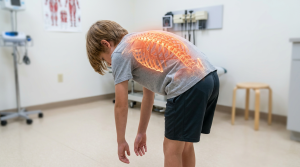
You might see uneven shoulders or hips, a rib prominence when your child bends forward or clothing that hangs unevenly. A child’s curve can be painless, so your child may have no complaints.
Our guide to scoliosis in children covers what the diagnosis means for your family.
What Adults Feel
For adults, degenerative scoliosis can cause back, hip or leg pain as well as sciatica, which is pain that travels along the sciatic nerve into the buttock or leg.
You can get day-to-day relief through heat and ice therapy, anti-inflammatory medication, activity modification (avoiding prolonged sitting or standing), and physical therapy to strengthen your core.
Two adults with the same Cobb angle can feel very different things, which is why the next step is an exam and imaging review that connects what you feel with the curve.
How Doctors Measure and Confirm a Thoracolumbar Curve
The report you’re holding describes a single image at a single moment. A doctor adds an exam, a precise angle measurement and, for a child, an estimate of remaining growth before recommending care.
The First Visit, Test by Test
The visit may include the same steps a doctor uses to evaluate other spinal curves. Each test below adds information about the curve’s shape, rotation and likelihood of changing:
- Forward bend test: Shows asymmetry in your back and rib cage during flexion.
- Scoliometer reading: A scoliometer is placed over the thoracolumbar area to provide the doctor with a rough estimate of the spine’s curvature.
- Measures trunk rotation during the forward bend test using a small level-like tool.
- Standing X-ray: Creates a baseline image of your spine’s curve and structure.
- Cobb angle measurement: Quantifies the exact degree of your spinal curve (10 degrees or more defines scoliosis).
- Growth assessment for children: Determines remaining skeletal maturity and the risk of curve progression.
These tests tell your doctor the curve’s size and whether it’s likely to worsen. Your doctor will likely order an MRI to see whether the curve is pinching a nerve.
When an MRI Enters the Picture
Your doctor will order an MRI if you have leg pain, numbness, weakness, or other nerve symptoms that suggest the curve is pinching a nerve.
An MRI shows soft-tissue details, including discs, nerves, and the spinal cord, that X-rays can’t see. It helps your doctor decide whether conservative care is enough or whether you need a different treatment approach.
Treatment Options for a Left Thoracolumbar Curve
Most adolescents with idiopathic scoliosis don’t need surgery. The plan depends on curve size, growth remaining, and symptoms, and nonsurgical treatment usually comes first.
Conservative Care Comes First
For smaller curves, the plan may involve observation and repeat standing X-rays at intervals your specialist sets based on the images.
The plan may also include physical therapy with exercises your therapist selects for you or your child’s needs.
For adults, Premier’s conservative pathway may include medication management, such as epidural injections and nerve blocks, activity changes and image-guided procedures when nerve pain dominates.
Specialists may recommend bracing for growing children with curves in the 25 to 40 degree range, which aims to hold the curve steady until growth ends rather than straighten it.
Our guide to scoliosis bracing explains how bracing works during growth.
When Surgery Enters the Conversation
Surgery may come up only after medically appropriate conservative options have run their full course, particularly when a curve passes roughly 45 to 50 degrees and keeps progressing.
| Surgery Type | What Happens | For |
|---|---|---|
| Spinal Fusion | Joins vertebrae together to correct and stabilize the curve | Adults & Children |
| Vertebral Body Tethering (VBT) | Uses flexible cord to guide spine growth while preserving motion | Children Only |
Dr. Jay S. Reidler, MD, MPH, a Harvard-, Hopkins-, and Columbia-trained spine surgeon with pediatric and adult deformity training, performs VBT as part of Premier’s pediatric spine program. He leads our spine surgery team and can discuss whether fusion or VBT may fit your situation.
When to See a Spine Specialist
Seeing a spine specialist can help clarify any new levoscoliosis finding on your child’s imaging, even when the curve appears mild, since growth can influence how it progresses.
If you’re an adult reviewing your own report, consider scheduling a visit when back pain starts limiting your daily activities or when you notice leg numbness, weakness or pain running down one leg.
Our neck and back specialists treat both children and adults with this diagnosis. A second opinion may be worth pursuing if your first visit leaves you with unanswered questions about any of the following:
- how a Cobb angle near the bracing range relates to your remaining growth
- whether an MRI should be considered for a left thoracolumbar curve
- why the first specialist recommended surgery before trying conservative care
A second specialist can review the same X-rays and address whichever question you have, giving you a clearer foundation for deciding your next step.
If you’d like someone to read your child’s report, or your own, line by line and explain what the thoracolumbar location means for the next step, our spine team in Northern New Jersey can walk you through it.
Frequently Asked Questions About Levoscoliosis of the Thoracolumbar Spine
Is a left thoracolumbar curve more serious than a right one?
Direction alone doesn’t determine how serious a curve is. Two curves with the same Cobb angle but bending in opposite directions can carry different implications depending on the person’s age, symptoms and where in the spine the curve sits.
When will my child need a follow-up X-ray?
No single follow-up interval fits every child. Your child’s specialist will set the timing after reviewing remaining growth, the Cobb angle and changes between images, so bringing earlier X-rays can help show whether the curve has progressed.
Can my child stay in sports with a thoracolumbar curve?
Sports participation may still be possible, but the plan depends on your child’s pain, curve size, brace use and stage of treatment. The treating specialist can explain whether your child needs any sport-specific changes. Our spine care FAQ covers broader questions about recovery and surgery.
Can a thoracolumbar curve keep changing after my child stops growing?
Curves that reach the surgical range before growth ends are more likely to keep progressing into adulthood, while smaller curves usually stay stable once bones stop growing. Adults with a curve from childhood may still see gradual change as the discs and joints wear over the years, which is why periodic imaging can be part of long-term follow-up.
This article is for general information only and isn’t a substitute for professional medical advice. Talk to your doctor about your specific situation before making treatment decisions.