
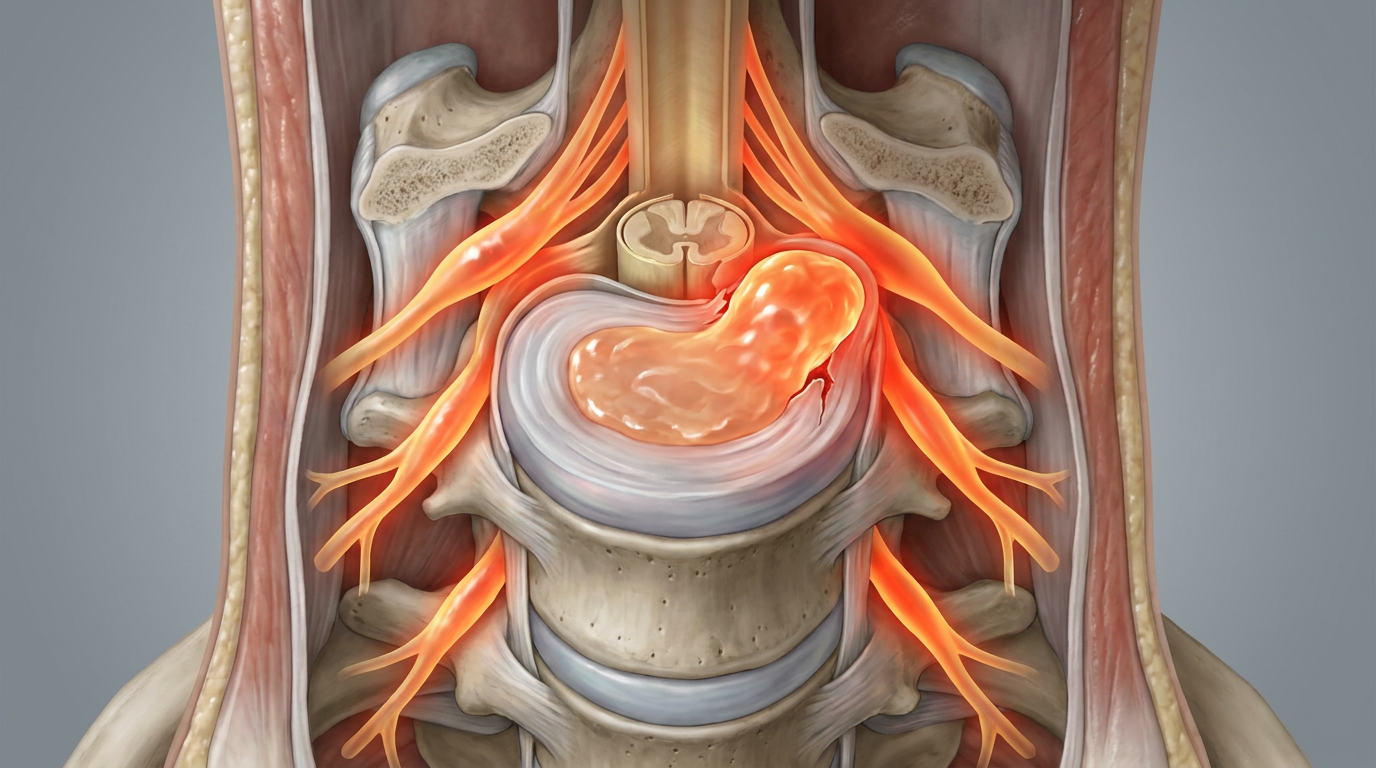
You turn your head to check a blind spot, and pain shoots from your neck into your shoulder and down one arm while your fingers tingle. That pattern often points to a herniated disc in the neck. Most cases improve without surgery, though the right treatments depend on how severe your symptoms are and whether a nerve or the spinal cord is under pressure.
This article from Premier Orthopaedics & Sports Medicine covers the causes, symptoms, diagnosis, conservative treatment, surgical thresholds and recovery.
Table of Contents
ToggleWhat Is a Herniated Disc in the Neck
A herniated disc happens when the soft, jelly-like center of a spinal disc pushes through a tear in its tougher outer layer.
In the neck, that bulging material can press on a nearby nerve root and cause pain, numbness or weakness in your neck, shoulders, arms or hands. Doctors call this a cervical herniated disc because the cervical spine is the section of the spine that runs through your neck.
The cervical spine runs between the base of your skull and your shoulders, with cushioning discs between most vertebrae. Herniated discs of all kinds are common, and more than three million people in the U.S. get a herniated disc (at any spinal level) each year.
What Causes a Cervical Herniated Disc
Age-related wear causes most cervical herniated discs. As you get older, the discs in your spine become less flexible, and small movements like bending or twisting can be enough to tear the outer layer.
After years of wear, an ordinary movement may trigger symptoms, and many people can’t point to a single moment when the problem started.
Worn discs don’t automatically mean pain. Nearly half of middle-aged and older people have degenerative disc changes and even nerve compression on imaging that cause no symptoms, so imaging changes may not match your symptoms.
A fall or a motor vehicle accident can also directly tear a disc. Heavy lifting can contribute to this type of injury, and a workers’ compensation claim may cover a job-related injury. The symptoms, rather than the cause alone, often bring people to the doctor.
Herniated Disc in the Neck Symptoms
The signature pattern is neck-to-arm pain along the path of the compressed nerve, and most people describe it as burning or sharp. Doctors call that pinched nerve root in the neck cervical radiculopathy.
Some cervical herniations never cause symptoms at all and turn up only when a scan for something else catches them. The location of your symptoms can help your doctor identify which disc may be pressing on a nerve.
Common Symptoms
Most people with a cervical herniated disc notice some combination of the following:
- Burning or sharp pain that radiates from the neck into the shoulder, arm or hand
- Tingling or numbness in the arm, hand or fingers
- Weakness in the arm or a weaker grip
- Pain that worsens with neck extension or rotation
Describing where the symptoms travel gives your doctor useful context for the evaluation. You should also mention any change in grip or arm strength.
Warning Signs That Need Immediate Care
A different set of signs can mean the disc presses on the spinal cord itself rather than a single nerve root. Doctors call spinal cord pressure cervical myelopathy, and it can affect strength and coordination as well as bladder or bowel control.
You need same-day medical care if you notice any of these:
- Symptoms in both arms or at several levels at once, especially after a fall or accident
- Weakness that worsens
- Bowel or bladder changes
- New clumsiness or trouble with coordination, such as fumbling buttons, dropping things or walking unsteadily
Doctors treat these signs with greater urgency than they do a pinched nerve root. Prompt care may improve your chance of neurological recovery.
Already been told you need neck surgery?
Most people with a cervical herniated disc improve without an operation, so a surgical recommendation is a natural point to ask questions. A second opinion is a normal part of that decision, and Premier’s spine team reviews your prior imaging and records before the visit, not during it.
How Doctors Diagnose a Herniated Disc in the Neck
Diagnosing a cervical herniated disc is a step-by-step process. Your doctor gathers clues from your history, confirms them with a hands-on exam and then decides whether imaging would add useful information. The goal is to connect the pattern of your symptoms to a specific nerve so treatment targets the right level.
History and Physical Exam
Diagnosis starts with your history and physical exam. Your doctor will ask when the pain began, what makes it better or worse and how it affects sleep, work and daily tasks, so be ready to describe where the pain travels, which fingers tingle and which neck movements change your symptoms.
During the exam, your doctor will map your arm symptoms and test your reflexes, sensation, and strength. Simple maneuvers, like gently tilting or rotating the head, can reproduce arm symptoms when a nerve root is irritated.
That mapping often helps neck and back specialists predict the disc level before imaging and decide which scans, if any, are worth ordering.
Imaging: MRI, X-Ray and Other Tests
MRI can show herniation and nerve pressure, and it’s the test doctors rely on most for cervical disc problems because it shows soft tissues like discs, nerves and the spinal cord.
A normal X-ray may not settle the question, as it shows bone alignment and degenerative changes but not the disc itself. Your doctor may still order one to check for arthritis or instability.
A CT scan or CT myelogram, and electromyography (EMG) or nerve conduction studies can be used instead to help determine whether arm symptoms stem from a pinched nerve in the neck or another problem, such as carpal tunnel syndrome.
Putting the Pieces Together
Doctors compare the exam and MRI when making a diagnosis, then use that diagnosis to guide treatment. Imaging findings that don’t match your symptoms are treated cautiously, because worn discs and even nerve compression can appear on scans of people who feel fine.
A clear match between the nerve your exam points to and the disc your MRI shows gives your doctor the strongest basis for choosing among therapy, injections and surgery.
Treatments for a Cervical Herniated Disc
Most people with a cervical herniated disc get better without surgery, so care follows an escalation pathway: conservative care first, injections if therapy alone isn’t enough and surgery only when those steps haven’t worked, or the nerve is at risk.
Your doctor can set a timeframe for each step based on your symptoms, strength and daily function.
Conservative Care First
Nonsurgical treatment helps many people improve. Early treatment usually combines a few approaches:
- Modifying activities that worsen your neck or arm symptoms
- Wearing a soft cervical collar for short-term symptom relief, for periods your doctor sets based on your symptoms and daily function
- Taking nonsteroidal anti-inflammatory drugs (NSAIDs) or, in some cases, a short course of oral steroids
- Starting physical therapy to restore motion and strengthen the muscles that support your neck
If your arm pain is easing week over week, your doctor may recommend continuing the current treatment. You should tell your doctor if the pain remains unchanged, worsens, or new weakness develops so your doctor can reassess the plan.
Injections When Therapy Isn’t Enough
When therapy and medication haven’t quieted the arm pain, your doctor may consider an epidural steroid injection. The injection may reduce inflammation around an irritated nerve.
Our pain management specialists perform these injections, and they’re part of a wider set of pain management treatments that may reduce symptoms while you recover without an operation.
When Surgery Enters the Conversation
Surgery becomes a serious option when symptoms persist despite a structured course of conservative treatment, with the timeframe set by your symptoms, strength and daily function.
Your doctor may raise it sooner if you have progressive weakness or symptoms you and your doctor can’t control. Signs of spinal cord pressure may prompt an immediate discussion about surgery.
The main cervical operations include:
- Anterior cervical discectomy and fusion (ACDF): Your surgeon removes the damaged disc through the front of the neck and joins the vertebrae above and below.
- Cervical artificial disc replacement: Your surgeon removes the damaged disc through the front of the neck and replaces it with a motion-preserving implant instead of fusing the vertebrae.
- Posterior laminoforaminotomy: Your surgeon removes a small amount of bone and disc through an incision at the back of the neck to relieve nerve pressure.
Our spine surgery team matches the operation to the affected disc level, your anatomy and your goals. You can also ask for a second opinion before scheduling anything.
What Recovery Looks Like
Recovery time varies, but many people notice improvement from a cervical disc herniation within weeks, even though full healing can take longer. Improvement often comes early.
Among people who chose nonsurgical treatment, 88 percent improved within the first four weeks as inflammation decreased and the body resorbed some disc material.
After ACDF, many people gradually return to daily activities as their surgeon clears them. Recovery and physical therapy often continue for several weeks, but your surgeon sets the duration based on the procedure, your symptoms and your daily function.
Your surgeon can explain which temporary symptoms to expect and why recovery timing varies.
For what to expect before and after an operation, Premier’s recovery guidance covers preparation, restrictions and follow-up.
When to See a Doctor About Neck and Arm Pain
You should make an appointment if neck or arm pain persists, interferes with sleep or work or occurs with numbness or weakness. You’ll need more urgent care if weakness progresses or you develop symptoms in both arms, coordination trouble, balance problems or bowel or bladder changes. The warning signs covered earlier call for same-day care. Premier’s spine team can evaluate whether a cervical herniated disc is responsible for your symptoms at our offices across Northern New Jersey.
Frequently Asked Questions About Herniated Disc in the Neck
Can a herniated disc in the neck heal on its own?
Often, yes, especially when pain, sensation and strength improve during conservative care. At follow-up visits, your doctor can compare your arm pain, sensation, grip and strength with your earlier exam. A simple weekly log of sleep, grip and difficult tasks can make those changes easier to describe.
Is it safe to exercise with a cervical herniated disc?
Continued daily activity and a structured home exercise program are usually part of treatment. You can ask your doctor or physical therapist which neck positions, lifting movements or sports activities you should modify. Tracking which exercises ease or worsen your arm symptoms can help your therapist adjust the program.
What happens when a herniated disc in the neck is treated without surgery?
Most people improve with a combination of activity modification, NSAIDs, physical therapy and sometimes an epidural steroid injection. Track pain, grip strength and tasks that remain difficult from week to week.
Bring that note, your medication list and questions about work or sleep to each follow-up so you can describe your progress clearly. Contact your doctor before the next routine appointment if weakness appears or worsens.
Do I need an MRI before starting treatment?
Bring any prior images and reports to your appointment so your doctor can compare them with your current exam. Be ready to describe where the pain travels, which fingers tingle and which neck movements change your symptoms. Your doctor can then decide whether an MRI would change the treatment plan.
This article is for general information only and isn’t a substitute for professional medical advice. Talk to your doctor about your specific situation before making treatment decisions.