Your 13-year-old bends to tie a shoe and one shoulder blade sits higher than the other. Maybe you’re 63, and an X-ray for hip pain comes back with the word “dextroscoliosis.”
The same right-leaning curve looks and feels different at 13 than at 63, and knowing which dextroscoliosis symptoms fit your age group tells you how quickly to act.
This guide walks through the signs of dextroscoliosis to watch for at any age, from subtle asymmetries in growing children to nerve-related changes more common in older adults.
What Is Dextroscoliosis?
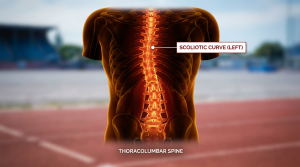
Dextroscoliosis is scoliosis in which the spine curves to the right. Right-leaning curves are common, and your doctor records the curve’s Cobb angle measurement in degrees.
Doctors often group curves by Cobb angle to guide monitoring and treatment. Curves of 10 to 25 degrees are considered mild, 25 to 40 degrees moderate and 40 degrees or more severe.
Curve location terms include thoracic, lumbar and thoracolumbar. Thoracic refers to the upper and middle back, where the ribs attach, while lumbar refers to the lower back. A thoracolumbar curve spans both areas, where the thoracic meets the lumbar.
Doctors often see thoracic curves in children and teens and lumbar curves in adults, patterns that can reflect different causes.
Dextroscoliosis Symptoms by Age
Dextroscoliosis symptoms fall into three age-based patterns: visible asymmetry in growing children and teens, back pain and posture changes in adults with a long-standing curve, and nerve-related leg symptoms in older adults with a degenerative curve.
Children and Adolescents
An estimated 90 percent of adolescents with scoliosis have a curve that bends right. The most common cause in this age group is adolescent idiopathic scoliosis, where no specific cause can be identified.
Less commonly, pediatric scoliosis is congenital (present at birth) or related to neuromuscular conditions such as muscular dystrophy, cerebral palsy, or spina bifida.
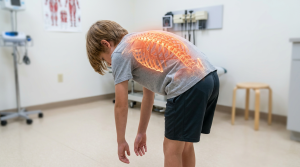
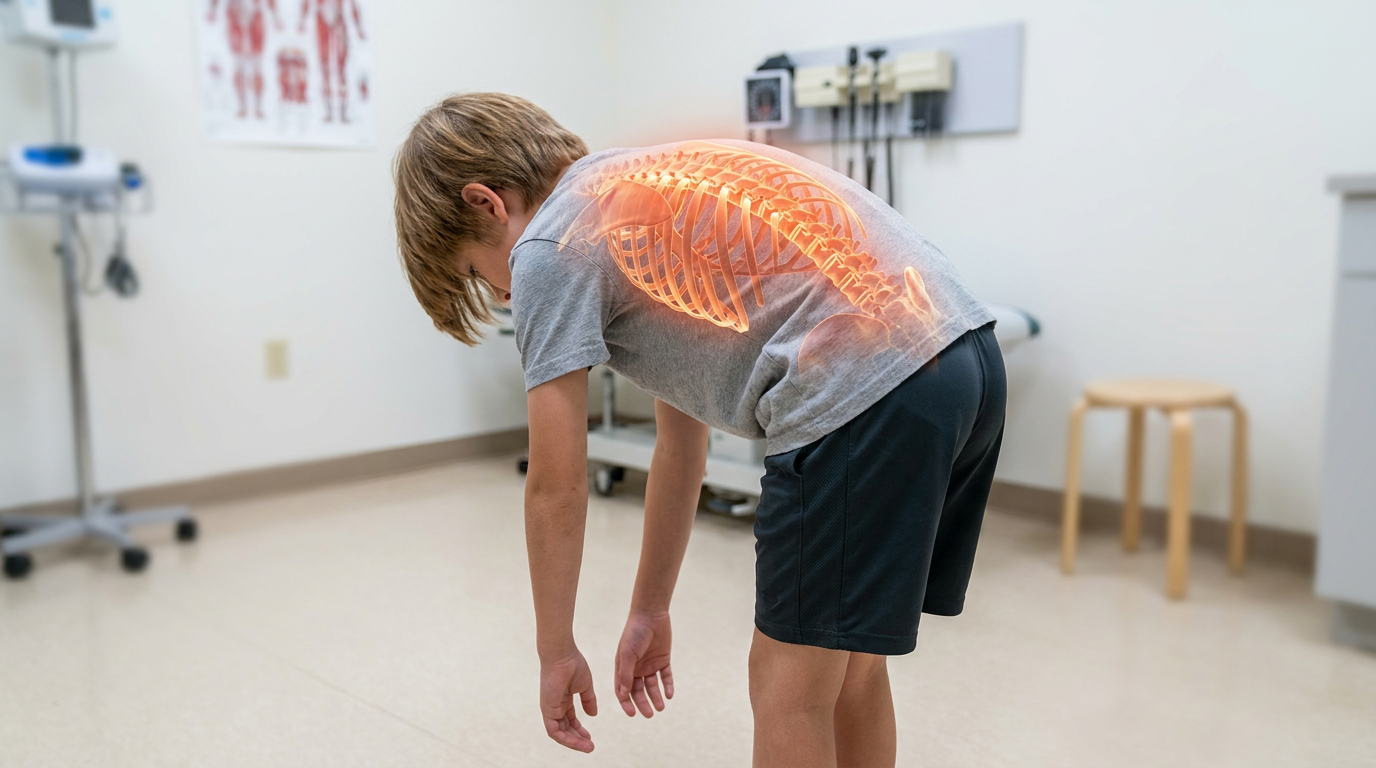
You can detect scoliosis in children by looking for the following signs, which may appear alone or together:
- One shoulder higher than the other, or one shoulder blade that sticks out
- A right-side rib hump when your child bends forward
- An uneven waistline
- The trunk shifted to one side so the body doesn’t sit centered over the pelvis
- The head sits off-center over the hips from behind
If you notice any of these signs, ask a doctor to evaluate your child. A medical evaluation determines whether the asymmetry represents scoliosis and whether the curve needs monitoring.
Some curves can worsen during growth, so doctors re-check scoliosis in children on a schedule.
Adults with a Long-Standing Curve
In adults, the most common cause of dextroscoliosis is adult idiopathic scoliosis (an adolescent curve that has persisted into adulthood), along with early degenerative changes in the discs and facet joints.
In adults in their 20s and 30s, 65 percent of those with thoracic idiopathic scoliosis had a right thoracic curve.
Pain is common in adult scoliosis and is reported by most patients in clinic-based studies. Adult symptoms often include these changes:
- Back pain
- A visible bulge or uneven posture in the mirror
- Leg pain or numbness when something near the curve presses on a nerve
- Fatigue during daily activity
- In some large curves, shortness of breath or early fullness when eating
Some adults see the curve stabilize, while others notice further curve progression, chronic pain, osteoporosis or fractures.
Doctors usually treat pain in the joints and muscles around the curve first, with scoliosis pain-relief options such as physical therapy and medication.
Your response helps your doctor decide whether nearby tissues cause the pain or whether you need further evaluation.
Older Adults with a Degenerative Curve
In older adults, degenerative (de novo) scoliosis is a curve that develops in someone with no history of scoliosis in their teens. It happens alongside degenerative changes in the spine such as disc wear.
You may notice one or more of these changes:
- Hip or leg pain, including sciatica, which travels along the sciatic nerve from the lower back down the leg
- Numbness or weakness, including foot drop (difficulty lifting the front of the foot when walking, which can cause the toes to drag)
- Leg heaviness or fatigue when walking
- Loss of height
- Uneven hip alignment
At your appointment, expect your doctor to spend as much time on your legs and walking tolerance as on your back. Nerve pressure from a degenerative curve often shows up first in how far you can walk and how comfortably.
Treatment Options for Dextroscoliosis by Age
Treatment for dextroscoliosis starts with conservative care at every age and only moves to surgery for large, progressing curves or persistent nerve symptoms.
The right plan depends on your age, symptoms and curve, since a growing child and a retiree with the same Cobb angle are under different protocols.
Conservative Care Comes First
Non-surgical care, tailored to age and symptoms, is the first step for nearly everyone with dextroscoliosis.
Conservative care is the starting point at every age, and doctors tailor the first steps to growth, symptoms and nerve involvement:
- Children and teens: observation with repeat X-rays during growth; care may also include physical therapy and scoliosis bracing for moderate curves during growth.
- Adults: physical therapy and activity modification for pain flares from the joints and muscles around the curve; your doctor may also recommend medication.
- Older adults with a degenerative curve: the adult measures above, plus epidural injections and nerve blocks when compressed nerves cause leg symptoms.
Follow-up on dextroscoliosis is based on growth, X-rays, and new symptoms to show whether the curve remains stable or conservative care is no longer enough.
When Surgery Enters the Conversation
Surgery becomes an option when a right-sided curve is large or keeps progressing, or when nerve symptoms don’t improve with conservative care.
Doctors may consider surgery for large or progressing curves or persistent nerve symptoms that haven’t responded to conservative care. Growth, curve characteristics and nerve pressure shape the choice:
- Children and teens: spinal fusion, which joins vertebrae so they heal as one bone, may help curves that keep progressing despite bracing. Another option is Vertebral Body Tethering (VBT), which offers a motion-preserving alternative to fusion for certain children with significant growth remaining.
- Adults and older adults: decompression surgery, which relieves pressure on nerves, may take place with or without fusion when nerve symptoms or curve progression limit daily life.
Dr. Jay S. Reidler, a Harvard, Hopkins and Columbia-trained spine surgeon, performs all these surgeries at Premier.
Your surgeon will compare those options with your response to conservative care before recommending an operation.
Recovery and Monitoring of Dextroscoliosis
For most people with dextroscoliosis, recovery consists of regular monitoring. Doctors re-check growing children with mild curves based on remaining growth, using exams and X-rays to track changes.
Visits usually spread out once growth stops, and you can keep earlier X-rays for comparison.
Adults follow a different schedule because symptoms often guide follow-up. Your doctor may reassess an adult curve after new leg pain, a visible posture shift or pain that no longer responds to previous treatments.
Talk with Premier’s Spine Team
Bring your imaging and prior X-rays so Premier’s spine team can compare them with your current exam and symptoms. The team sees children and adults with dextroscoliosis across Northern New Jersey, whatever stage of monitoring or treatment you’re in.
Frequently Asked Questions About Dextroscoliosis Symptoms
Can a mild dextroscoliosis curve cause my back pain?
A mild curve can appear on the same X-ray as a painful disc or joint problem without causing the pain itself. Track where the pain starts, which movements worsen it and whether it travels into your leg. Your doctor can compare that pattern with your exam and imaging rather than assuming the curve explains every symptom.
Is a right-curving spine more or less concerning than a left one?
Curve direction alone doesn’t determine how concerning it may be. Ask your doctor to show you the curve’s location and Cobb angle and compare them with older X-rays. That information tells you more than the words “right” or “left” on the report.
How can I check my child at home for signs of a right thoracic curve?
A forward-bend check can help you notice asymmetry, but it can’t measure a curve or confirm scoliosis. If the same rib or shoulder difference appears more than once, write down which side looks higher and when you first noticed it. That record can help you describe the change during a medical evaluation.
Does dextroscoliosis get worse after you stop growing?
Some adult curves change slowly as discs and joints wear, while others remain stable. Age alone can’t predict whether your curve will progress. Ask your doctor how the curve’s location, size and your symptoms should shape your monitoring schedule.
This article is for general information only and isn’t a substitute for professional medical advice. Talk to your doctor about your specific situation before making treatment decisions.