
Artificial Disc Replacement Treatment in New Jersey
Hearing that you might need a disc replaced sounds more serious than it is, as it is a fairly common procedure. Artificial disc replacement treatment removes one worn down or herniated disc that’s pressing on a nerve or causing pain, and puts in a small implant that bends and turns the way a healthy disc does. For most people, that means relief from the pain, numbness or weakness the damaged disc was causing, while keeping the normal movement in their neck or lower back. It’s usually considered only after physical therapy, medication or injections haven’t helped enough. If you’re trying to understand whether it applies to you, our spine specialists in Bloomfield, Englewood and Union City can look at your symptoms and imaging and help you determine if it is the right move for you.
What Is Artificial Disc Replacement?
Artificial disc replacement, also called total disc replacement or disc arthroplasty, is spine surgery that removes a worn or herniated disc and puts a motion-preserving implant in its place. Your discs sit between the bones of the spine, cushioning them and letting you bend and turn. When a disc breaks down, it can press on a nearby nerve or become a source of pain on its own.
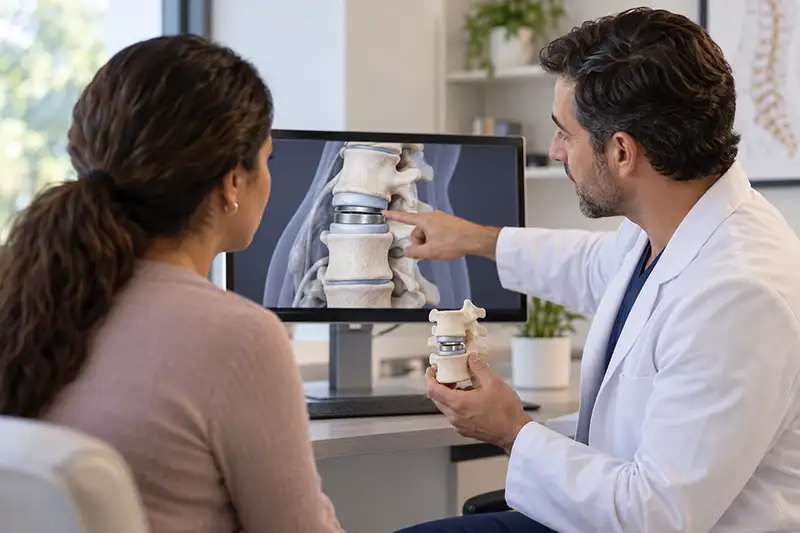
Most artificial discs have two metal endplates that anchor to the bone above and below, with a smooth gliding core between them. The design lets the treated level bend, rotate and absorb everyday movement much the way a healthy disc does, which helps the spine above and below it keep working naturally.
Why Is Artificial Disc Replacement Performed?
Artificial disc replacement is performed to take pressure off nerves irritated by a damaged disc while keeping natural movement at that level of the spine. The procedure treats several disc-related conditions: a herniated disc pressing on a nerve root, a bulging disc that has stopped responding to conservative care, and degenerative disc disease, the gradual wear that thins a disc and lets it collapse over time. In the neck, disc replacement can also relieve a pinched nerve in the arm (cervical radiculopathy) and spinal stenosis when a disc and the bone spurs around it are what’s causing the space to narrow. Which of these qualifies you depends on whether the problem disc sits in your neck or lower back.
Cervical (Neck) Artificial Disc Replacement Candidates
Neck disc replacement is most often considered for arm pain, tingling, numbness or hand weakness caused by a herniated or worn disc pressing on a nerve. The damaged disc should be at one or two levels in the middle or lower neck, and symptoms should still be limiting daily life after several weeks of non-surgical treatment such as physical therapy, medication or injections.
Lumbar (Lower Back) Artificial Disc Replacement Candidates
Lower back disc replacement is generally reserved for back pain that traces to degenerative disc disease at one or two levels in the lowest part of the spine. Because the surgery is larger, most candidates have already tried around six months of structured non-surgical care. Leg pain caused mainly by a single disc fragment, often felt as sciatica, usually responds to a smaller operation, and a microdiscectomy may be the better first step in that case.
How Is Artificial Disc Replacement Performed?
Artificial disc replacement is performed under general anesthesia through the front of the body, so the spine surgeon can reach the disc without moving the spinal cord or cutting through the back muscles. The procedure follows the same principles as minimally invasive spine surgery: a small incision, muscles gently moved aside instead of cut, and live imaging to guide each step. At Premier Orthopaedics, disc replacement is performed by Dr. Jay S. Reidler, a board-certified spine surgeon who trained at Harvard Medical School and Johns Hopkins and completed his spine fellowship at Columbia University. He removes the damaged disc and any bone spurs pressing on the nerves, then sizes and fits the implant into the open space. Live X-ray imaging during surgery lets him confirm the implant’s size and position before the incision is closed.
Cervical (Neck) Artificial Disc Replacement Approach
Neck disc replacement uses a small incision along a natural skin crease at the front of the neck. The windpipe and food pipe are gently moved to one side to expose the disc, then returned to their normal position once the implant is seated.
Lumbar (Lower Back) Artificial Disc Replacement Approach
Lower back disc replacement uses an incision in the lower abdomen. An access surgeon often assists by moving blood vessels and abdominal organs aside so the front of the spine can be reached safely, which is one reason the hospital stay runs longer than it does for the neck.
What to Expect After Artificial Disc Replacement
Most patients stand and walk within hours of artificial disc replacement treatment, and gentle movement is encouraged from the start. For both neck and lower back procedures, bone grows onto the implant over the first few months and holds it securely in place. Your own timeline depends on the level treated, your overall health, your job and your surgeon’s guidance.
Cervical (Neck) Artificial Disc Replacement Recovery
Most people go home the same day as a neck disc replacement or after one night in the hospital. A sore throat, hoarse voice or mild trouble swallowing is common for one to two weeks and fades as swelling settles. Desk work often resumes within one to three weeks, and physical therapy usually begins two to four weeks after surgery. Most people can turn their head comfortably again within a few weeks. Driving usually resumes once you are off narcotic pain medication and can check your blind spots without strain. Heavy lifting and physically demanding work typically wait around six weeks.
Lumbar (Lower Back) Artificial Disc Replacement Recovery
A lower back disc replacement usually involves a hospital stay of one to three days, and most patients take their first walk the same day or the next morning. The abdomen is often sore and stiff for the first couple of weeks while the incision heals. Short, frequent walks help the most during that stretch, and long periods of sitting get easier after the first few weeks. Physical therapy generally starts two to six weeks after surgery, and desk work often resumes within three to six weeks. Bending, twisting and lifting come back in stages as therapy rebuilds core strength, with heavy lifting and physical jobs taking anywhere from six weeks to three months.
Frequently Asked Questions About Artificial Disc Replacement in New Jersey
Cervical disc replacement is artificial disc replacement performed in the neck. You may also hear it called total disc replacement, disc arthroplasty or, when it’s done in the lower back, lumbar disc replacement. All of these names describe the same idea: removing a damaged disc and putting in an implant that preserves motion.
Neck disc replacement is typically done through an incision of an inch or two, which puts it in line with minimally invasive techniques. Lower back disc replacement needs a larger incision in the abdomen because of the blood vessels and organs in front of the spine, though the back muscles are still left untouched. Dr. Reidler can explain which approach your spine needs and what it means for your recovery.
For well-chosen patients, disc replacement offers lasting relief. In a 10-year FDA clinical trial, patients with two-level neck disc replacements kept their pain relief and neck motion through the full decade. Results are strongest when imaging shows a clear disc problem at one or two levels that matches the patient’s symptoms.
Artificial discs are built for long-term use, with materials chosen to hold up to years of daily bending and turning. Research continues to follow patients well past the 10-year mark, and periodic X-rays let your surgeon keep an eye on the implant over time.
There is no single age limit for disc replacement. Bone quality and joint health matter more than age, and osteoporosis or advanced facet arthritis, both more common later in life, are the factors that most often rule it out.
Disc replacement at Premier Orthopaedics is performed by Dr. Jay S. Reidler, who sees spine patients at our Bloomfield, Englewood and Union City,. He reviews your symptoms and imaging, explains what the procedure involves and tells you honestly whether it suits your spine before you make any decision.
Disc replacement at Premier Orthopaedics is performed by Dr. Jay S. Reidler, who sees spine patients at our Bloomfield, Englewood and Union City,. He reviews your symptoms and imaging, explains what the procedure involves and tells you honestly whether it suits your spine before you make any decision.
Artificial Disc Replacement Near You in Northern New Jersey
Premier Orthopaedics sees spine patients at our offices in Bloomfield, Englewood and Union City, all reachable at (201) 833-9500. Request an appointment to find out whether artificial disc replacement treatment is a good fit for you.