
Complex Spinal Reconstruction in New Jersey
What is Complex Spinal Reconstruction?
Complex Spinal Reconstruction fixes the shape of the spine, then holds it in place with screws and rods while the bones grow together. Your spine is built to stack your head over your hips so that standing takes little effort. When that stack tilts, the muscles in your back have to work all day to keep you from falling forward. Constant strain like that is why many people with a bent or unstable spine feel worn out and sore by midday.
A routine spinal fusion joins 1 or 2 vertebrae to relieve a single painful spot. Reconstruction is a larger operation that often covers many levels, may reshape bone to change the angle of the spine, and is planned around how your whole body stands.
Why is Complex Spinal Reconstruction Performed?
At Premier Orthopaedics in Northern New Jersey, Dr. Jay Reidler recommends complex spinal reconstruction when the shape of the spine is the source of the problem. Therapy, medicine, and injections can ease pain, but none of them can change that shape. You may be a candidate for complex spinal reconstruction if you have:
- Kyphosis, a forward rounding that leaves you stooped or looking at the floor
- Flatback, where the lower back loses its natural inward curve, often years after an older fusion
- A past spine surgery that failed, such as broken rods or screws, bones that never fused, or wear at the level just above or below a fusion
- A spine that became unstable or healed crooked after an injury or fracture
- Nerve pain that keeps returning because the spine is out of line
- A large adult curve from scoliosis that keeps getting worse
How is Complex Spinal Reconstruction Performed?
Every spine is unique, which is why your treatment starts with precision imaging. Standing whole-spine X-rays reveal how your head and chest align over your hips, while detailed MRI and CT scans capture your nerves and bones. Dr. Reidler uses these images to determine the correction needed to restore your body’s natural balance.
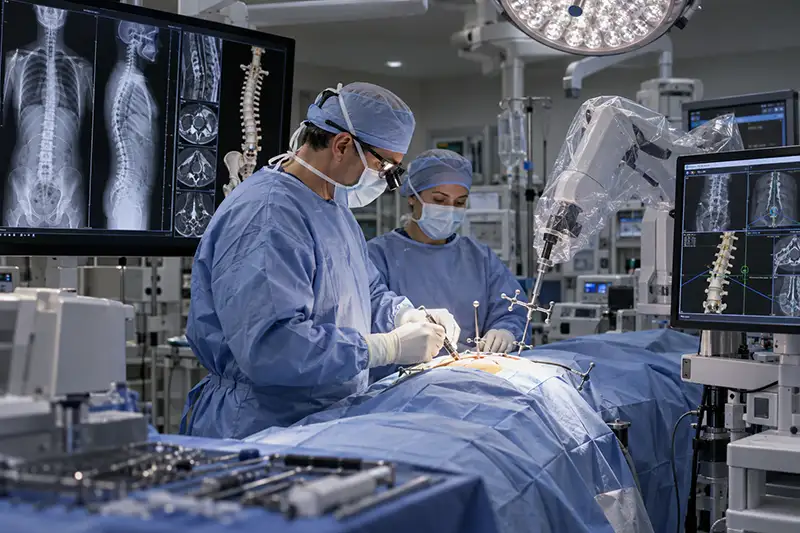
During your spinal reconstruction surgery, you will be comfortably asleep under general anesthesia while a specialized monitoring team tracks your nerve function continuously for safety. Dr. Reidler places screws into the vertebrae and connects them to custom-shaped rods to hold your new alignment. He uses computer navigation and robotic guidance to position these screws with pinpoint accuracy. If your spine is stiff, wedges of bone may be removed so it can move into a healthier position. Finally, bone graft material is laid along the spine, allowing your body to naturally grow new bone over the following months to join the vertebrae into a single, solid support structure.
A standard spinal fusion is usually the right fit when your pain comes from one worn or slipped segment of the spine. The goal is to calm that single problem area by joining the affected vertebrae so they stop moving painfully. Complex spinal reconstruction is meant for a different situation: your whole spine has shifted out of balance, or an earlier surgery did not hold. Instead of treating one spot, reconstruction corrects your overall alignment so you can stand straighter and walk farther with less effort.
Recovery differs between the two operations as well. Many fusion patients have a short hospital stay and notice relief within a few weeks to a few months. After complex spinal reconstruction, most people stay in the hospital for several days, and the improvement builds gradually, with most of the gains arriving over the first year.
What Should You Expect after Complex Spinal Reconstruction?
Recovery from complex spinal reconstruction starts in the hospital. A physical therapist will have you standing and walking within the first day or two, and most people stay for several days. During that time, the care team manages your pain, checks your incision, and teaches you how to get in and out of bed, sit, and stand without twisting your spine. You go home once you can walk safely and your pain is under control with oral medication.
At home, healing depends on steady, gentle activity. You will walk a little farther each day, which helps circulation and strengthens the muscles that support your new alignment. Bending, lifting, and twisting stay off limits while the bone graft fuses. Small changes make the early weeks easier, like moving everyday items to counter height, keeping a reach tool nearby, and having someone help with chores and errands. Smoking and nicotine slow bone growth, so quitting before surgery protects the result.
Follow-up visits track how the fusion is healing. Dr. Reidler uses X-rays at each appointment to confirm the hardware is holding and the bones are joining. Formal physical therapy is added once the spine is ready, with a focus on posture, core strength, and walking endurance. When you can drive or return to work depends on your job, the size of your surgery, and when you stop needing prescription pain medication. Dr. Reidler will set that timeline with you.
Frequently Asked Questions about Complex Spinal Reconstruction
Artificial Disc Replacement Near You in Northern New Jersey
Premier Orthopaedics sees spine patients at our offices in Bloomfield, Englewood and Union City, all reachable at (201) 833-9500. Request an appointment to find out whether artificial disc replacement treatment is a good fit for you.