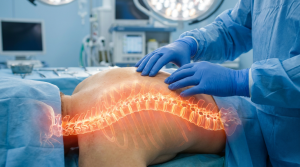

You’ve had a dull ache between your shoulder blades for two months, and it peaks by afternoon, whether you’ve been at a desk or on your feet all day. You’re starting to wonder whether this upper back pain is posture, a disc or something that needs a specialist.
Below is a walkthrough of what likely causes upper back pain, how a spine specialist in Bergen County can help and your treatment options.
Table of Contents
ToggleWhat Area Does the Upper Back Cover?
Upper back pain covers the area from the base of your neck to the bottom of your rib cage, a region doctors call the thoracic spine. It sits between your cervical spine (your neck) and your lumbar spine (your lower back), starting at the base of your neck and ending at the bottom of your ribs.
The thoracic spine has 12 vertebrae labeled T1 through T12, each connected to a pair of ribs. Your thoracic spine is built mainly for structure and support, so it bends and twists less than your neck or lower back.
Common Causes of Upper Back Pain
Upper back pain usually comes from one of three sources: muscle and posture issues, wear and tear in the discs or joints, or a fractured vertebra. Each source has its own typical pattern, and knowing which group you fall into helps shape the treatment path.
Muscle Strain and Posture-Related Pain
Hours at a desk or behind the wheel can hold the muscles between your shoulder blades in one position, leaving them tight and sore by afternoon. Repetition with poor form, weak back muscles and stress-related tension can do the same.
Among office workers, 21.2 percent report upper back symptoms, and poorly fitted seat height is linked to them. Over time, a trigger point can form, a tight knot of muscle fibers that sends pain to a nearby spot and makes the ache hard to pinpoint.
Structural and Degenerative Causes
Several structural issues in the thoracic spine can cause upper back pain, from disc problems to arthritis to changes in curvature. The most common ones to know about:
- Herniated disc: A herniated disc occurs when the disc’s soft center pushes through its outer layer. It’s uncommon in the thoracic spine but can cause sharp, localized pain or band-like pain around the rib cage.
- Degenerative disc disease: Thoracic disc degeneration is age-related wear of the discs, and it often starts as a dull, localized ache that builds over months or years.
- Spinal arthritis: Arthritis in the thoracic facet joints can leave your upper back stiff and achy first thing in the morning, loosening up once you start moving.
- Kyphosis: The spine’s natural kyphosis is the forward curve of the thoracic spine, typically 20 to 45 degrees. A larger curve, including Scheuermann’s kyphosis, can cause pain at the curve’s peak, which posture-focused physical therapy often helps reduce.
Imaging often confirms structural causes, but most people still respond to the same conservative care used for muscle and posture pain. Surgery enters the picture only when the pain affects your daily life, or there are signs of nerve or spinal cord involvement.
Fractures and Bone Loss
Vertebral compression fractures (VCFs) happen when the bony block of a vertebra collapses under load, which can lead to severe pain, loss of height and a forward curve in the spine. VCFs occur most often in the thoracic spine, the middle section of your back.
Pain usually sits right at the break, worsens with movement and position changes and eases when you lie down. Osteoporosis, a disease that thins bone, often explains why the bone gave way in the first place.
Once bone is thin enough, the break can follow a fall or something as ordinary as reaching, twisting, coughing or sneezing. Fracture care usually goes hand in hand with a bone-health workup, so the next cough doesn’t become the next fracture.
Our spine team at Premier Orthopedics & Sports Medicine weighs each cause against your exam, imaging and symptoms before recommending a treatment plan.
Symptoms That Point to the Thoracic Spine
You’ll sometimes notice thoracic pain in a few recognizable patterns. The list below covers the ones that most often show up in a spine consult:
- An ache between the shoulder blades that builds through the day and eases with rest.
- Stiffness and soreness first thing in the morning that loosens up once you start moving.
- Pain that wraps around one side of the rib cage, sometimes sharper with a deep breath or a cough.
- A dull ache that eases when you lean forward or change position for a while.
- Sharp, pinpoint pain in one spot in the mid-back after a minor strain, cough or fall.
- Tight, knotted muscles between the shoulder blades that feel tender to the touch.
- A burning or pulling sensation along one side of the spine that worsens when you reach overhead or carry a bag on one shoulder.
- Pain that wakes you up at night or doesn’t ease in any position.
Your specialist weighs these patterns against your age, bone health and exam findings. The combination usually narrows the likely cause well before any scan is ordered.
How a Spine Specialist Diagnoses Upper Back Pain in Bergen County
Diagnosing upper back pain usually comes down to three steps: a focused history, a hands-on exam and, when the pain hasn’t settled on its own, targeted imaging.
History and Patient Interview
At your first visit, your specialist asks where the pain is, what triggers it and what eases it, when it began and how it’s changed since. You’ll also go over your work and daily activity, any recent injuries, prior back problems, current medications and relevant medical history like osteoporosis, cancer or long-term steroid use.
The symptoms and patterns that come out of these questions often point toward one group of causes before any test is ordered. That focus keeps the exam and imaging tied to a specific question rather than a general screen.
Physical and Neurological Exam
Your specialist checks reflexes, strength and sensation in your arms and legs and watches how you move, bend and twist. They’ll feel along your spine and the surrounding muscles for tender spots, muscle spasm or a step-off that could suggest a fracture.
The neurological check helps separate muscle and joint pain from nerve or spinal cord pain, which changes both the urgency and the type of imaging you may need.
Imaging: X-ray, MRI and CT
For persistent pain or signs of nerve involvement, your specialist chooses the right scan for the question at hand. An X-ray shows bone alignment, arthritis and compression fractures.
An MRI shows discs, nerves and the spinal cord in detail, which makes it the test of choice when a disc or nerve problem is suspected. A CT scan offers sharper bone detail and is useful when a fracture needs more detail than an X-ray can provide.
Your specialist matches the scan to the exam before naming a cause, so the imaging confirms the working theory rather than drives it.
Has Surgery Been Raised for Your Back Pain?
Premier’s spine team reviews your prior imaging and records before the consult, so you walk in with a clear view of your options.
Treatment Options For Upper Back Pain
Treatment for upper back pain follows a specific order: physical therapy, medication and activity changes first, injections if those stall, and surgery only when a nerve, the spinal cord or a fracture leaves no better option. Most people never need to move past the first step.
Physical Therapy, Medication and Activity Changes
Physical therapy strengthens supporting muscles and retrains posture. A gradual return to activity works better than bed rest for most patients, and non-steroidal anti-inflammatory drugs (NSAIDs) such as ibuprofen or naproxen can reduce pain and inflammation, while heat and ice ease sore muscles.
Injections and Pain Management
When physical therapy alone isn’t enough, epidural injections and nerve blocks deliver anti-inflammatory medication to an irritated nerve, and a trigger point injection treats a muscle knot.
A thoracic epidural, an injection into the epidural space, the layer just outside the covering of your spinal cord, may temporarily ease pain and can make therapy easier to keep up.
When Surgery Enters the Conversation
Surgery in the thoracic spine is uncommon, but a few conditions may warrant it. These include a thoracic disc herniation pressing on the spinal cord or a nerve root, thoracic spinal stenosis, severe or progressive kyphosis, a tumor involving a vertebra, or an unstable or badly collapsed compression fracture.
Surgery becomes an option when imaging shows pressure on the spinal cord (myelopathy), nerve pain that doesn’t respond to treatment or structural instability that puts the cord at risk. For a compression fracture with severe pain that nonsurgical care hasn’t improved, your surgeon may recommend kyphoplasty or vertebroplasty, procedures that stabilize the fractured vertebra with bone cement.
Schedule an Upper Back Evaluation
An evaluation with our Northern New Jersey spine team starts with your history and a neurological exam to identify the likely source and ends with a clear plan for next steps. Call 201-833-9500 or request an appointment online.
Frequently Asked Questions About Upper Back Pain in Bergen County
Which type of doctor should I see for upper back pain?
For strain and posture-related pain, you’ll often start with a physiatrist, a doctor who treats muscle, nerve and spine problems without operating. Our pain management specialists handle injections, and spine surgeons step in when the exam and imaging show nerve or spinal cord pressure or a fracture that isn’t settling.
What should I bring to my first spine visit?
You’ll want to bring a short timeline of the pain: when it started, what worsens it and every treatment you’ve tried. Also bring your current medications, any prior X-ray or MRI reports and images, and the date and activity if a specific event started it.
What non-spine problems can mimic upper back pain?
A tearing or ripping pain between the shoulder blades can signal an aortic problem, right-sided pain under the shoulder blade can trace to the gallbladder, and deep mid-back pain that bores through to the front can come from the pancreas. A one-sided band of burning or tingling that follows a stripe across the back, sometimes a few days before a rash appears, can be early shingles. These need a primary care or ER workup, not a spine evaluation.
What if my upper back pain started after lifting at work?
Your first step is to promptly report the injury to your employer. In New Jersey, the employer or its carrier designates the authorized treating physician.
Confirm with your carrier that it has authorized Premier before you book. Our guide to workers’ compensation orthopedic doctors covers the process.
This article is for general information only and isn’t a substitute for professional medical advice. Talk to your doctor about your specific situation before deciding on treatment.