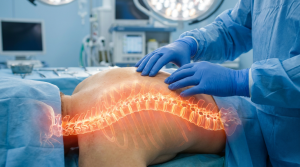

You’re six weeks past your lumbar fusion, your surgeon just mentioned “core work” at your last visit, and your discharge papers still say no bending, lifting or twisting. It feels like a contradiction.
This guide explains when it’s safe to start core training after lumbar fusion and walks through the four phases of core work, plus the symptoms that mean you should call your spine surgeon or 911.
Table of Contents
ToggleWhy Core Strengthening Is Important After Lumbar Fusion
Core training matters after lumbar fusion because the deep abdominal and spinal muscles act as a built-in brace for your lower back, taking load off the fused segment and the discs just above and below it.
A lumbar fusion doesn’t rebuild that support, and surgery combined with weeks of reduced activity often leaves the abdominal and spinal muscles weaker than before.
A stronger core helps you move, lift and sit without putting extra strain on neighboring levels, which is a key part of your physical therapy (PT) program.
When Core Strengthening Can Begin After Lumbar Fusion
You won’t start core strengthening on a set week or day after surgery. The bone can take several months to fuse, and your surgeon limits movement at that segment while the bone heals. During this period, the fused spine must stay properly aligned.
Your surgeon clears you to start when it’s time to start physical therapy, which should include a focus on core strengthening, based on your condition and recovery progress.
Some protocols suggest starting physical therapy between three and six weeks after surgery can reduce low back pain, speed functional recovery and lower disability for single-level lumbar interbody fusion.
Strength-based rehab as early as three weeks after surgery is safe and may help you return to normal activity sooner, though waiting until the 12-week mark has been linked to better outcomes at a lower cost than starting at 6 weeks.
Premier Orthopaedics & Sports Medicine’s guide on physical therapy after fusion explains how bone healing sets the recovery timeline.
Core Exercises After Lumbar Fusion by Recovery Phase
Core strengthening after spinal fusion moves through four phases, starting with early activation and building toward maintenance after PT ends.
In every phase, you’ll target the deep stabilizers, mainly the transversus abdominis and lumbar multifidus, the deep abdominal trunk muscles that run alongside your spine. There are some exercises that you should avoid during this period.
Phase One: Early Activation as Directed by Your Care Team
Start with short walks and gradually lengthen them, and ask your care team whether they approve stationary cycling or an elliptical.
Here are the simple exercises to start with:
- Breathe with your diaphragm: these are breathing muscles below your lungs. Lie on your back with knees bent and one hand on your belly.
- Brace lying down: Abdominal bracing means tightening the deep abdominal muscles as your physical therapist shows you. Inhale, then hold that tightness as you exhale slowly. Your therapist checks your form in person and confirms what the right tension feels like.
- Tilt your pelvis: Gently flatten your lower back toward the floor and release.
- Squeeze your glutes (buttock muscles): Lie on your back and hold the contraction for the time your therapist sets.
Treat the week or two you spend on these exercises as a baseline. None of these exercises should raise your heart rate or leave you sore the next morning.
Phase Two: Core Strengthening
As your restrictions lift, core stabilization exercises shift from lying still to holding your spine steady while your limbs move.
Common core stabilization exercises include:
- Slide your heels: Lie braced with knees bent, slide one heel away until the leg is nearly straight, then draw it back.
- March in place on your back: Stay in the same position, lift one foot slightly, lower it, then switch sides.
- Lift into a glute bridge: A glute bridge is a hip lift on your back. Press through your heels and raise your hips until knees, hips and shoulders line up.
- Hold a bird dog: From hands and knees, reach the opposite arm and leg out at once.
- Hold a modified plank: Your therapist may start planks after lumbar fusion on forearms and knees or with hands on a wall. Keep a straight line from head to knees.
The goal in this phase is to develop clean form before adding reps or longer holds. Your therapist watches to keep your spine quiet while your arms and legs do the work.
Phase Three: Progression Once the Fusion Is Solid
When your surgeon confirms the fusion is solid, lumbar fusion rehab exercises include longer holds and upright movements.
- Lengthen your holds: Hold the same bridge, bird dog and plank positions longer, as your therapist allows.
- Brace standing: Brace your core while standing, then walk a few steps.
- Hinge at your hips: A hip hinge is bending at the hips with your spine neutral: soften your knees, push your hips back and keep your chest long.
- Lift with the hinge: Brace, hinge and pick up a light object your therapist chooses.
The habits built in this phase are the ones you’ll keep for life. Bracing automatically before you reach for a child, a laundry basket, or a toolbox protects the lumbar levels above and below the fusion over the long term.
Your surgeon decides when you can resume bending and twisting under load.
Phase Four: Core Work After PT Ends
Core conditioning doesn’t end when PT does. A maintenance program can continue for life, with a focus on doing it two to three days a week. Consistent training will help you maintain lower-back strength and range of motion.
Fear of moving the fused segment is understandable. Programs that paired exercise with cognitive behavioral training cut pain-related fear more than exercise alone, though that evidence is low quality.
Bring your routine to each follow-up rather than adding load on your own, and let your surgeon decide whether any restrictions remain once the fusion heals.
Our patient education resources cover more of recovery.
Questions About Your Plan After Fusion?
If another procedure or a change to your recovery plan has been raised, a second opinion is a normal part of a decision like that. Premier’s spine team reviews your prior imaging and records before the visit, not during, so the conversation can focus on your recovery and options. Call 201-833-9500 or request a visit online.
What’s Normal and What’s a Concern During Core Work
Mild muscle soreness after a session is normal, and you can usually keep going by shortening the hold or dropping back to the last level your therapist gave you.
If your pain worsens or you develop new symptoms, stop immediately and call your care team.
Use the table below to tell routine soreness from a warning sign, and have our neck and back specialists evaluate anything that doesn’t settle within a session or two.
| Sensation | Usually normal | Stop and call |
|---|---|---|
| Soreness timing | Muscle soreness hours after a session that fades on its own | Sharp soreness mid-session, or soreness that lingers and worsens |
| Effort or fatigue | Muscles shaking or tiring late in a hold | Fatigue so heavy you can’t hold your spine in its natural, neutral alignment, or weakness in one leg |
| Pain during the move | Not expected. Stop if pain appears | Pain at the surgical site or down a leg |
| Session-to-session trend | Sessions feel the same or a little easier | Sessions get harder, or settled symptoms return |
Some symptoms warrant immediate attention and shouldn’t be brushed off as normal post-exercise soreness.
When to Call Your Surgeon or Care Team
Warning signs during core work split into emergencies and same-day calls. Call 911 or go to the emergency room (ER) if you notice any of these:
- Sudden chest pain.
- Sudden shortness of breath or coughing.
- New loss of bowel or bladder control, or new numbness in the groin or inner thighs.
Any one of those three means stop whatever you’re doing and get to the ER.
Call your surgeon’s office the same day if you notice any of the following, and stop the routine while you wait for guidance:
- Calf swelling, tenderness or redness (a possible sign of Deep Vein Thrombosis, which is a blood clot).
- New or worsening leg numbness, weakness or pain spreading down a leg.
- Fever or changes at the incision.
- Pain at the surgical site that doesn’t settle with rest.
The office can usually sort out whether what you’re feeling is a flare you can manage at home or something that needs an in-person check.
Talk With Premier About Your Core Program After Fusion
If you’re not sure your surgeon has cleared you for core work, or an exercise your therapist gave you hurts, we can take a look. Call 201-833-9500 or request an appointment online at one of our offices across Northern New Jersey.
Frequently Asked Questions About Core Exercises After Lumbar Fusion
Can I ever do planks or crunches again after a lumbar fusion?
You can return to a modified plank once your surgeon clears you. Crunches bend the lumbar spine under load with every repetition, the same bending your early restrictions rule out. Your surgeon will decide whether you can return at all.
Does a desk job or a physical job change my core routine?
A physical job calls for more practice of standing, bracing and hip-hinge lifting before you return. A desk job calls for regular breaks from long sitting so your back doesn’t settle into one position. Your care team sets the routine and the return date for either kind of work.
Does a multi-level fusion change which core exercises I can do?
Your surgeon’s protocol for your specific fusion level sets the timing and progression, whether your surgeon fused one level or several. Ask which phase you’re in before adding anything.
Can I progress my core routine at home without a physical therapist?
Your therapist’s sign-off comes first. At your next PT visit, name the move you’d like to add and ask whether your bracing is strong enough for it and which form fault to watch for. Our spine care FAQ covers broader recovery questions.
This article is for general information only and isn’t a substitute for professional medical advice. Talk to your doctor about your specific situation before deciding on treatment.