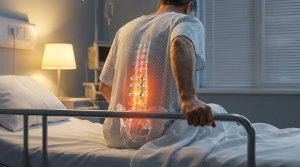

You saw “dextroscoliosis of the thoracic spine” on an imaging report, and you’re trying to figure out if it’s something serious. Dextroscoliosis is a scoliosis that bends toward the right, and how much it matters depends on the curve size, whether you’re still growing, your symptoms and whether the curve is changing over time.
Your doctor looks at those details together, because a small stable curve means something different from a curve that’s growing or causing symptoms. This article explains what thoracic dextroscoliosis means, what can cause it, which symptoms to watch for, how doctors diagnose it and how treatment usually moves from monitoring through bracing, therapy or surgery when needed.
Table of Contents
ToggleWhat Dextroscoliosis of the Thoracic Spine Means
Dextroscoliosis of the thoracic spine means your spine curves to the right in your upper and mid back. Scoliosis is a side-to-side spinal curve that measures 10 degrees or more on an X-ray. “Dextro” tells you the curve bends to the right, while “levo” describes a left-bending curve. “Thoracic” points to the section of your spine attached to your rib cage.
What the Direction Means
A right-bending thoracic curve is the typical pattern in adolescent idiopathic scoliosis, so seeing it on a report often reflects the most common form of the condition. Some curve patterns or symptoms may prompt closer evaluation when your doctor needs to rule out another cause.
How Doctors Judge the Curve
Once a curve shows up on imaging, your care team asks a few questions to understand what it means for you. Those details help your doctor decide whether the curve needs monitoring, treatment or a closer look at another possible cause:
- How large is the curve in degrees?
- Is it staying stable or getting bigger over time?
- Are you still growing, or is your skeleton mature?
- Is the curve affecting your daily life, posture or breathing?
Those answers guide how often your doctor checks the curve and whether you need treatment. They also help your doctor separate a stable finding from a curve that could become more important over time.
Causes of Dextroscoliosis of the Thoracic Spine
The cause of your curve matters because your doctor uses it to decide how closely to monitor you and which treatments make sense. Dextroscoliosis falls into a few broad categories, and the one that applies to you depends largely on your age and how the curve developed. Your curve can be idiopathic, degenerative, congenital or neuromuscular.
Idiopathic Scoliosis (Most Common)
Idiopathic scoliosis has no known cause and accounts for most cases. It shows up most often in children and teens during growth spurts, which is why routine screening focuses on that age range. Scoliosis tends to run in families, so if you or your child has a diagnosis, a relative may have had one too.
Degenerative Scoliosis in Adults
Degenerative scoliosis develops in adults as the discs and joints in your spine wear unevenly. These adult curves can pull the spine out of balance over time. This type becomes more common with age, and it often appears alongside other changes like arthritis or disc problems.
Congenital and Neuromuscular Causes
Congenital scoliosis ties back to how the spine forms before birth, such as a hemi vertebra, which is a vertebra that only partly develops. Neuromuscular scoliosis develops from conditions that affect the muscles or nerves supporting the spine. Your doctor treats these causes differently from idiopathic scoliosis, because the underlying condition changes the monitoring plan and treatment options.
Symptoms of Thoracic Dextroscoliosis
Your symptoms depend heavily on how large the curve is. Mild curves often cause no symptoms at all and may only reveal themselves through subtle changes in how your body looks. As the curve grows, the effects become more noticeable and can start to affect how you feel day to day.
Mild Visible Signs
For a mild curve, the first clues are usually visible signs rather than pain. Your doctor may look for these changes during an exam, and you may notice some of them in a mirror or during clothing changes:
- Uneven shoulders or one shoulder blade sticking out more than the other
- A visible curve in the spine
- Uneven hips or waistline
- One side of the rib cage pushing forward when you bend at the waist
These signs help your doctor decide whether you need imaging, follow-up or a more detailed scoliosis evaluation.
Symptoms That Need Prompt Evaluation
Moderate to severe curves can cause the trunk to rotate, which creates a rib hump, and some people notice fatigue with activity. Large thoracic curves can crowd the chest and make breathing feel harder, especially during exertion.
Red-flag symptoms are symptoms that need prompt medical attention because they may point to nerve pressure or another spine problem. You should call your doctor promptly if you notice new back pain, leg pain, numbness or changes in bladder or bowel control.
Already been told you need scoliosis surgery?
A second opinion is a normal step before committing to spinal fusion, and many patients learn more about motion-preserving options like Vertebral Body Tethering along the way. Premier’s spine team reviews your prior imaging and records before your visit, not during it.
How Dextroscoliosis Is Diagnosed and Measured
Diagnosis starts with a conversation and a physical exam, then moves to imaging that pins down the exact size of the curve. Your doctor reviews your history, asks about symptoms and checks your posture from the front, back and side.
Physical Exam
One common part of the exam is the Adam’s forward bend test. You bend forward at the waist so the clinician can check for rib prominence and asymmetry along your back.
X-rays and Imaging
A standing full-spine X-ray confirms the diagnosis and gives your team a number to track. On that X-ray, your doctor measures the Cobb angle, which is the measurement in degrees describing the size of the curve. Your doctor may add other imaging when the curve pattern, symptoms or treatment plan call for a more detailed view of the spine and surrounding structures.
Our neck and back specialists use these steps to understand your curve and what it means for you. If you want answers to broader questions about spine care, our spine care FAQ covers common ground.
Treatment for Dextroscoliosis of the Thoracic Spine
Treatment depends on your age, whether your skeleton is still growing, the size of the curve, your symptoms, whether the curve is progressing and your own goals. At Premier Orthopaedics & Sports Medicine, we start with conservative care and reserve surgery for the situations that genuinely call for it. Your curve size, growth stage and symptoms determine how conservative or involved treatment needs to be.
Observation and Monitoring
Your doctor usually recommends observation for small, mild curves that aren’t causing major symptoms. During this phase, your doctor tracks the curve with exams and X-rays on a schedule based on your growth stage, curve size and symptoms. If the curve stays stable, monitoring may be all you ever need.
Bracing for Adolescents
Bracing is an option for growing children and teens with moderate curves, typically when the curve is large enough to progress, but not in the surgical range. A brace can reduce progression risk while your child is still growing, but your child must wear it as directed. Once your child is done growing, your doctor usually stops bracing because the curve has less growth left to influence.
Physical Therapy and Exercise
Physical therapy can support strength, mobility, posture and breathing mechanics as part of non-surgical care, especially when your therapist tailors exercises to your curve and symptoms. Some patients ask about Schroth-style therapy, which uses scoliosis-specific exercises and breathing techniques to work on posture, muscle balance and spinal alignment.
When you need bracing or surgery, physical therapy can still support strength, mobility, posture and breathing mechanics. You can read more about how physical therapy fits into non-surgical care.
Pain Management and Supportive Care
Pain management matters most for adults, where scoliosis often comes with added arthritis, disc or muscle pain. Options include medications and targeted rehab that addresses the specific source of discomfort.
Our pain management treatments include injections and other interventional approaches, meaning procedures that target a specific pain source rather than treating scoliosis as a whole, and our pain management specialists can build a plan around your symptoms.
Surgical Options
Surgery generally comes into the conversation at roughly 45 to 50 degrees, or for curves that are progressing and heading toward that range. Spinal fusion, the standard operation, joins the curved vertebrae so they heal into a single solid segment that holds the correction.
For certain children and teens who are still growing, Vertebral Body Tethering (VBT) may offer a motion-preserving alternative that uses a flexible tether to guide the spine as growth continues rather than fusing the bones together.
Dr. Jay Reidler, MD, MPH, performs both spinal fusion and VBT, which means he can match the operation to your situation rather than defaulting to one approach. He completed pediatric and adult spine fellowships and works with Premier’s spine team on complex deformity cases.
For planned correction surgery, Dr. Reidler may use robotic spine surgery when it fits your case, using advanced navigation and robotic technology to help plan and guide parts of the procedure. Premier’s recovery guidance walks you through what to expect before and after the procedure. After scoliosis surgery, your recovery plan may include pain management, physical therapy, regular follow-ups and activity limits until your surgeon clears you.
Schedule a Scoliosis Evaluation
A scoliosis evaluation can measure the curve, review your symptoms, estimate progression risk and help you understand which options fit your situation. Premier sees people across Northern New Jersey, and you can call 201-833-9500 to schedule.
Get an Evaluation for Thoracic Dextroscoliosis
An evaluation can show whether your curve needs observation, bracing, therapy or surgery based on its size, your growth stage and your symptoms. Premier Orthopaedics works with patients across Northern New Jersey to track and manage scoliosis at every age.
Frequently Asked Questions About Dextroscoliosis of the Thoracic Spine
Is dextroscoliosis the same as scoliosis?
Dextroscoliosis is scoliosis with the direction and location spelled out, not a separate disease. If your report lists thoracic dextroscoliosis, bring the report and any prior spine X-rays to your visit so your doctor can compare curve measurements over time. That comparison often matters more than the label alone.
Does dextroscoliosis always get worse?
A single Cobb angle doesn’t show whether the curve is getting worse. Your doctor compares it with older or future standing X-rays and considers how much growth remains, especially for children and teens. Ask how often the curve should be rechecked and what amount of change would shift the plan from observation to bracing or another treatment.
Can you fix dextroscoliosis without surgery?
Many people never need surgery for dextroscoliosis, but the right non-surgical plan depends on why the curve is causing concern. For a growing child, ask about brace wear time, remaining growth and what signs would mean the brace isn’t enough. For an adult, ask whether pain is coming from the curve itself, arthritis, a disc problem or irritated muscles, because each source may call for a different treatment plan.
This article is for general information only and isn’t a substitute for professional medical advice. Talk to your doctor about your specific situation before making treatment decisions.