
You picked up your imaging report or left an appointment with one of these look-alike words on the page, and now you can’t tell whether you have one problem, two problems or something serious. The words sound almost identical, but they describe different spine findings and often lead to different next steps.
Understanding spondylolisthesis vs. spondylosis can help you see which diagnosis points to which next steps, and Premier Orthopaedics & Sports Medicine can help explain those findings through our spine surgery team.
Table of Contents
ToggleWhat Spondylosis Is
Spondylosis is a general term for age-related breakdown in your spine. It covers wear-and-tear changes that build up over years in your discs, facet joints, the small joints in the back of the spine, ligaments and bone.
These changes reflect gradual wear over time. Degeneration like this can show up anywhere along the spine, including your neck (the cervical region), mid-back and lower back; as discs dry out and shrink, bone spurs develop, and this pattern is common in older adults.
Spondylosis often causes no symptoms at all. Many people have worn discs that never produce pain, so seeing the word on a report can be a neutral finding. When symptoms appear, they often include stiffness or a dull ache, with reduced flexibility in some people. If the degeneration narrows the space around nerves, you might notice pain traveling into the arms, numbness in the hands or arms, and leg weakness, but the presence of degeneration matters far less than whether it’s actually causing you trouble.
What Spondylolisthesis Is
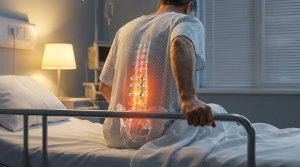
Spondylolisthesis happens when one vertebra slips out of position and onto the one below it. The condition is an alignment problem, which is the core difference between the two conditions. Degenerative spondylolisthesis develops from age-related joint and disc breakdown and shows up more often in older adults. Isthmic spondylolisthesis comes from a stress defect in part of the vertebra called the pars, and if you’re younger or an athlete, it’s the more likely type.
Doctors may grade how far the vertebra has slipped, and degenerative spondylolisthesis is a common form. Symptoms can include low back pain with hamstring tightness. Pain may travel into the buttocks and down the thighs or legs, sometimes with numbness or weakness. Standing or walking often increases symptoms while sitting or bending forward eases them, and a slip becomes concerning when it’s unstable or compresses nerves.
Spondylolisthesis vs. Spondylosis: Key Differences
Spondylosis is a wear-and-tear pattern across the tissues of your spine, while spondylolisthesis is a specific vertebra that has shifted out of line. That distinction matters because each finding points your doctor toward different questions about pain, stability and nerve pressure.
Structural Change vs. Wear and Tear
Spondylosis describes degenerative changes in the discs, joints, ligaments and bone. Spondylolisthesis describes a vertebra that is out of alignment with the one beneath it. You can have spondylosis without any slip at all, which is common. A degenerative slip can also develop because worn facet joints and discs stop stabilizing a segment and let it move out of position.
Symptom Patterns
Spondylosis tends toward stiffness and localized aching; some people also lose flexibility. Nerve symptoms appear when the degeneration narrows the space around nerves. With spondylolisthesis, your doctor checks whether the segment is stable.
Back pain is more likely to worsen with standing and walking. Pain can also move into the buttock or leg, and some people have hamstring tightness or nerve symptoms. These patterns overlap, so your doctor pairs your history with an exam and imaging rather than reading either one in isolation.
Imaging Findings
Doctors diagnose spondylosis primarily with imaging, and it shows up as disc narrowing, bone spurs, facet arthritis and thickened ligaments, with bone changes clearest on X-ray and soft tissue clearest on MRI or CT. Your doctor confirms spondylolisthesis with a physical exam plus X-ray, then uses CT or MRI to check for disc or nerve damage.
A supine MRI, meaning an MRI you have while you lie down, can underestimate a slip while a standing or flexion-extension X-ray shows it, so your doctor decides which study best fits the question. The same worn segment that shows degenerative disc changes on one study can reveal instability on another.
Been told you need fusion for a slipped vertebra?
Deciding between continued conservative care and surgery for spondylolisthesis is a big decision, and getting a second opinion is a normal part of that process. Premier’s spine team reviews your prior imaging and records before your visit, not during it, so you get a focused conversation about whether fusion is really the right next step.
How These Two Conditions Overlap
The two conditions often appear together. Over time, degeneration can gradually reduce the stability of a spinal segment, so one vertebra begins to shift. Spondylolisthesis may occur as a result of spondylosis when the facet joints degenerate and move out of their normal position.
A report might list both degenerative spondylosis and spondylolisthesis. Seeing both words usually points to one process leading to the other. Even then, the finding is often manageable, and degenerative slips are progressive but rarely exceed low grade. Your symptoms and nerve exam matter more than the words on the page, as do your daily limits.
Treatment for Spondylosis
Treatment for spondylosis usually begins with nonsurgical measures, including conservative care. Worn discs often cause no pain at all, and degeneration on its own may need no treatment. When it does, the first steps focus on relieving symptoms and keeping you moving without surgery.
- Activity modification: adjusting how you move, lift and sit to take pressure off the irritated area
- Physical therapy: guided physical therapy to improve mobility, posture and the strength of the muscles supporting your spine
- Medication when appropriate: anti-inflammatory medication to calm pain and swelling
- Injections: pain management treatments may include epidural steroid injections, which deliver anti-inflammatory medicine into the space around irritated spinal nerves, or nerve blocks, which numb a specific nerve to identify or reduce pain. Your doctor may also use other spinal injections if pain persists or a nerve is irritated
These measures can resolve or control symptoms. You and your doctor usually try nonsurgical measures first and discuss surgery only when they don’t provide relief. Surgery for spondylosis alone usually isn’t the first step. It becomes a real consideration when degeneration causes nerve compression, stenosis (narrowing of the spinal canal), weakness or symptoms that persist despite non-surgical care.
Treatment for Spondylolisthesis
Treatment for spondylolisthesis also begins with conservative care. Activity modification, physical therapy that includes core stabilization, medication when appropriate and injections from pain management specialists for nerve-related pain are the usual first steps. Nonsurgical care is successful for most people, and because most people with a slip have few or no symptoms, a conservative-first approach makes sense for the majority.
Your doctor may consider surgery when the slip is unstable, symptoms are severe, nerve compression causes weakness or disabling leg pain, or conservative care has failed to help. In those cases, fusion, surgery that joins two bones so they heal into one stable segment, may stabilize the affected level and can have good outcomes when your doctor recommends it for the right reasons.
At Premier, Dr. Jay Reidler offers complex spine evaluation and uses custom 3D-printed aPrevo implants when appropriate for select reconstruction and fusion cases, and Premier also offers robotic spine surgery to support surgical planning. Your doctor bases the plan on your anatomy, imaging, symptoms and goals.
Questions to Ask Your Doctor
Bringing a short list of questions to your appointment helps you understand which condition is driving your pain and what to do about it. Knowing which finding is actually generating your pain helps your doctor match the treatment to the cause rather than to the label on the report.
- Is my pain coming from spondylosis, the slip itself, nerve compression or another cause?
- Is the slip stable, or does it change when I move or bend?
- What grade is the slip, and how does that affect my treatment?
- Which conservative treatments should I try first?
- Do injections fit my specific symptoms?
- What symptoms would make surgery more likely for me?
- If we discuss surgery, is the goal decompression, which relieves pressure on nerves, stabilization or both?
Writing down the answers gives you a clearer picture of your own spine and makes the next steps easier to weigh. It also helps you compare conservative care, injections and surgical options using the same set of facts.
Get a Clear Diagnosis for Your Back Pain
If your doctor has told you that you have spondylolisthesis, spondylosis or both, our neck and back specialists can connect your imaging findings with your symptoms and explain what they mean. Call 201-833-9500 or schedule online with our offices across Northern New Jersey.
Get Clarity on Your Spondylosis or Spondylolisthesis Diagnosis
An evaluation with Premier’s spine team can help you understand which finding is actually behind your pain and what treatment options fit your situation. Our Northern New Jersey patients get a clear plan based on their own imaging and symptoms, not just the words on a report.
Frequently Asked Questions About Spondylolisthesis and Spondylosis
Can spondylosis lead to spondylolisthesis?
Yes. Degenerative spondylolisthesis can develop when advanced spondylosis weakens the discs and facet joints that hold a spinal segment steady. One vertebra can then shift forward. Progression varies, and degenerative slips rarely become severe. Many people with advanced spondylosis never develop a slip at all.
Is spondylolisthesis more serious than spondylosis?
Sometimes, depending on stability and nerve compression. A slip is more concerning when it’s unstable or presses on nerves, but a mild spondylolisthesis can cause fewer problems than severe spondylosis with stenosis. Your symptoms and any nerve involvement determine severity more than which word sounds more alarming on the report.
Do both conditions always need treatment?
No. Imaging findings need treatment only when they match your symptoms or create a risk such as nerve compression, weakness, instability or worsening function. Plenty of people have degenerative changes on imaging with no pain at all, so your symptoms should guide whether you need care. You can learn more in our spine care FAQ.
This article is for general information only and isn’t a substitute for professional medical advice. Talk to your doctor about your specific situation before making treatment decisions.