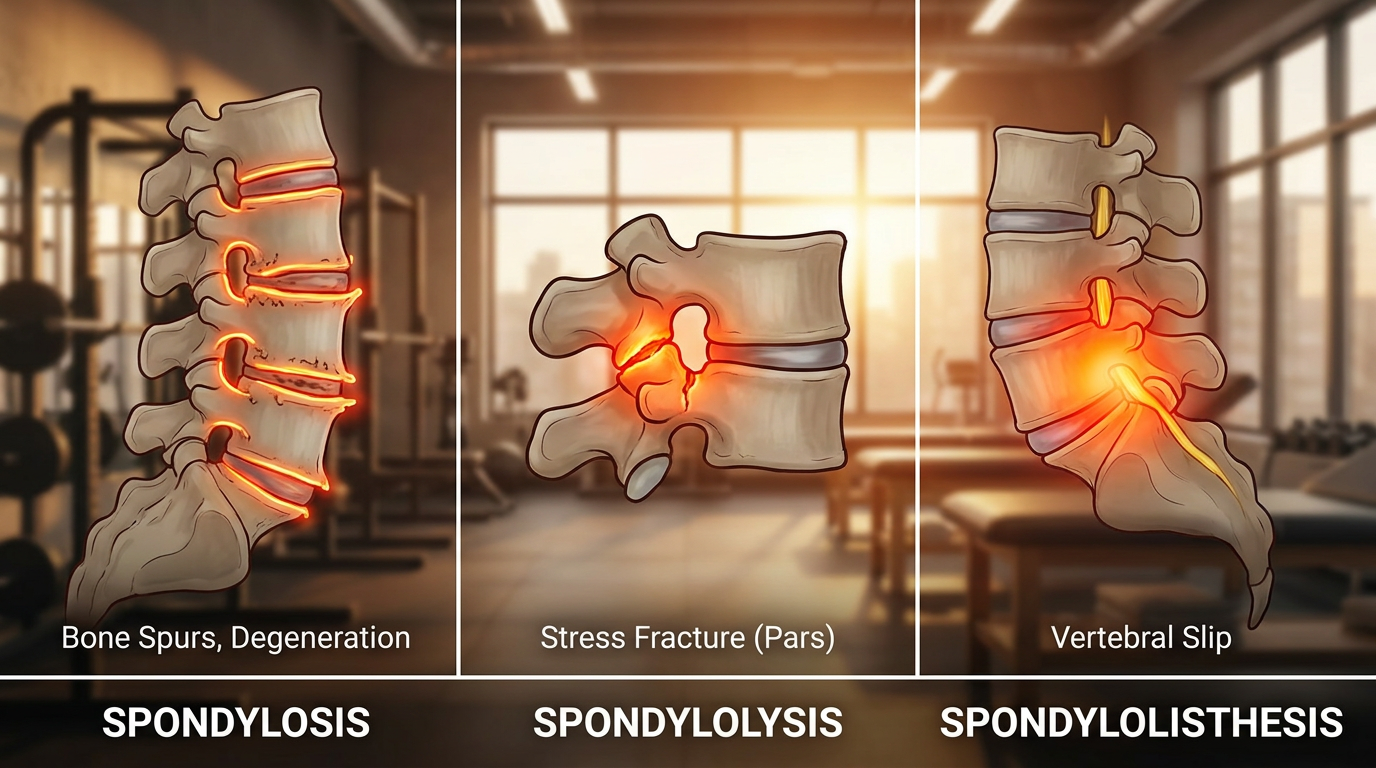
You left an appointment or opened an imaging report, and one of three words is staring back at you: spondylosis, spondylolysis or spondylolisthesis. They sound almost identical. These are separate spine conditions with different causes and treatments. Spondylosis is spinal degeneration, spondylolysis is a pars stress fracture, and spondylolisthesis is vertebral slippage.
Table of Contents
ToggleA Quick Overview of All Three Conditions
Each term points to a different spine problem. The easiest way to separate them is to ask whether the issue involves wear, a crack or a slip.
| Condition | Plain-Language Meaning | Core Difference |
|---|---|---|
| Spondylosis | General wear-and-tear degeneration of the spine | An aging process affecting discs, joints and bone |
| Spondylolysis | A stress fracture in a small bridge of bone in a vertebra | A crack, usually from repetitive stress |
| Spondylolisthesis | One vertebra slipping forward out of alignment | Actual movement of a bone in the spine |
The names overlap because all three involve the spine, but they are not interchangeable. Spondylosis describes a gradual process. The other two terms point to a crack in the bone or to a vertebra that has shifted. Spondylolysis can lead to spondylolisthesis, and age-related degeneration can lead to degenerative spondylolisthesis, which is why a single imaging report sometimes mentions more than one of them.
What Is Spondylosis?
Spondylosis is age-related degeneration of the spine. The discs, joints, bones and ligaments in your neck or lower back slowly wear down over time. Over time, spinal stenosis and radiculopathy can develop alongside this degeneration. Spinal stenosis narrows the space around the spinal cord or nerves, and radiculopathy is nerve pain that travels into an arm or leg.
Causes and Who Gets Spondylosis
Spondylosis is mostly a function of age. Discs dry out and shrink, and bone spurs can form where bones rub together. Cervical spondylosis, the version in the neck, affects more than 85 percent of people older than 60.
Finding these changes on imaging is common and doesn’t automatically mean pain. Nearly half of middle-aged and older people have worn disks without any painful symptoms.
Symptoms of Spondylosis
When spondylosis does cause symptoms, what you feel depends on where the degeneration is and whether it’s affecting a nerve. Some people never notice anything beyond occasional stiffness. Others develop a pattern over time.
- Localized neck or lower back pain and stiffness
- Numbness, tingling or weakness in the arms or legs if degeneration narrows the space around a nerve or the spinal cord
If nerve-related symptoms appear, that’s a signal to have Premier Orthopaedics & Sports Medicine’s neck and back specialists take a closer look. Those symptoms change how your doctor evaluates and manages the condition.
What Is Spondylolysis?
Spondylolysis is a stress fracture or defect in the pars interarticularis, a small bridge of bone that connects the front and back parts of a vertebra. Doctors often look for this defect near the lowest lumbar vertebra in your lower back.
Causes and Who Gets Spondylolysis
Spondylolysis tends to show up in adolescents and young athletes whose activities involve repeated backward arching of the spine. That repetitive stress on the pars leads to the crack. It appears more common in males, and while it affects a small percentage of the general population, doctors see it far more often in adolescent athletes with low back pain.
Symptoms of Spondylolysis
Spondylolysis typically causes localized low back pain that gets worse with backward bending and activity and eases with rest. Leg pain is less typical unless a nerve is also involved, which sets it apart from conditions that press directly on nerve roots. Some people with a pars defect never have much pain, and a doctor finds the defect on imaging done for another reason.
What Is Spondylolisthesis?
Spondylolisthesis is when one vertebra slips out of alignment relative to the one below it. The vertebra usually slides forward.
Doctors describe the amount of slippage with a grade. Most slips fall into grades one through four, and doctors may call complete slippage spondyloptosis. The grade is only one part of the picture and doesn’t decide treatment on its own.
Causes, Types and Grading
Spondylolisthesis comes in a few distinct types, and knowing which one you have matters. Your doctor uses the type, grade, symptoms and stability of the spine to decide what the finding means.
- Isthmic: a pars defect, or spondylolysis, lets the vertebra slip
- Degenerative: age-related loss of stability in the spine lets the vertebra slip
- Traumatic: an acute injury causes the slip
- Congenital: a birth difference in how the spine formed allows the slip
The grade describes the size of the slip, but most low-grade slips stay stable and don’t steadily worsen. Stability often matters as much as the amount of slippage because a stable low-grade slip may need a different plan than a progressive one.
Symptoms of Spondylolisthesis
Spondylolisthesis often causes low back pain, and when the slipped vertebra presses on a nerve, you may feel leg pain or numbness. Some people notice that sitting or bending forward eases symptoms, while standing or walking may aggravate them. That positional pattern gives your doctor one clue when sorting spondylolisthesis from the other two conditions.
Been told you need spinal fusion for a slipped vertebra?
A fusion recommendation for spondylolisthesis is a big decision, and getting a second opinion is a normal part of weighing it. Premier’s spine team reviews your prior imaging and records before the visit, not during it, so the conversation can focus on whether nonsurgical care still has more to offer or whether surgery truly makes sense for your slip.
How These Conditions Are Connected
The three conditions connect through two main progression pathways. In the first, a pars stress fracture, or spondylolysis, weakens the vertebra’s structural connection, and that crack can let the vertebra slip forward into isthmic spondylolisthesis. Your doctor will also look at whether the defect affects one side or both sides of the vertebra because that detail can change monitoring.
In the second pathway, broad age-related degeneration, or spondylosis, reduces stability in the spine, and that instability can lead to degenerative spondylolisthesis. These conditions can overlap and co-occur, so it’s common to have degeneration and a slip at the same time. Imaging helps your doctor sort out which problem, or which combination of problems, is present.
Diagnosis: How Your Doctor Tells Them Apart
Diagnosis starts with your symptoms, history and physical exam before imaging. Your pain location and the pattern of what makes it better or worse point your doctor toward one condition over another, especially if symptoms travel into a limb.
Exam and Imaging Clues
Each type of imaging contributes something different. Your doctor chooses the test based on whether the main question involves alignment, motion, nerves or bone detail.
- Standing X-rays show overall alignment and whether a vertebra has slipped
- Flexion-extension X-rays show whether a slip moves when you bend forward and back, which tells your doctor about stability
- MRI shows nerve compression and soft tissue like discs and ligaments
- CT gives detailed bone images and is useful for defining a pars defect
Matching Imaging to Symptoms
Your doctor matches what the imaging shows to your actual pain pattern. That matters because worn disks without painful symptoms, asymptomatic pars defects and asymptomatic slips can show up without matching your pain. The exam helps your doctor decide which finding is most likely driving symptoms.
Treatment for Each Condition
For spondylosis, spondylolysis and spondylolisthesis, treatment often starts with conservative care, which means non-surgical treatment such as activity changes, medication, physical therapy or injections.
Surgery is the exception, and your doctor considers it only after you and your doctor fully explore nonsurgical approaches or when worsening neurological symptoms, nerve compression or instability change the picture. Recovery depends on which condition drives your pain, whether nerves are involved and how you respond to conservative care.
Treating Spondylosis
Doctors usually manage spondylosis without surgery. A typical plan may include physical therapy to strengthen the muscles supporting the spine, along with medication for pain and inflammation. Activity modification limits aggravation.
For flare-ups, targeted pain management treatments such as injections can calm an irritated area. Surgery comes into the conversation only when conservative care fails or neurological symptoms worsen, such as weakness, numbness or loss of function.
Treating Spondylolysis
Spondylolysis often becomes symptom-free without surgery. Treatment centers on rest from the aggravating activity, activity modification, physical therapy and medication. Your doctor may use bracing in some cases to protect the area while it settles.
Many young athletes can return to full sport with conservative management, and doctors seldom need surgery for spondylolysis. If your doctor finds a pars defect incidentally and it isn’t causing symptoms, your doctor may leave it untreated.
Treating Spondylolisthesis
Spondylolisthesis treatment depends heavily on the size of the slip and whether it affects nerves. For stable low-grade slips, physical therapy, injections, activity modification and monitoring are usually enough, and most people improve with stretching and strengthening.
Nonsurgical care relieves symptoms, but doesn’t repair the slip itself, so your doctor may discuss surgery if symptoms don’t improve after a period of structured nonsurgical care. Before that step, your doctor may try epidural injections, which deliver medication around irritated spinal nerves, from our pain management specialists before moving toward surgery.
Fusion, a surgery that joins two or more vertebrae so they heal into one stable segment, becomes more likely for high-grade or progressive slips or for slips that compress a nerve and haven’t responded to nonsurgical treatment.
Our spine surgery team handles these cases. Dr. Jay Reidler treats spondylolisthesis from conservative management through spinal fusion, and he also uses custom 3D-printed aPrevo implants when your anatomy needs a precise surgical fit. If surgery does become part of your plan, Premier’s recovery guidance walks through what to expect before and after.
Schedule a Spine Evaluation
If you have back or leg symptoms, new numbness or weakness or an imaging report that mentions one of these three conditions, we can clarify what it means and what fits your situation. Call 201-833-9500 to schedule an evaluation at one of our offices across Northern New Jersey.
Get Clarity on Your Spondylosis, Spondylolysis or Spondylolisthesis Diagnosis
An evaluation with Premier’s Northern New Jersey spine team can sort out which of these conditions is actually driving your pain and match a treatment plan to it. Most patients start with conservative care, and surgery only comes up if nerves are affected or symptoms don’t improve.
Frequently Asked Questions About Spondylosis, Spondylolysis and Spondylolisthesis
Can spondylolysis turn into spondylolisthesis?
Yes. A pars defect can weaken the structural connection in a vertebra enough that the bone slips forward, which is how isthmic spondylolisthesis develops. That said, not everyone with spondylolysis goes on to develop a slip, and even when a slip does occur, it doesn’t always cause pain. Your doctor may monitor a pars defect over time to watch for any movement.
Do all three of these conditions need surgery?
No. All three start with conservative care, and most people improve without an operation. Surgery is the exception, considered when symptoms stay severe, a slip compresses a nerve, the problem keeps progressing, or the spine is unstable. For most people, physical therapy and activity changes are enough to manage symptoms; targeted injections may help when pain persists or flares.
Why did two doctors give me different answers about my spine?
These findings often show up on imaging as incidental changes that may not match what’s causing your pain. Because of that, two clinicians can reasonably weigh the same images differently depending on how well the findings line up with your symptoms. You can get a second opinion when the picture is unclear, and you can find more answers in our spine care FAQ.
This article is for general information only and isn’t a substitute for professional medical advice. Talk to your doctor about your specific situation before making treatment decisions.