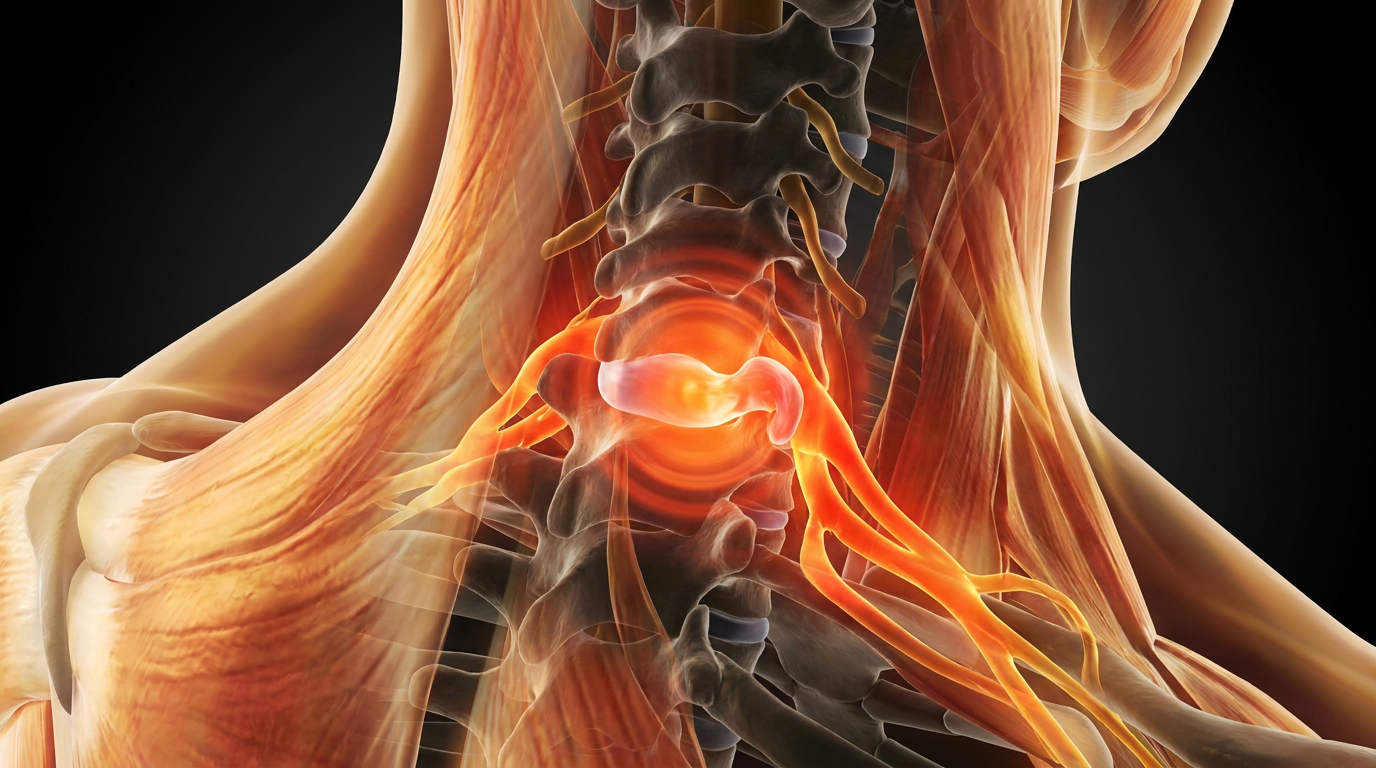
Your surgeon has recommended anterior cervical discectomy for neck, arm or hand symptoms coming from a compressed nerve root, a spinal nerve branch that leaves the spinal cord, or pressure on the spinal cord itself.
Anterior cervical discectomy removes the problem disc from the front of the neck. Reconstruction either fuses the level through anterior cervical discectomy and fusion (ACDF) or preserves motion with an artificial disc replacement in selected cases.
Table of Contents
ToggleWhat an Anterior Cervical Discectomy Is
Anterior cervical discectomy is surgery that removes a damaged disc in your neck and rebuilds the space it leaves behind. Breaking the name down helps: “anterior” means the surgeon works from the front of your neck, “cervical” refers to the neck region of your spine and “discectomy” means removing the disc. Surgeons use this approach to treat cervical disc problems that compress a nerve root or the spinal cord.
Your surgeon takes out the disc pressing on the nerve root or spinal cord, which takes pressure off those structures. The surgeon then reconstructs that space with a spacer or bone graft so the two vertebrae heal into one solid unit, and surgeons call that fusion version ACDF. For selected cases, the surgeon places an artificial disc instead to preserve motion.
Who May Be a Candidate for Anterior Cervical Discectomy
Surgery comes into the picture when your symptoms and imaging point to the same cervical disc or narrowing problem that hasn’t improved with non-surgical care. It also becomes a more urgent option when neurological findings, like progressive weakness or spinal cord symptoms, show up. Your surgeon reviews your exam and imaging together before recommending an operation.
Conditions ACDF May Treat
Several neck conditions can lead to this procedure when they don’t settle down on their own. Cervical radiculopathy, irritation of a nerve root that causes pain, numbness, tingling or weakness into your shoulder, arm or hand, is one common reason. The conditions most often behind an ACDF include:
- Cervical radiculopathy, which is irritation of a nerve root that causes pain, numbness, tingling or weakness running into your shoulder, arm or hand
- A herniated disc in the neck pressing on a nearby nerve
- Cervical stenosis, a narrowing of the space around the spinal cord or nerves
- Degenerative disc disease, the gradual wear that changes how a disc sits and functions
- Cervical myelopathy, which is pressure on the spinal cord itself and can bring hand clumsiness or balance changes
Surgeons tend to treat myelopathy more urgently because it involves the spinal cord directly. If you’ve been dealing with ongoing neck or arm symptoms, your surgeon will sort out which condition is driving them.
When Conservative Care Comes First
Most cervical disc problems and radiculopathy get better without surgery. Many people with cervical radiculopathy improve over time even without an operation.
That conservative care usually includes medication, activity modification, physical therapy and, when needed, epidural injections and nerve blocks. Surgery generally becomes a serious conversation after an appropriate trial of non-surgical care hasn’t given enough relief.
How ACDF Compares to Artificial Disc Replacement
Both ACDF and artificial disc replacement start the same way: the surgeon removes the damaged disc and takes pressure off the nerve or spinal cord. Reconstruction separates the two procedures. ACDF places a spacer or graft so the two bones heal together over time, while artificial disc replacement uses a motion-preserving implant at that level.
Your surgeon weighs your anatomy and imaging, including the involved level and the condition your surgeon is treating. The right choice matches your specific situation. Dr. Jay Reidler performs anterior cervical discectomy with both fusion and artificial disc replacement and selects the reconstruction based on each patient’s anatomy and condition.
| Dimension | ACDF (fusion) | Artificial disc replacement |
|---|---|---|
| What happens to the disc space | Surgeon places a spacer or graft so the bones fuse | Surgeon places a motion-preserving implant |
| Motion at the treated level | The level fuses and stiffens | The level keeps its motion |
| Who it may suit | Used for several cervical disc and narrowing conditions | Select candidates with suitable anatomy |
| Healing focus | Bone fusion over months | Implant integration |
What Happens Before Surgery
Your pre-surgery plan confirms the level, the approach and the reconstruction method. The care team also checks medical factors that could affect anesthesia, bleeding risk or healing.
Imaging and Clearance
Your surgeon first reviews your MRI, and sometimes a CT scan, to pin down which level is involved and how best to reach it. Those images help your surgeon decide whether fusion or disc replacement makes more sense for your anatomy.
Medical clearance helps your care team account for other conditions or medications that affect anesthesia safety or healing. Your care team may pause some medications before surgery and continue others, so you’ll need to follow those instructions rather than guessing. You’ll also fast before anesthesia, and your care team tells you when to stop eating and drinking.
Home Planning
A little planning at home makes the first days easier. Before your surgery date, you can set up the basics so you won’t need to strain your neck.
- Everyday items within easy reach
- Simple meals prepared or stocked
- A comfortable sleep setup you can get in and out of without trouble
- Post-op instructions reviewed before surgery day
You’ll need a ride home and some help for the early days, since you won’t be driving right away. Premier Orthopaedics & Sports Medicine’s Premier’s recovery guidance walks through these preparation steps in more detail.
Already been told you need ACDF?
A second opinion is a normal part of weighing fusion against artificial disc replacement, and many patients find it clarifies which option actually fits their anatomy. Premier’s spine team reviews your MRI and prior records before your visit, not during it, and can walk you through both reconstruction options for your specific level.
What Happens During the Procedure
The operation happens in an operating room under anesthesia. Your number of treated levels shapes the plan, along with your anatomy and whether reconstruction uses fusion or disc replacement. Your surgical team walks you through the specifics beforehand.
The Surgical Approach
Your surgeon reaches the cervical spine through a small incision at the front of your neck. The front, or anterior, route gives direct access to the disc.
Disc Removal and Reconstruction
Once your surgeon reaches the spine, the surgeon removes the damaged disc and decompresses the nerve root or spinal cord. Taking pressure off those structures is the part that addresses your symptoms. The surgeon then reconstructs the space, either placing a graft or spacer for a fusion or setting an artificial disc.
What Recovery Looks Like After Anterior Cervical Discectomy
Your recovery timeline depends on the number of levels treated, whether you had a fusion or disc replacement, the physical demands of your job and your overall health. The surgeon will give you a timeline built around your procedure.
The First Few Days
Your care team will tell you whether your plan allows you to go home soon after surgery or calls for an overnight stay. Expect neck and incision soreness, along with short-term effects of the front approach such as sore throat or hoarseness. Trouble swallowing can also happen and usually improves over time. Arm pain, numbness or tingling can take time to settle.
Weeks One Through Six
Your care team may ask you to protect the surgical area, keep walking and build light activity gradually while avoiding restricted movements and lifting. The surgeon will tell you whether a collar, follow-up visits or imaging are part of your plan for checking how things are healing.
Return to desk work and driving varies from person to person, though many people resume driving within about 16 days and reach unrestricted driving by six weeks. If you’re taking opioid pain medication, longer opioid use can slow recovery and delay return to work.
Six Weeks Through Three Months and Beyond
This is often when physical therapy starts or picks back up, and your return to work depends heavily on how physical your job is. Feeling better doesn’t mean the bones have finished fusing. Full recovery, including physical therapy, often takes six to 12 weeks for routine activity, while the graft itself solidifies over six to 12 months.
Risks and Outcomes
ACDF works well for appropriate candidates when symptoms line up with imaging. Single-level fusion succeeds at high rates of about 94 to 97 percent. Patient satisfaction runs high at 95.6 percent, and pain relief success rates are in the range of 88 to 90 percent in the right candidates.
Those numbers are reassuring, but every operation carries risk. The short-term effects most people notice, including throat irritation, hoarseness, swallowing difficulty and soreness around the neck or incision, tend to fade.
Less common but more serious risks include infection, nerve injury, hardware problems and non-union, which means the bones don’t fuse together as intended. Symptoms can also linger when long-term pressure has irritated a nerve, since nerves sometimes recover slowly or incompletely.
Questions to Ask Your Surgeon About Cervical Discectomy
A good pre-surgical conversation usually covers the diagnosis and the recovery plan for each treatment choice. These are worth raising with your surgeon:
- What’s causing my symptoms, and which level or levels need treatment?
- Am I a candidate for artificial disc replacement instead of fusion?
- What are the benefits and tradeoffs of ACDF in my case?
- Which of my symptoms are most likely to improve?
- How long will I be out of work given my job?
- What restrictions should I expect in the first six weeks?
- Will I need a collar, follow-up imaging or physical therapy?
- What complications should I watch for, and what if my symptoms don’t improve?
Bringing these to your visit helps you leave with a clear picture. Premier’s spine team evaluates cervical disc conditions and can walk you through both fusion and disc replacement during a consultation. Our neck and back specialists see patients across Northern New Jersey.
Schedule a Cervical Spine Evaluation
If neck, arm or hand symptoms are limiting your daily life, Premier can help you understand whether anterior cervical discectomy or another option fits your situation.
Frequently Asked Questions About Anterior Cervical Discectomy
How long does recovery from anterior cervical discectomy take?
Recovery varies, but the general arc starts with managing incision soreness and temporary throat symptoms, then builds into light activity over several weeks. Return to routine activity often happens gradually, while bone fusion continues solidifying longer. The number of levels treated and how physical your job is will shift that timeline in either direction.
Is anterior cervical discectomy an outpatient surgery?
Anterior cervical discectomy can be an outpatient surgery. Some people go home soon after surgery while others need a short hospital stay. That decision depends on your specific procedure plan, your medical history and what your early recovery needs look like.
What is the difference between ACDF and artificial disc replacement?
Both procedures remove the damaged disc and relieve pressure on the nerve or spinal cord. ACDF reconstructs the space so the bones fuse together, while artificial disc replacement uses a motion-preserving implant at that level. For broader questions about neck and spine care, our spine care FAQ covers more ground.
This article is for general information only and isn’t a substitute for professional medical advice. Talk to your doctor about your specific situation before making treatment decisions.