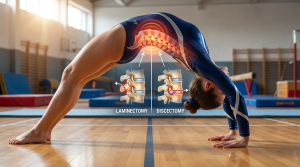
You’re holding an MRI report that mentions a herniated disc or a narrowed canal, and your surgeon used the words laminectomy and discectomy in the same visit without saying which one applies to you.
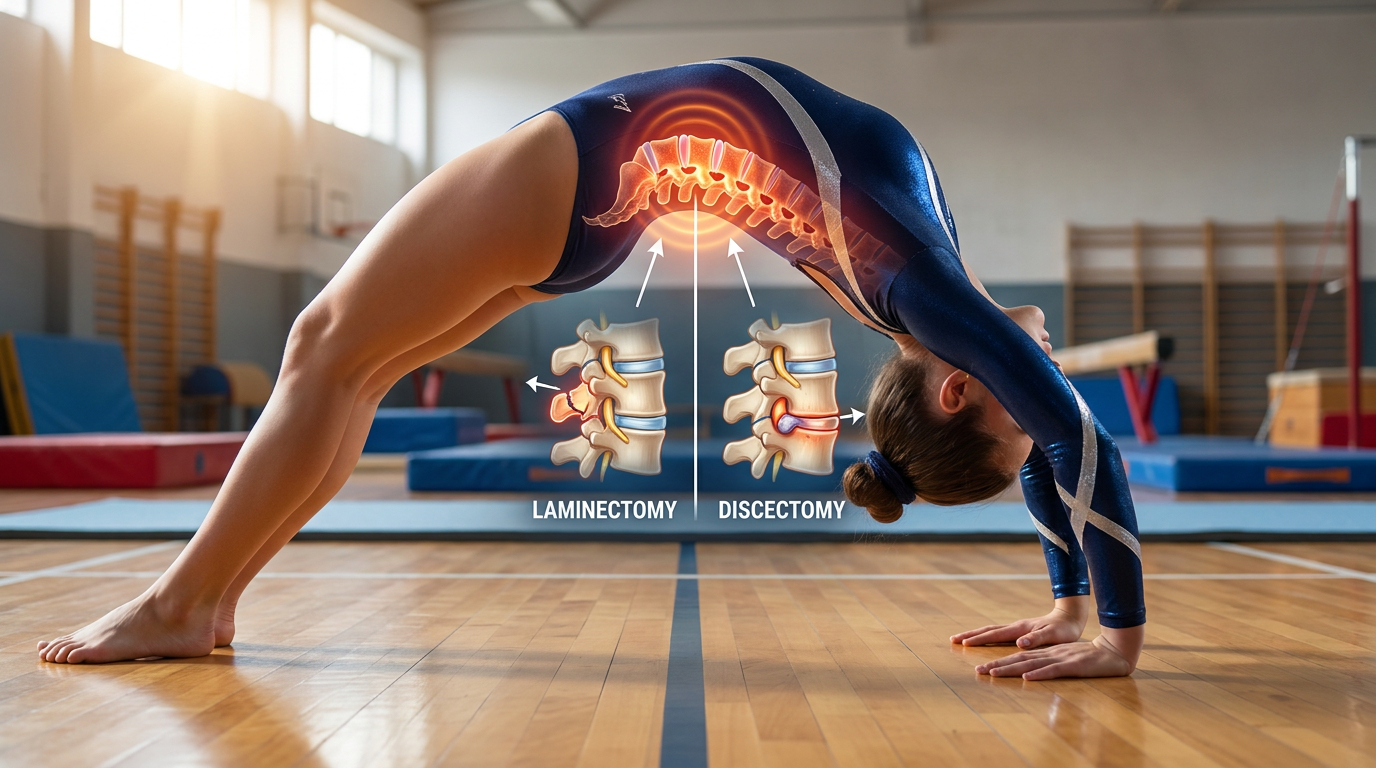
The laminectomy versus discectomy decision comes down to what your surgeon needs to remove. A laminectomy removes bone over the spinal canal, while a discectomy removes damaged disc material. Both operations relieve pressure on a pinched nerve, but they target different tissue for different problems.
Why the Right Procedure Depends on What’s Pressing on the Nerve
Sharp pain down one leg usually traces back to a disc pressing on a single nerve root, which is why a discectomy is the right fit. Your surgeon removes the offending fragment and relieves pressure on that nerve without disturbing the rest of the canal.
Heaviness in both legs that builds as you walk usually points to bony narrowing crowding several nerves at once, which calls for a laminectomy to remove the lamina and open up the canal around all of them.
Your MRI, symptom pattern and neurological exam tell your surgeon which tissue is compressing, which determines which operation you need.
A surgeon may consider discectomy when six to 12 weeks of physical therapy or steroid injections haven’t relieved your symptoms, or when nerve weakness makes it hard to stand or walk.
Laminectomy typically comes up after three or more months of supervised nonsurgical treatment hasn’t worked, though new or worsening weakness moves that timeline up.
Premier Orthopaedics & Sports Medicine performs both discectomy and laminectomy, along with the combined and fusion-added versions when your anatomy calls for them.
Our neck and back specialists will walk you through which operation fits your imaging and symptoms, then plan the surgical and recovery approach that gives you the best shot at lasting relief.
Laminectomy vs. Discectomy: At-a-Glance Comparison
Both procedures have minimally invasive spine surgery versions that use smaller openings and reduce disruption of surrounding tissue when your anatomy and surgical plan allow.
| Comparison point | Discectomy | Laminectomy |
|---|---|---|
| What’s removed | The injured disc tissue and any loose fragments that have escaped the outer wall. | The lamina, the bony arch over the canal, on one or both sides. Surgeons may also trim bone spurs. |
| Variations | Microdiscectomy keeps the opening small and the rest of the disc in place. | Full laminectomy removes both laminae at a level. A laminotomy removes only a small window of bone. |
| Typical symptoms | Buttock or leg pain, or numbness or weakness in a leg or arm, traced to one nerve root. | Pain, numbness or heaviness in one or both legs that worsens with standing or walking. |
| Who is a candidate | Patients whose leg-dominant symptoms haven’t improved after six to 12 weeks of conservative care. | Patients whose walking-limiting symptoms haven’t improved with medicine, physical therapy or injections. Weakness that’s getting worse or new bowel or bladder changes needs immediate evaluation. |
| Incision and approach | A small 1 to 1.5-inch incision under a microscope for a microdiscectomy. Larger open approaches are used when the anatomy calls for it. | Over the affected level or levels. Minimally invasive versions are available for select cases. |
| Hospital stay | Often outpatient, depending on the surgical plan. | Varies with the number of levels treated, wound healing, safe walking and pain control. Multi-level surgery may require a longer stay. |
| Return to work | Desk work once you can sit, walk and manage pain safely. Heavy work follows safe lifting, bending and twisting. | Desk work after safe walking, wound healing and surgeon clearance. Heavy work depends on job demands and therapy progress. |
| Outcomes | About 78 to 95 percent of patients report significant leg-pain relief one to two years after a microdiscectomy. | Laminectomy has a 90 percent success rate. The reoperation rate is around 18 percent at eight years after lumbar decompression for spinal stenosis. |
| Main long-term risk | Reherniation, where the treated disc herniates again. | Recurrent narrowing that may need another operation. Surgery does not cure the underlying arthritis, and some patients develop post-laminectomy syndrome. |
The next section walks through the specific spine conditions that point to one procedure over another, so you can match your diagnosis to the reasoning your surgeon will use.
Which Spine Condition Points to Laminectomy or Discectomy?
Your diagnosis decides which operation you need. Here are the most common ones and the surgery that fits each.
Herniated Disc: Usually a Discectomy
A herniated disc happens when the soft inner material of a spinal disc pushes through the outer wall and presses directly on a nerve root.
Your surgeon removes the escaped fragment and relieves pressure without opening the canal. The healthy portion of the disc stays in place to preserve the cushioning between vertebrae and keep the spinal segment stable.
Spinal Stenosis: A Laminectomy
Spinal stenosis is a narrowing of the canal that surrounds your spinal cord, usually caused by arthritic bone spurs and thickened ligaments that crowd several nerves at once.
The compression is diffuse rather than focal, so removing a single disc fragment won’t create enough room. Removing the lamina along with the offending spurs and ligament enlarges the canal and gives the crowded nerves space without pressure.
Instability or Spondylolisthesis: Laminectomy Plus Fusion
Spondylolisthesis means one vertebra has slipped forward over another, which typically narrows the central canal, pinches several nerves at once, and destabilizes the spine.
A laminectomy takes off the bone crowding the nerves, but decompression alone may allow the slip to worsen. Surgeons pair it with fusion, which joins the two vertebrae with hardware and bone graft to lock the segment in place.
A discectomy may be added when a disc fragment at the slipped level also contributes to the pinch, and you should have a clear reason if your surgeon recommends fusion.
Herniation Plus Stenosis: A Combined Procedure
An MRI can show both problems at once: a fresh herniation inside a canal that had already narrowed with age.
Your surgeon combines a laminectomy and a discectomy in the same operation, removing the lamina to open the canal and taking out the herniated disc portion and any loose pieces at the same time. You can ask which part will set your recovery timeline.
Cauda Equina Syndrome: An Emergency Decompression
Cauda equina syndrome most often develops when a large herniation or severe stenosis crushes the nerves at the bottom of the spine. It disrupts bladder or bowel control and risks permanent damage.
Urgent discectomy, laminectomy or both take pressure off the nerve bundle so the nerves can recover before the injury becomes permanent.
What to Discuss With Your Surgeon Before Choosing
A good recommendation comes with reasons for each surgery choice. Before you agree to either operation, ask:
- Which structure on my MRI is pressing on the nerve, and at how many levels?
- Why does that finding call for a discectomy rather than a laminectomy, or the reverse?
- Do I have any instability or spondylolisthesis, and are you proposing fusion as well?
- What does recovery look like for my specific job, and when can I drive?
- What happens if we continue conservative care for another six weeks?
- Will my insurer require prior authorization (advance approval), and which therapy notes, injection dates, or other records will I need?
A second opinion makes sense when your symptoms aren’t improving, the proposed operation doesn’t match the MRI findings, or your surgeon proposes fusion without explaining why.
Get Help Choosing Between a Laminectomy and Discectomy
If you’re weighing these operations or want another review of your imaging, Premier’s spine surgeons in New Jersey see patients at offices across Bergen, Hudson and Essex County. Call 201-833-9500 or request an appointment online.
Frequently Asked Questions About Laminectomy vs. Discectomy
Can a surgeon do a laminectomy and a discectomy in the same operation?
Yes. The plan should state which bone and disc material your surgeon expects to remove and whether spinal stability could change the operation. You can also ask which part will set your hospital stay, restrictions and therapy schedule.
How soon can you drive after each procedure?
There’s no single driving date for either procedure. Wait for your surgeon’s clearance at a follow-up visit rather than picking a date based only on how many days have passed.
Your surgeon will check whether you can sit comfortably, control the vehicle, react quickly and manage pain without medication that makes driving unsafe.
Does a laminectomy stop spinal stenosis from returning?
No. A laminectomy relieves the pressure stenosis causes, but it doesn’t cure the underlying arthritis driving the narrowing, so symptoms can return as that process continues.
Report early warning signs at each follow-up, like returning leg heaviness, new numbness patterns or a shorter walking distance before symptoms start. Catching recurrent narrowing early gives your surgeon more non-surgical options before another operation is needed.
When can a disc herniate again after a discectomy?
Reherniation risk is highest in the first six months while the disc’s outer wall is still healing, which is why your surgeon may restrict bending, lifting and twisting during that window.
Smokers, patients who return to heavy lifting early and those with larger initial tears face recovery issues, so matching your activity to the disc’s healing timeline matters more than any single restriction.
This article is for general information only and isn’t a substitute for professional medical advice. Talk to your doctor about your specific situation before making treatment decisions.