
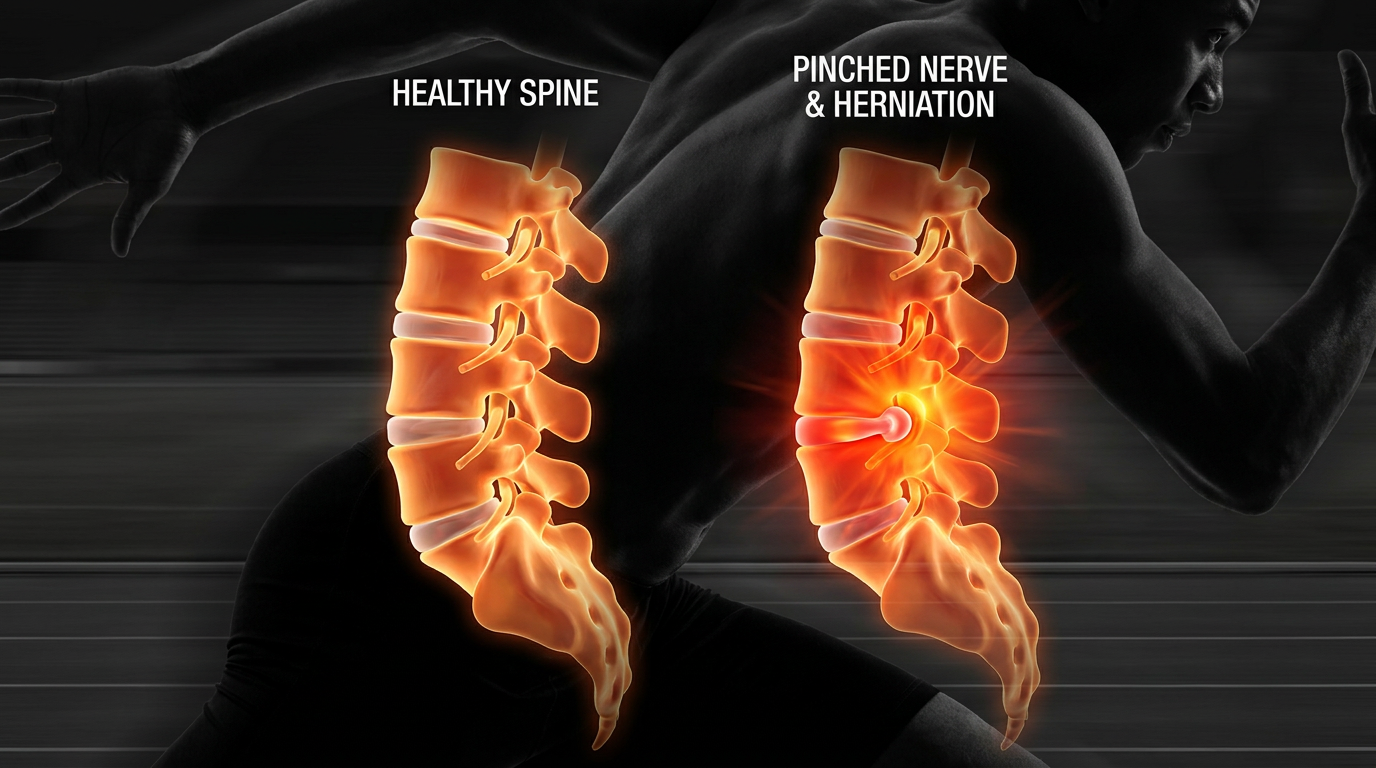
Your lower back has hurt for days or weeks, and now the pain has changed. It shoots down one buttock and leg, or fades into tingling and numbness you can’t shake. That pattern may point to a pinched nerve in your lower back, and this article covers its causes, symptom patterns, red flags, diagnosis and how treatment typically starts with conservative care.
Understanding what’s happening in your spine can help you make informed decisions about when to rest, when to seek care and when symptoms warrant urgent attention.
What a Pinched Nerve in the Lower Back Is
A pinched nerve in the lower back means pressure compresses or inflames one of the nerve roots where it exits your lumbar spine. Doctors call this lumbar radiculopathy, a pinched or inflamed nerve at its exit point from the spine. When the compression involves the nerve roots that form the sciatic nerve, doctors commonly call the resulting symptoms sciatica.
Low back pain is common, and not all of it involves a nerve. Pain from a strained muscle or a stiff joint may stay in the back and feel sore or achy in one region.
When pressure affects a nerve root, symptoms may travel beyond the back and follow a path down the leg. That traveling pain raises the question of what’s placing pressure on the nerve, including disc changes, spinal narrowing or vertebral slippage.
What Causes a Pinched Nerve in the Lower Back
There are many reasons why a nerve in your lower back can become pinched, ranging from sudden disc injuries to gradual changes in the spine. Common causes of nerve pressure include the following:
- A herniated disc or bulging disc, where disc material pushes through or extends beyond its outer layer and can cause sciatica
- Spinal narrowing, including foraminal stenosis, which narrows the opening where a nerve exits
- Bone spurs
- Spinal arthritis
- Vertebral slippage, known as spondylolisthesis, which means one vertebra slips forward over another
Whatever the starting point, each of these can place pressure on a nerve root, and the location of that pressure helps shape the symptom pattern.
Symptoms of a Pinched Nerve in the Lower Back
Sometimes a pinched nerve feels fairly standard, but symptoms can change over time and may lead to red flags that call for emergency care.
The Classic Symptom Pattern
The most recognizable pattern is pain that starts in your lower back and radiates down one buttock and the back of the leg, sometimes as far as the foot. Your doctor will consider the overall pattern of your symptoms during the evaluation. Other classic symptoms include:
- Radiating pain down one buttock and leg that may reach the foot
- Numbness in parts of the leg or foot
- Tingling or a burning, electric-shock sensation
- Muscle weakness in the affected leg
- Pain that gets worse when you cough, sneeze, bend or lift your legs while lying on your back
The path and triggers help your doctor connect the leg symptoms to a lumbar nerve root.
How Symptoms Change Over Time
A pinched nerve rarely stays the same from one week to the next, and tracking those shifts can give your doctor useful clues about what’s happening. Symptoms often shift as the pinched nerve settles or worsens. Pain may ease before numbness or tingling fades, and some people notice leg symptoms becoming more prominent as back pain quiets down.
New numbness or weakness is different, and you should tell your doctor about those changes promptly, even if your pain is improving at the same time.
Red-Flag Symptoms That Need Emergency Care
A few symptoms point to cauda equina syndrome, compression of the nerve root bundle at the bottom of the spinal canal and a surgical emergency. These symptoms belong in an emergency room:
- Bladder or bowel changes, including loss of control or a new inability to urinate
- Saddle-area or bilateral symptoms, including numbness in the groin or inner thighs, new weakness in both legs or severe pain running down both legs at once
If any of these appear, you should go to the emergency room immediately. Suspected cauda equina syndrome needs immediate emergency evaluation and often urgent surgical decompression, so you shouldn’t wait for an office appointment.
How Doctors Diagnose a Pinched Nerve in the Lower Back
Diagnosing a pinched nerve usually begins with a conversation rather than a scan, since your description of the symptoms often points to which nerve root is involved. Your doctor will piece together your history, a hands-on exam and, when needed, imaging to build a clear picture of what’s happening.
Your doctor may ask when the pain started, where it travels, what makes it worse and whether you’ve noticed numbness or weakness. A physical exam may follow, including checks of your movement, leg sensation and weakness based on the symptoms you’ve described.
How your symptoms affect movement and day-to-day function shapes the next step. When the exam raises questions, an MRI may add useful detail, and your doctor can explain what any scan can show in your case.
Treatment Options for a Pinched Nerve in the Lower Back
Treatment depends on how long you’ve had symptoms and whether weakness or bladder and bowel changes have appeared. Most people receive conservative care first.
Your doctor may consider injections if pain persists and generally reserves surgery until conservative care falls short. Weakness or bladder and bowel changes can make earlier surgery necessary, so treatment timing also depends on whether weakness has appeared.
| Option | Who it’s for | When your doctor considers it |
|---|---|---|
| Conservative care | Most people with new radiating leg pain | First, before any procedure |
| Epidural steroid injection | Pain persisting despite therapy | After conservative care alone falls short |
| Surgery | Persistent pain, difficulty walking, weakness or bladder or bowel loss | After conservative care fails for pain, or immediately for cauda equina syndrome |
Conservative Care Comes First
Conservative care often includes anti-inflammatory medication and, for many people, physical therapy. Your plan may also focus on movements that feel manageable while limiting those that aggravate your symptoms. Anti-inflammatory medication may remain part of the plan for managing pain and irritation.
During treatment, your doctor will monitor changes in the underlying problem and your symptoms. Roughly 60 to 90 percent of people with symptomatic disc herniations improve with conservative care.
Your doctor gauges progress by how your symptoms respond before considering an injection or another treatment.
Injections for Persistent Nerve Pain
When therapy and medication alone don’t control the pain, your doctor may consider an epidural steroid injection, which delivers anti-inflammatory steroid medication into the space around the spinal nerves.
The doctor will assess whether an injection could offer temporary relief and whether it fits your broader treatment plan. A pain management physician may perform the injection, one of several epidural injections and nerve blocks that treat nerve pain.
When Surgery Becomes an Option
Your doctor will consider surgery after you and your doctor have fully explored conservative care or may consider surgery sooner if you develop muscle weakness, have difficulty walking or lose bladder or bowel control.
Depending on what’s compressing the nerve, your doctor may discuss one of several procedures:
- Microdiscectomy: For a single herniated disc, this procedure removes the herniated part of the disc pressing on the nerve through a small incision.
- Laminectomy: Removes a portion of the vertebral bone (the lamina) to create more space for the nerves, often used when spinal stenosis is the underlying cause.
- Foraminotomy: Widens the opening where a nerve root exits the spine, which can help when foraminal stenosis or bone spurs are pinching the nerve.
- Spinal fusion: Joins two or more vertebrae together to stabilize the spine, sometimes considered when vertebral slippage (spondylolisthesis) or instability is contributing to the nerve compression.
- Artificial disc replacement: Replaces a damaged disc with an artificial one, which may be an option for select patients as an alternative to fusion.
Asking for a second opinion before you agree to an operation is a reasonable step. Our spine surgery team can tell you whether your condition warrants a procedure.
How Long a Pinched Nerve Takes to Improve
Many people improve over time with conservative care, though timelines vary by cause and severity. Surgery typically isn’t considered unless pain hasn’t eased after six to eight weeks of conservative therapy, or unless you develop worsening difficulty moving or signs of spinal cord compression.
Your timeline may differ depending on whether a herniated disc or gradual spinal narrowing is driving your symptoms, and your doctor can set expectations for your situation.
Changes in day-to-day function, such as sitting through a meal or sleeping through the night, may also help your doctor assess progress. Cause and severity affect how long symptoms last, and symptoms that don’t improve can help determine when you should seek another evaluation.
Get Answers About Your Lower Back Pain at Premier
Lower back pain that shoots down your leg is worth an evaluation, and Premier Orthopaedics & Sports Medicine can help you sort out what’s driving it. We provide orthopedic spine evaluation and both nonsurgical and surgical care across Bergen, Hudson and Essex counties. Our neck and back specialists are a practical first call, and our spine care FAQ answers common questions about what an evaluation involves.
You can reach us at 201-833-9500 or request an appointment online to see a spine specialist in Northern New Jersey.
Frequently Asked Questions About a Pinched Nerve in the Lower Back
Can I keep working and driving with a pinched nerve in my lower back?
How manageable work stays depends on how your symptoms respond to a full day. Avoiding heavy lifting until your doctor has evaluated you is a reasonable precaution. If leg weakness makes you unsure about pedal control, talk to your doctor about driving.
Can a pinched nerve in the lower back cause pain in both legs?
One leg is the usual pattern, but symptoms can affect both legs. Before your visit, write down where each leg hurts or feels numb, when each symptom began and whether one side is worse. If new weakness develops in both legs, go to the emergency room rather than waiting for a scheduled appointment.
Will an MRI always show why my leg hurts?
No. If you’ve already had an MRI, bring both the images and the written report to your visit, along with notes about which movements trigger your symptoms, so your doctor can compare what you experience with what appears on the scan.
Can a pinched nerve in the lower back come back after it gets better?
If symptoms return after they improve, your doctor may reassess whether an ongoing condition such as disc degeneration could be relevant. Disc degeneration refers to age- or wear-related changes in spinal discs.
Repeat episodes, growing weakness or symptoms that continue may prompt another evaluation and sharing your history of past episodes at that visit may help your doctor assess the pattern over time.
This article is for general information only and isn’t a substitute for professional medical advice. Talk to your doctor about your specific situation before making treatment decisions.